Exploring Brooklyn’s Past and Present: The Legacy of Packard and Early Urban Transport
A look at Brooklyn, then and now, through the lens of automotive history and urban evolution.
The journey through time often begins with a single, remarkable invention. For the automotive world, and specifically for the era of luxury and innovation, the name Packard stands as a towering testament. Founded by the visionary James Ward Packard, the company’s genesis dates back to 1899, when Packard engineered and constructed his inaugural automobile. This foundational achievement laid the groundwork for what would become one of America’s most revered automotive marques. James, alongside his brother William and astute business partner George Weiss, formally established the Ohio Automobile Company in 1900. Just two years later, reflecting its growing ambition and distinct identity, the enterprise was rebranded as the Packard Motor Car Company, solidifying its place in the burgeoning industrial landscape.
Packard: A Pioneer of American Luxury and Innovation
From its inception, Packard distinguished itself as a purveyor of fine, luxury automobiles, setting unparalleled standards in engineering, design, and comfort. The company’s relentless pursuit of perfection led to a series of groundbreaking innovations that profoundly shaped the entire automotive industry. Among its most notable contributions was the introduction of the modern steering wheel, a vast improvement over the tiller steering common in early vehicles, offering drivers greater control and a more intuitive driving experience. Packard also pioneered the integration of 12-cylinder engines into its production vehicles, a move that delivered unprecedented power, smoothness, and sophistication, cementing its reputation at the pinnacle of automotive performance. Furthermore, anticipating the growing desire for passenger comfort, Packard was among the first to introduce factory-installed air conditioning in automobiles, transforming long journeys into far more pleasant experiences.
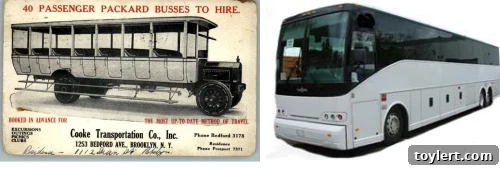
Beyond its iconic luxury cars, Packard’s strategic vision extended to the broader transportation sector. Very early in their production cycle, recognizing the diverse needs of a rapidly modernizing society, they diversified their offerings to include robust lines of trucks and buses. These commercial vehicles, built with the same meticulous engineering and durability that characterized their luxury cars, quickly gained traction. They served an essential role in urban development and inter-city connectivity, facilitating everything from goods transport to public transit and, notably, leisure tours. The image above captures one such early Packard touring bus, a magnificent machine that not only transported people but also carried the promise of exploration and discovery, much like the changing landscape of cities it served, such as Brooklyn.
The Golden Age of Packard: Engineering Excellence and Brand Prestige
Packard’s commitment to quality was legendary. Each vehicle was a masterpiece of craftsmanship, often hand-finished with exquisite attention to detail. This dedication fostered a loyal customer base, including industrialists, celebrities, and even royalty, who sought the prestige and reliability that only a Packard could offer. The brand’s slogan, “Ask the Man Who Owns One,” became synonymous with its reputation for owner satisfaction and enduring value. This era, spanning the early 20th century through the 1930s, marked Packard’s undeniable golden age, a period where it consistently outmaneuvered competitors in both luxury and engineering prowess.
The company’s factories, primarily located in Detroit, Michigan, were paragons of industrial efficiency and innovation. Skilled engineers and artisans worked tirelessly, pushing the boundaries of what was possible in automotive design and manufacturing. While other manufacturers focused on mass production, Packard maintained a focus on quality over quantity, ensuring that each vehicle leaving its assembly line upheld the brand’s lofty standards. This strategy allowed them to command premium prices and attract a discerning clientele who valued exclusivity and superior performance. The legacy of Packard is not merely in its cars, but in its influence on how automotive engineering and luxury were perceived for decades.
Brooklyn in the Roaring Twenties: A City in Motion
To fully appreciate the significance of a Packard tour bus, one must envision the urban landscape it traversed. Let’s transport ourselves to Brooklyn during the early 20th century, a vibrant borough undergoing monumental transformation. The turn of the century saw Brooklyn rapidly evolve from a collection of independent towns into a sprawling, densely populated urban center, intricately linked to Manhattan by the iconic Brooklyn Bridge and, later, various subway lines. This was a period of immense growth, characterized by burgeoning industries, diverse immigrant communities, and a blossoming cultural scene. Electric streetcars crisscrossed the borough, new housing developments sprang up, and Brooklyn solidified its identity as a powerful economic and social force.
Imagine a Packard tour bus gliding along the tree-lined avenues of Brooklyn in the 1920s or 1930s. The streets, still a mix of cobblestone and nascent asphalt, would have echoed with the sounds of horse-drawn carriages, early automobiles, and the chatter of pedestrians. Passengers on such a bus would have witnessed a panorama of architectural marvels. Grand brownstones in neighborhoods like Park Slope and Brooklyn Heights stood as proud symbols of Victorian elegance, their stoops bustling with daily life. Further east, newly developed residential areas offered homes for the burgeoning middle class, while industrial waterfronts buzzed with the activity of shipping and manufacturing, especially in areas like Red Hook and Bushwick.
A Tour Through Historic Brooklyn on a Packard Bus
A typical tour aboard a Packard bus might have begun near the Brooklyn Bridge, offering breathtaking views of the Manhattan skyline before delving into the borough itself. The route could have wound its way through Brooklyn Heights, showcasing its elegant promenades and historic homes with panoramic views of New York Harbor. From there, the bus might have proceeded to Prospect Park, Frederick Law Olmsted and Calvert Vaux’s magnificent urban oasis, where families picnicked and strolled. The bus, with its comfortable seating and smooth ride, would have allowed passengers to soak in the beauty of the park’s sprawling meadows, serene lakes, and architectural follies, providing a tranquil escape from the city’s hustle.
Continuing the journey, the tour could have ventured into downtown Brooklyn, a bustling commercial hub with department stores like Abraham & Straus and Loeser’s, their grand facades inviting shoppers. Court Street would have been lined with legal offices, while Fulton Street buzzed with retail energy. Further exploration might have taken visitors through Coney Island, Brooklyn’s legendary amusement park and beach resort. Here, the opulent rides, vibrant boardwalk, and lively atmosphere provided a stark contrast to the quieter residential streets. A Packard bus arriving at Coney Island would have been part of the spectacle, ferrying excited visitors eager for a day of thrills and seaside relaxation, embodying the very spirit of leisure and escapism that the destination offered.
These buses were more than mere transportation; they were mobile windows into a dynamic era, allowing both locals and tourists to experience the rich tapestry of Brooklyn’s diverse neighborhoods and burgeoning attractions. They represented a sophisticated way to navigate a city that was continually expanding and redefining itself, bridging distances and fostering a sense of community even amidst rapid change. They served as vital arteries, connecting people to new experiences and cementing Brooklyn’s identity as a vibrant, multifaceted urban center.
Brooklyn Today: Echoes of the Past, Visions for the Future
Fast forward to the present day, and Brooklyn remains a borough of unparalleled dynamism, though its character has undeniably transformed. The vintage Packard bus, a symbol of early 20th-century luxury and robust utility, has been replaced by modern public transport systems – an extensive network of subways, buses, and ferries – along with ride-sharing services and a vibrant cycling culture. Yet, the spirit of exploration and appreciation for urban beauty that those early tour buses embodied continues to thrive, now reimagined through walking tours, modern sightseeing buses, and digital guides.
Modern Brooklyn still celebrates its architectural heritage. The brownstones of Brooklyn Heights and Park Slope endure, meticulously preserved, now commanding some of the highest real estate values in the city. Downtown Brooklyn has undergone a dramatic resurgence, evolving into a towering skyline of residential high-rises and commercial complexes, a far cry from the department store hub of yesteryear. Prospect Park remains a cherished green lung, even more essential in a denser city, hosting countless community events and providing respite from urban life, continuing its role as a central gathering place.
Coney Island continues its legacy as an entertainment destination, albeit with modernized attractions and a renewed focus on its historic charm, drawing millions of visitors annually. The waterfronts, once dominated by industrial activity, have been largely revitalized into scenic parks, residential developments, and cultural venues, offering stunning views and public access that would have been unimaginable a century ago. Neighborhoods like Dumbo and Williamsburg, once industrial centers, are now thriving hubs of art, technology, and culinary innovation. These transformations reflect Brooklyn’s resilience and its continuous ability to reinvent itself while honoring its deep roots, demonstrating a unique blend of historical preservation and contemporary progress.
The Enduring Appeal of Heritage and Innovation
The story of Packard, a company that once defined automotive luxury and pushed the boundaries of engineering, serves as a poignant reminder of industrial cycles and the relentless march of progress. Its innovations, such as the modern steering wheel and air conditioning, became standard features, testament to its profound impact on the entire automotive industry, even though the company itself eventually ceased production. Similarly, Brooklyn’s evolution from a bustling industrial hub to a global cultural epicenter showcases the powerful interplay between historical legacy and contemporary innovation, a narrative of constant reinvention.
Just as Packard vehicles seamlessly blended strength with elegance, Brooklyn today harmonizes its historic charm with cutting-edge modernity. The borough’s brownstones stand proudly alongside sleek, minimalist high-rises. Artisanal food markets thrive near historic ethnic enclaves. This “then and now” narrative is not just about comparing two distinct points in time; it’s about understanding the continuous thread of change, adaptation, and enduring character that defines both a pioneering automotive brand and a celebrated urban landscape. The ghost of that early Packard bus, perhaps imagined cruising through modern Brooklyn streets, provides a beautiful metaphor for how the past informs and enriches our present, reminding us of the journey taken, the lessons learned from innovation, and the road that still lies ahead for this ever-evolving borough.