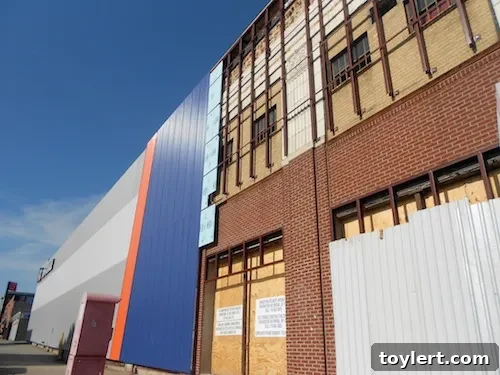
The rapid transformation of Brooklyn’s urban landscape continues unabated, often at the expense of its rich architectural heritage. A striking example of this ongoing shift is the former Packard Automobile Showroom located at 1050 Atlantic Avenue. Construction workers have now largely completed the task of shrouding this once elegant building with the distinctive and, to many, somewhat “garish” facade of a Storage Deluxe facility. This significant overhaul, which commenced earlier this summer, marks another chapter in the story of Atlantic Avenue’s evolution, replacing a piece of history with modern utility. This Brooklyn location is just one of many acquired by Storage Deluxe, a company that embarked on an aggressive $120 million buying spree across the borough last year, solidifying its dominant presence in the burgeoning self-storage market. While proponents might argue that the new paneling causes “minimal harm” to the building’s exterior, the broader question of preserving historical aesthetics versus fulfilling contemporary demands remains a poignant one for Brooklyn residents and urban planners alike.
From Automotive Elegance to Storage Utility: The Story of 1050 Atlantic Avenue
The building at 1050 Atlantic Avenue was once a testament to American industrial design and automotive luxury. As a Packard Automobile Showroom, it stood as a beacon of aspirational motoring during a golden age of car manufacturing. Packard, a brand synonymous with prestige, innovation, and craftsmanship, commanded respect and admiration. Its showrooms were more than just sales floors; they were architectural statements designed to impress discerning buyers and showcase the engineering marvels of the era. These structures often featured expansive windows, grand entrances, and sophisticated interior layouts, all intended to highlight the vehicles within and reflect the brand’s premium status. For decades, 1050 Atlantic Avenue played a role in this narrative, contributing to the vibrant commercial tapestry of Brooklyn. Its presence underscored Atlantic Avenue’s importance as a bustling thoroughfare, connecting various neighborhoods and serving as a hub for diverse businesses.
The transformation of such a historically significant site into a self-storage facility represents a profound symbolic shift. It illustrates the changing priorities of urban development, where the functional often supplants the architecturally distinctive. While the necessity for storage solutions in dense urban environments like Brooklyn is undeniable—driven by smaller living spaces, population growth, and evolving consumption patterns—the method and manner of their integration into the existing urban fabric are frequently subjects of contention. The “garish” facade, as described, speaks to a clash of aesthetics, where the original building’s character, likely imbued with details reflective of its automotive heritage, is now obscured by a standard corporate exterior.
Brooklyn’s Storage Boom: A $120 Million Investment in Space
Storage Deluxe’s substantial investment of $120 million in acquiring multiple Brooklyn properties highlights a significant trend in the real estate market: the soaring demand for self-storage. Brooklyn, with its rapidly increasing population, an influx of new residents, and a concurrent rise in real estate prices, has become an ideal location for storage facilities. As living spaces shrink and urban dwellers accumulate more belongings, the need for off-site storage solutions becomes critical. This economic dynamic makes self-storage facilities attractive ventures for developers and investors. They often require less complex internal infrastructure than residential or commercial spaces, and they offer steady revenue streams, making them resilient investments even during economic fluctuations.
The aggressive expansion by Storage Deluxe in Brooklyn is a strategic move to capture a significant share of this growing market. By acquiring existing properties, particularly those with large footprints like former industrial or commercial buildings, the company can quickly establish new locations and meet the surging demand. This strategy, however, often puts these companies in direct conflict with local communities and preservationists who lament the loss of unique architectural structures. The sheer scale of Storage Deluxe’s acquisitions underscores a broader shift where historical buildings, once community landmarks, are increasingly viewed through the lens of their potential for adaptive reuse—or in this case, complete functional conversion—to meet contemporary logistical needs.
The Aesthetic Dilemma: Preservation vs. Practicality
The phrase “At least the panelling causes minimal harm to the building’s exterior!” carries a sharp undertone of sarcasm, encapsulating the frustration many feel when historic buildings are altered for modern commercial purposes. While the structural integrity of the old Packard showroom might indeed be largely preserved beneath the new facade, the visual and cultural harm is often profound. An exterior is not merely a protective shell; it’s the face of a building, telling a story about its past, its purpose, and its place in the community. Replacing a distinctive facade with a generic corporate skin effectively erases that story from public view, diminishing the urban landscape’s diversity and historical depth.
This conversion represents a broader aesthetic dilemma facing many developing urban areas. How do cities balance the need for new services and infrastructure with the desire to preserve their unique character and historical architecture? Self-storage facilities, by their very nature, are often large, windowless, and designed for efficiency rather than visual appeal. When they occupy prominent locations previously held by architecturally significant buildings, they can contribute to a sense of homogenization, where local distinctiveness is slowly eroded. The visual impact on Atlantic Avenue, a street with its own eclectic mix of old and new, is substantial. The new facade, regardless of its practicality, marks a clear departure from the building’s original intent and aesthetic contribution to the streetscape.
Atlantic Avenue’s Evolving Identity: A Microcosm of Brooklyn’s Change
Atlantic Avenue itself is a microcosm of Brooklyn’s ongoing evolution. Historically a major artery, connecting the waterfront to inland neighborhoods, it has seen countless changes over the centuries—from a rail corridor to a bustling commercial street lined with diverse businesses, factories, and residences. In recent decades, like much of Brooklyn, Atlantic Avenue has experienced significant gentrification and redevelopment. Old industrial sites give way to luxury condos, independent shops are replaced by chain stores, and the character of the street continuously reinvents itself. The arrival of a large Storage Deluxe facility at 1050 Atlantic Avenue fits squarely within this narrative of change, albeit often a contentious one.
The debate surrounding such developments often centers on quality of life, community identity, and the economic benefits versus cultural costs. While self-storage provides a valuable service to many residents and businesses, critics argue that these facilities, due to their often sterile appearance and lack of street-level engagement, do little to enhance the vibrant, pedestrian-friendly environments that are crucial for thriving urban areas. The presence of a self-storage facility can sometimes act as a “dead zone” on an otherwise lively street, interrupting pedestrian flow and reducing the commercial diversity that defines successful urban corridors. As Brooklyn continues to grow and redefine itself, the choices made on prominent streets like Atlantic Avenue will ultimately shape its future identity for generations to come.
The Future of Preservation in a Developing City
The conversion of the Packard Automobile Showroom at 1050 Atlantic Avenue into a Storage Deluxe facility serves as a stark reminder of the challenges inherent in urban development. It prompts important questions about the value we place on historical structures, the aesthetic integrity of our cityscapes, and the processes by which these transformations occur. While the functional necessity of self-storage in a dense city like Brooklyn is clear, the methods of integrating such facilities into communities demand careful consideration. Moving forward, a balanced approach that respects historical preservation while addressing contemporary needs will be crucial for maintaining Brooklyn’s unique character and ensuring its sustainable growth. The story of 1050 Atlantic Avenue is not just about one building; it’s a commentary on the constant negotiation between past and present, legacy and utility, that defines the modern urban experience.
For those interested in the ongoing dialogue surrounding these transformations, or to delve deeper into the historical context, the following resources provide additional insights:
Another Old Building Swallowed By a Storage Facility [Brownstoner]
Yet Another Storage Facility for Atlantic Avenue [Brownstoner]
Building of the Day: 1050 Atlantic Avenue [Brownstoner] GMAP