Park Slope School Rezoning: Navigating Changes for Brooklyn Families
The landscape of education in Park Slope, Brooklyn, is undergoing a significant transformation. Recently, the Department of Education (DOE) and the District 15 Community Education Council (CEC 15) unveiled a pivotal school rezoning proposal designed to address persistent and severe overcrowding issues within some of the district’s most sought-after elementary schools. This initiative, proposed for the 2013-14 school year, aims to reconfigure school district boundaries, introduce new facilities, and ultimately create a more sustainable and equitable educational environment for all students in the vibrant Park Slope community.
At the heart of this comprehensive plan is the urgent need to alleviate the strain on P.S. 321 and P.S. 107, two institutions currently operating significantly beyond their intended capacities. P.S. 321 is reported at an alarming 128 percent utilization, while P.S. 107 faces even greater pressure at a staggering 158 percent utilization. Such levels of overcrowding directly impact classroom size, resource availability, and the overall quality of the learning experience. The proposed rezoning is not merely a logistical adjustment; it represents a critical step towards ensuring that every child in District 15 has access to an optimal learning environment.
Understanding the Proposed Changes: A New Educational Blueprint
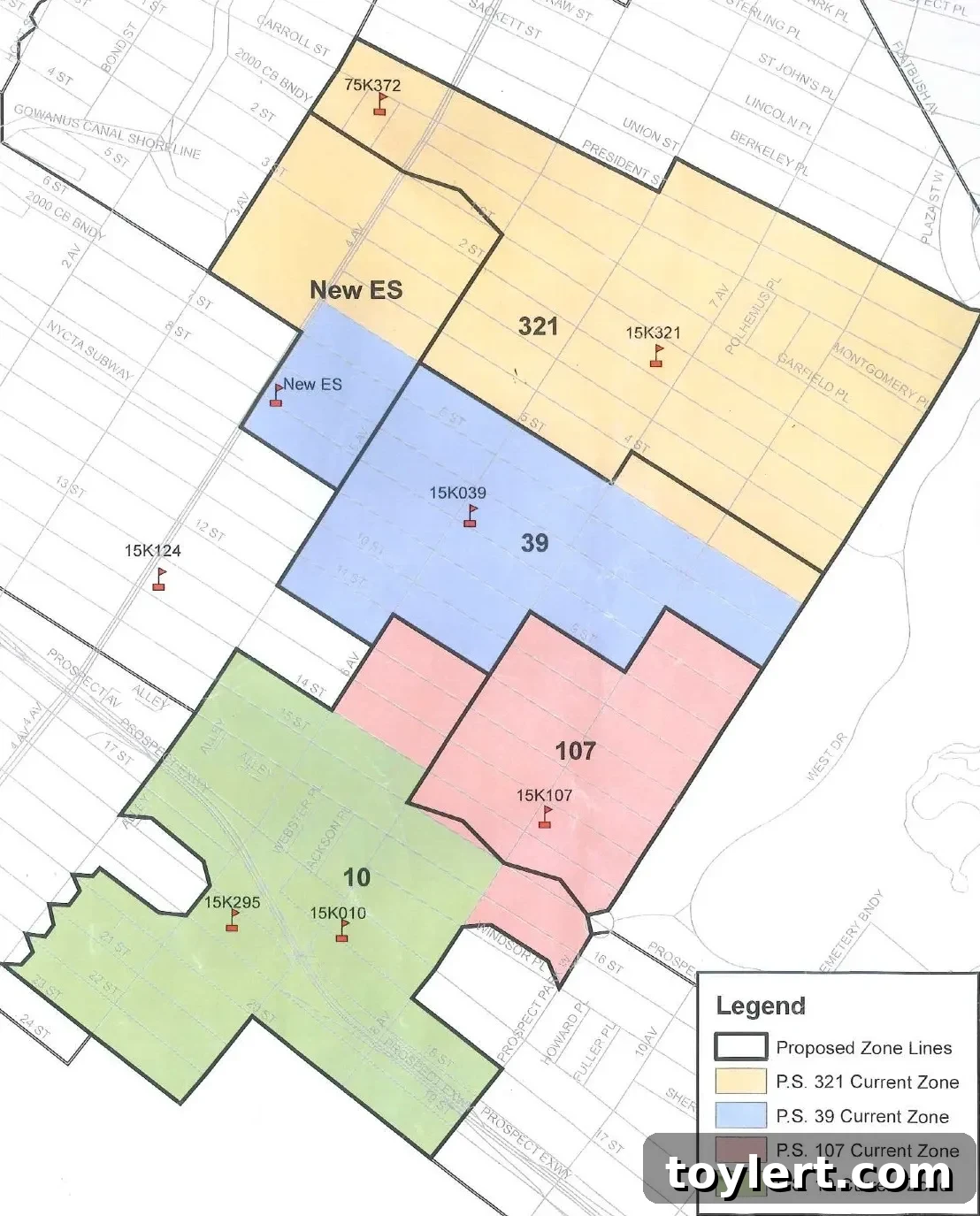
The proposed rezoning introduces several key adjustments to the current school district boundaries, aiming to redistribute student populations more evenly across local schools. The map above visually illustrates these changes, with current zones depicted in color and the proposed adjustments marked by distinct lines. (Clicking the image provides an enlarged view for a detailed understanding.)
A cornerstone of this proposal is the incorporation of two new educational facilities into the District 15 framework. A new K-5 school is planned for the former Thomas Aquinas building, conveniently located at Eighth Street and Fourth Avenue. This addition is expected to absorb a substantial number of students, easing the pressure on existing schools. Furthermore, the plan accounts for the eagerly anticipated P.S. 133, currently under construction at 4th Avenue and Butler Street, which will also play a crucial role in accommodating the growing student population.
Specific shifts in school zones include approximately ten blocks situated in the southwest corner of the P.S. 321 zone, which are slated to transition into the new school district. Additionally, several southern and western portions of the P.S. 107 zone will be redrawn to P.S. 10. These adjustments are meticulously planned to balance enrollment numbers, reduce class sizes, and ensure that all schools can provide a high-quality education without the burden of excessive overcrowding.
Carrie Marlin from the DOE underscored the immediate necessity of these changes, confirming that the proposed boundaries are set to take effect for the 2013-14 school year. This proactive approach aims to address the capacity crisis before it escalates further, providing a more stable and predictable educational future for Park Slope families.
The Rationale Behind Rezoning: A Long-Term Vision for District 15
District 15 President Jim Devor articulated the comprehensive nature of this rezoning effort, stating, “We must confront many of our needs in one plan, since a rezoning doesn’t happen that often.” This statement highlights the strategic importance of this particular rezoning, positioning it not as a temporary fix but as a foundational solution to long-standing challenges. The DOE and CEC 15 are aiming for a holistic approach, considering not just the immediate needs but also future growth projections for Park Slope.
The decision to undertake such a significant rezoning is driven by several factors beyond mere numbers. It reflects a commitment to educational equity, ensuring that all schools within the district operate under manageable conditions, allowing educators to focus on teaching rather than managing overstretched resources. Overcrowding often leads to a diminished quality of instruction, limited access to specialized programs, and increased stress for both students and staff. By proactively managing student distribution, the district aims to foster a more conducive and enriching learning environment across all its schools.
Furthermore, the growth of Park Slope as a desirable family neighborhood has contributed significantly to the surge in student enrollment. With new housing developments and a steady influx of young families, the existing school infrastructure has struggled to keep pace. The integration of new schools like the Thomas Aquinas K-5 facility and P.S. 133 is therefore not just about relieving current pressure but also about building capacity for sustained community growth, ensuring that educational resources are adequately expanded to serve future generations of students.
Community Voices: Parents’ Concerns and Questions
While the proposed rezoning offers a clear path to alleviating overcrowding, it has also sparked considerable discussion and, in some cases, significant frustration among Park Slope parents. A public hearing provided a platform for community members to voice their concerns, highlighting the complex emotional and logistical implications of such fundamental changes to school zones.
The Issue of Out-of-Zone Students
One prominent source of anger stemmed from the perception that children residing outside current school zones are permitted to attend popular schools like P.S. 321. Parents expressed frustration, feeling that their adherence to zoning rules—often influencing significant life decisions like home purchases—was undermined. P.S. 321 Principal Liz Phillips clarified the legal framework, explaining that while the school does its best to enforce zoning, a student is legally permitted to continue attending P.S. 321 if they initially enroll as a kindergartner and subsequently move out of the zone. This legal loophole, while understandable from a continuity perspective, often feels unjust to families who strategically bought homes within desired zones. Philippe Verfaillie, a local father, powerfully articulated this sentiment, stating, “We played by the rules… We bought in the zone because we wanted to be in the zone.” This underlines the deep personal investment parents make in their children’s education and their frustration when perceived inequities arise.
Concerns Over Racial Diversity and Equity
Another critical concern raised by parents revolved around the potential impact of the rezoning on racial diversity within the affected schools. One woman pointed out that the specific Park Slope blocks being rezoned out of P.S. 321 are notably among the most racially diverse in the neighborhood. This raises important questions about whether the rezoning inadvertently exacerbates existing disparities or, conversely, presents an opportunity to promote greater integration across schools. Ensuring that rezoning efforts contribute positively to diversity and inclusion, rather than diminishing them, is a key challenge that the DOE and CEC 15 must navigate carefully.
Process Transparency and Community Engagement
Beyond the substance of the proposal, many parents voiced aggravation regarding the process itself. Complaints included insufficient notice for the public meeting and the assertion that a 45-day public comment period was inadequate for such a far-reaching and impactful decision. Effective community engagement and transparent communication are paramount in such sensitive matters. Allowing ample time for parents to understand the proposal, analyze its implications, and provide thoughtful feedback is crucial for building trust and ensuring that the final plan reflects a broad range of community perspectives. Public comments will continue to be accepted until late November, after which the Community Education Council will proceed with its vote.
The P.S. 133 Affirmative Action Plan: A Point of Contention
A significant sticking point in the rezoning discussions centers on the new P.S. 133 and the lack of an agreed-upon affirmative action plan for its admissions. This issue gained considerable attention, being detailed in the New York Times. CEC 15 President Jim Devor emphasized that the CEC is awaiting a guarantee from the DOE regarding a diversity policy for admissions at P.S. 133 before they cast their vote on the overall rezoning. This highlights the CEC’s commitment to not just managing capacity but also actively shaping the demographic composition and educational equity of new schools. The establishment of a clear and effective diversity policy is crucial for ensuring that P.S. 133 serves as a model for inclusive education, reflecting the diverse fabric of the Park Slope community. Further specifics regarding P.S. 133’s development and admissions policies are anticipated soon.
The Road Ahead: What Happens Next?
The journey through this rezoning process is far from over. Following the closure of the public comment period in late November, the District 15 Community Education Council will convene to cast its vote. This decision is critical and will determine the future educational landscape for thousands of children and families in Park Slope.
P.S. 321 Principal Liz Phillips, a proponent of the rezoning, offered a pragmatic perspective on the entire proposal, acknowledging its inherent complexities: “It’s not the ideal solution — there is no ideal solution. It’s the permanent solution.” Her words encapsulate the challenging reality of addressing systemic issues like overcrowding, where perfect outcomes are elusive, and practical, long-term solutions, even imperfect ones, become necessary. This rezoning, therefore, represents a pragmatic step forward, designed to bring stability and order to a system under strain.
The collective efforts of the DOE, CEC 15, and concerned parents are all geared towards one ultimate goal: creating the best possible educational environment for the students of Park Slope. The dialogue and debates surrounding this proposal, while at times contentious, are indicative of a highly engaged community deeply invested in the quality of its schools. The outcome of the CEC’s vote will not only reshape school attendance zones but also influence the dynamics of neighborhood communities and educational pathways for years to come.
For more detailed information and perspectives on the initial public hearing and the proposed rezoning, readers are encouraged to consult reports from local news outlets. Further insights into this crucial development can be found at DNAinfo and The New York Times, which have provided comprehensive coverage of the situation. The ongoing discussion surrounding the rezoning of popular Park Slope schools continues to be a focal point for the community, as documented by Brownstoner, reflecting the profound importance of this decision for Brooklyn’s educational future.