Unveiling the Hidden Grandeur: 114 Fort Greene Place, A Historic Brooklyn Gem
Nestled within the vibrant heart of the Brooklyn Academy of Music Historic District, an exceptional opportunity awaits those with an appreciation for history, architecture, and the promise of restoration. Despite being presented in an “as-is” condition and showcased with only a limited collection of photographs, the sprawling row house at 114 Fort Greene Place captivates with its undeniable charm and a trove of remarkably preserved interior details. This wide Fort Greene residence beckons, offering a rare glimpse into a bygone era of elegance and craftsmanship that is increasingly difficult to find in today’s bustling urban landscape. From its majestic marble mantels to its distinctive architectural nuances, this property stands as a testament to Brooklyn’s rich heritage.
A Canvas of Architectural History: Inside 114 Fort Greene Place
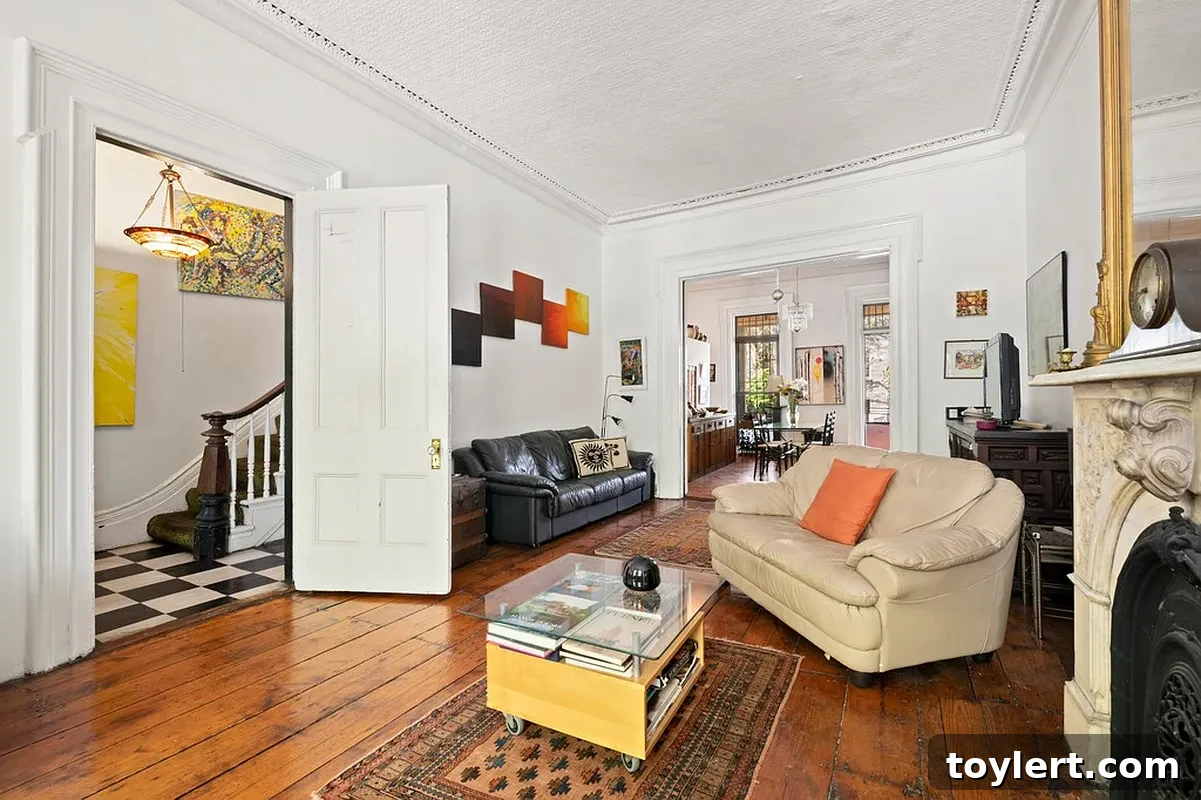
Stepping beyond its historic facade, 114 Fort Greene Place immediately transports visitors to the mid-19th century, a period when meticulous artistry defined residential design. The interior reveals a stunning array of original features, each telling a story of the home’s distinguished past. Visible inside are exquisitely carved white marble mantels, serving as stately focal points in the primary living spaces, reflecting the refined tastes of its original occupants. These are complemented by the elegant Greek Revival ear moldings that adorn doorways and windows, showcasing the architectural style’s emphasis on classical proportions and decorative restraint.
Beneathfoot, wide planked floorboards, likely original to the 1850s construction, lend an authentic warmth and character, their rich patina speaking volumes of decades of life within these walls. Overhead, the sophisticated artistry of elegant pierced plasterwork graces ceilings and cornices, a delicate embellishment that requires skilled craftsmanship and is a hallmark of period luxury. Perhaps one of the most intriguing and historically significant features is the grand main stair, complete with a distinctive coffin corner. This unique architectural niche, often shrouded in folklore, adds a layer of mystery and historical depth to the home, sparking curiosity about its original purpose and the lives it has witnessed.
Roots in the Brooklyn Academy of Music Historic District
The location of 114 Fort Greene Place is as significant as its architecture. It proudly stands within the esteemed Brooklyn Academy of Music Historic District, a designation that underscores the area’s profound historical and cultural importance. This particular row house is one of a distinguished group of six brick transitional Greek Revival/Italianate row houses. This unique blend of styles, characteristic of mid-19th century American architecture, marries the classical austerity of Greek Revival with the more elaborate and picturesque elements of the burgeoning Italianate style.
According to the comprehensive designation report for the district, these impressive structures were masterfully constructed by the notable builders Thomas Skelly and Michael Murray. The report meticulously dates the entire row to approximately 1855, placing its creation firmly in a period of rapid development and architectural innovation in Brooklyn. This era saw the transformation of pastoral landscapes into bustling urban neighborhoods, with Fort Greene emerging as a desirable residential enclave for Brooklyn’s growing middle and upper classes. The foresight of builders like Skelly and Murray, coupled with the transitional style, captures a pivotal moment in the evolution of American domestic architecture.
A Block Transformed: From Canton Street to Fort Greene Place
The historical journey of Fort Greene Place itself offers a fascinating narrative of urban evolution. Before it adopted its current, well-known name, the thoroughfare was identified as Canton Street. Historical records, such as an illuminating map of 1855, vividly depict the street during this earlier period. Intriguingly, this map shows a largely empty block where 114 Fort Greene Place and its neighbors would soon rise, signifying the rapid pace of development that was characteristic of Brooklyn in the mid-19th century. Within just a few years, the landscape would be utterly transformed.
The significant change from Canton Street to Fort Greene Place occurred in 1859, as documented by an 1859 name change. This renaming not only reflected the growing identity of the area but also likely capitalized on the prestige of the nearby Fort Greene Park, a historical site with roots in the American Revolutionary War. Such renamings were common in rapidly urbanizing areas, often intended to create a more distinguished or historically resonant identity for burgeoning neighborhoods, thereby enhancing their appeal to prospective residents. The empty block depicted in 1855 quickly filled with stately homes, attracting a diverse population of Brooklynites eager to establish roots in a burgeoning cultural and residential hub.
Preserving Authenticity: The Enduring Charm of 114
Among its row companions, 114 Fort Greene Place holds a special distinction: it was specifically cited in the district’s designation report as the property that most faithfully retained its original exterior appearance. This is a crucial detail for preservationists and history enthusiasts, as it signifies a rare degree of architectural integrity in a city where facades often undergo significant alteration over time. The report highlights several key elements that contribute to this authenticity, painting a picture of its initial grandeur.
These preserved features include its original iron railings, which gracefully define the boundary between public and private space, exhibiting the decorative metalwork prevalent in the era. The elegant pedimented door hood, a classical architectural element that frames the main entrance, further enhances its distinguished facade. Simple yet robust lintels above the windows and doors attest to the enduring construction quality of the period. Capping the structure is a handsome bracketed cornice, an architectural flourish that adds a touch of sophistication and detail to the roofline. The intricate details of this cornice, along with other exterior elements, can be more clearly observed and appreciated in the invaluable circa 1940 tax photo. Such historical photographs are indispensable tools for understanding and verifying the architectural evolution of properties, allowing us to trace their physical appearance through the decades and confirming 114’s remarkable preservation.
A Tapestry of Lives: Fort Greene’s Social History and Hiram S. Thomas
Beyond its bricks and mortar, 114 Fort Greene Place, and indeed the entire block, is woven into the rich tapestry of Brooklyn’s social history. The area gained particular notoriety in the 1890s, a period of significant social and economic change in New York City. This era was explored in depth by Brownstoner columnist Suzanne Spellen, who delved into the intriguing story of a prominent resident who added a unique dimension to the block’s historical narrative.
During this time, the successful African American hotelier Hiram S. Thomas bought a row house on this very block. Thomas was a remarkable figure, a trailblazing entrepreneur whose success as a Black hotelier in the 19th century was extraordinary, especially given the pervasive racial prejudices of the era. His ownership of a property in Fort Greene speaks volumes about the evolving demographics and social mobility within Brooklyn, highlighting pockets of prosperity and community among African Americans during a challenging period. His presence on Fort Greene Place not only brought press attention to the block but also underscored the diverse and dynamic character of the neighborhood, which was home to a variety of influential figures, pioneering professionals, and burgeoning families. Thomas’s story is a powerful reminder of the hidden histories embedded within historic homes and the significant contributions of individuals often overlooked in broader historical narratives.
The Allure of “As-Is”: A Vision for Restoration
The current listing of 114 Fort Greene Place as “as-is” might, at first glance, suggest a daunting project. However, for the discerning buyer or investor with a passion for historical preservation, this condition represents a unique and thrilling opportunity. An “as-is” sale, particularly for a property of this caliber, implies a chance to embark on a sympathetic restoration project, bringing this historic gem back to its full glory while honoring its original character and architectural integrity. The existing rich details – the marble mantels, the wide plank floors, the intricate plasterwork – provide an incredible foundation, a historical blueprint for a sensitive renovation.
Such a project offers the rare privilege of breathing new life into a significant piece of Brooklyn’s past, transforming it into a magnificent modern residence that retains its soul and story. It’s an invitation to become a custodian of history, to meticulously restore and update a home that has stood for over 160 years, bearing witness to generations of Brooklyn life. The limited photographs, rather than a deterrent, add to the mystique, inviting potential buyers to discover its full potential firsthand and envision the grandeur that lies beneath. This Fort Greene row house is not just a property; it’s a legacy waiting to be continued, a vibrant chapter in Brooklyn’s ongoing narrative.
Conclusion: A Timeless Treasure in Fort Greene
In conclusion, 114 Fort Greene Place stands as a compelling architectural and historical treasure. Its combination of Greek Revival and Italianate influences, its remarkably preserved interior details, and its rich historical context within the Brooklyn Academy of Music Historic District make it an extraordinary offering. From its original builders, Skelly and Murray, to its transformation from Canton Street, and even its connection to pioneering figures like Hiram S. Thomas, every element of this row house speaks to a vibrant and significant past. For those with a vision for restoration and a deep appreciation for authentic Brooklyn history, this “as-is” property presents an unparalleled chance to own a piece of the city’s enduring legacy, meticulously restoring it to once again shine as a beacon of historical elegance in Fort Greene.