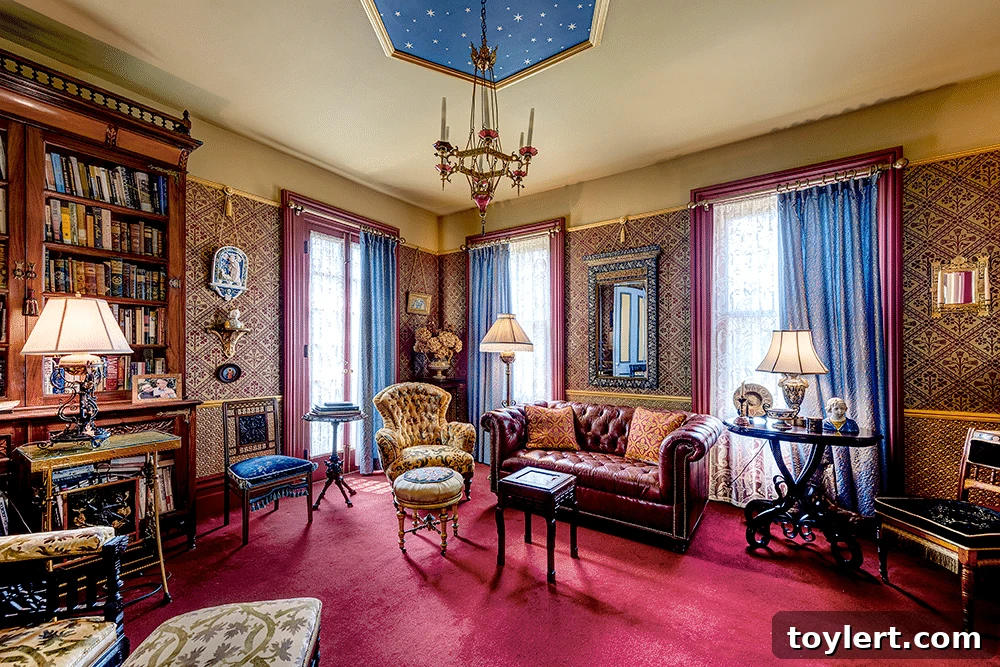
Discover a Masterpiece of Victorian Elegance: A Restored 19th-Century Italianate Villa in Germantown, NY
Nestled in the picturesque landscape of Columbia County, New York, awaits a truly extraordinary property: a meticulously restored 19th-century Italianate villa at 75 Factory Road in Germantown. This architectural marvel offers an unparalleled journey back in time, presenting a lavish interior brimming with the intricate patterns and rich textures characteristic of the late Victorian era. For enthusiasts of design history, this home is more than just a residence; it’s a vibrant, living canvas showcasing the pivotal style movements of the 1870s and 1880s, brought to life through dedicated, loving restoration.
An Authentic Dive into Victorian Interior Design
The interior of this stunning Italianate villa is a testament to the period’s grandeur and a celebration of craftsmanship. Every detail has been carefully curated to reflect the sophisticated aesthetic of the era. Visitors are immediately enveloped by an atmosphere rich with historical authenticity, featuring reproduction wallpapers by seminal figures like William Morris and A. W. N. Pugin. These papers, known for their elaborate motifs and deep color palettes, form the backdrop to a collection of other exquisite period-appropriate elements.
Beyond the walls, the floors boast authentic encaustic tiles, renowned for their decorative patterns and remarkable durability. Lincrusta, a resilient and deeply embossed wall covering, adds another layer of tactile and visual interest, mimicking carved wood or stamped leather. These luxurious details, combined with the period furnishings and decorative arts, transport one to a bygone era where artistry and comfort converged beautifully.
The Enduring Legacy of William Morris and the Arts and Crafts Movement
The presence of William Morris’s reproduction papers in this Italianate villa is particularly significant. Morris, a pivotal figure in the British Arts and Crafts Movement, advocated for a return to handcrafted quality and natural motifs in an age of increasing industrialization. His designs, characterized by dense, repeating patterns inspired by flora and fauna, were a direct reaction against the perceived soulliness of mass production. Owning a home adorned with his work means embracing a philosophy that championed beauty, craftsmanship, and the harmony between art and nature. His influence extended beyond wallpaper to textiles, furniture, and book design, leaving an indelible mark on Victorian aesthetics.
A. W. N. Pugin and the Gothic Revival
While distinct from Morris, the inclusion of A. W. N. Pugin’s reproductions also speaks volumes about the home’s commitment to historical accuracy. Pugin was a leading proponent of the Gothic Revival style, advocating for the moral and architectural superiority of medieval forms. His designs often featured strong geometric patterns, rich ecclesiastical symbolism, and a profound respect for structural integrity. The juxtaposition of Morris’s organic flow with Pugin’s structured precision offers a fascinating dialogue within the home’s various spaces, reflecting the diverse yet interconnected design philosophies of the 19th century.
The Artistry of Encaustic Tiles and Lincrusta
The material choices further underscore the dedication to authenticity. Encaustic tiles, unlike glazed tiles, derive their patterns from different colors of clay inlaid into the body of the tile, allowing for intricate, geometric, and often heraldic designs that do not wear away. Popularized during the Gothic Revival and later adopted by the Arts and Crafts Movement, they provided durable and aesthetically pleasing floor and wall coverings in grand homes and public buildings. Lincrusta, invented in 1877, was another innovative product of the Victorian era. Made from a mixture of linseed oil, wood flour, and wax pressed onto a paper base, it could be molded into deep relief patterns, offering a cost-effective alternative to carved wood paneling or plasterwork. Its resilience and decorative versatility made it a favorite for wall and ceiling treatments, adding texture and grandeur to any room.
A Curator’s Vision: The Passion Project of a Brooklyn Museum Expert
It comes as no surprise that such an authentic and intricate transformation of this wood-frame Italianate house was orchestrated by a truly skilled hand. The meticulous restoration was the passion project of a former Brooklyn Museum curator, whose deep understanding of art history and decorative arts imbued every decision with academic rigor and artistic sensitivity. This individual’s expertise ensured that the restoration was not merely a renovation, but a scholarly endeavor to revive the spirit and substance of the 19th century within these walls.
Before his passing in 2018, the curator extensively detailed the intricate process and profound design philosophy behind this restoration for an insightful article in Antiques Magazine. This publication, renowned for its authority on historical decorative arts, provided a platform for sharing the exhaustive research, the challenges overcome, and the precise choices made to achieve such a high degree of historical accuracy. His contribution cemented the home’s status as a significant example of period restoration, offering invaluable insights into the techniques and ethos of bringing Victorian design back to life.
Crafting a Narrative: The Imagined Lives Within
To further enrich the historical context and breathe life into the dwelling, a compelling backstory was meticulously crafted for its imagined 1870s inhabitants. The narrative envisioned these sophisticated owners embarking on transformative cultural experiences that profoundly shaped their aesthetic tastes and collecting habits. Their journey began with a visit to the monumental 1876 Philadelphia Centennial Exhibition and culminated in an extensive Grand Tour, with an itinerary that included England and Italy.
The Impact of the 1876 Philadelphia Centennial Exhibition
The 1876 Philadelphia Centennial Exhibition was a landmark event in American history, marking the nation’s centennial and showcasing industrial progress, technological innovation, and artistic achievements from around the globe. For the imagined owners of this Germantown villa, attending such an exhibition would have been an overwhelming and inspiring experience. They would have encountered an array of decorative arts, furniture, textiles, and architectural styles from various nations, providing a rich tapestry of ideas and trends. This exposure would undoubtedly have broadened their horizons, introducing them to new aesthetics and influencing their desire to bring a cosmopolitan flair back to their American home.
The Grand Tour: A Journey Through European Culture
Following the Centennial, their hypothetical Grand Tour through England and Italy would have been a quintessential experience for wealthy Victorians seeking cultural enlightenment and a deeper appreciation for classical and contemporary arts. In England, they would have immersed themselves in the burgeoning Arts and Crafts movement and the lingering influences of the Gothic Revival, perhaps even encountering the works of William Morris and Pugin firsthand. Their time in Italy would have exposed them to the grandeur of Renaissance architecture, classical sculpture, and the vibrant artistic traditions that had captivated travelers for centuries. Such a journey would not only have provided them with a rich education but also with the opportunity to acquire exquisite objects and form a discerning eye for beauty.
Embracing the Aesthetic Movement: Art for Art’s Sake
Crucially, these travels are imagined to have introduced the villa’s fictional owners to the burgeoning Aesthetic Movement. This influential art movement, which gained prominence in the latter half of the 19th century, championed the idea of “art for art’s sake” – that art and beauty should be appreciated for their intrinsic qualities rather than for any didactic or moral purpose. Figures like Oscar Wilde and James McNeill Whistler were key proponents, advocating for beauty, sensuousness, and artistic refinement in all aspects of life, from painting to interior design.
The Aesthetic Movement rejected the perceived vulgarity and moralizing tendencies of some earlier Victorian styles, favoring instead subtle colors, elegant forms, and an eclectic mix of influences, particularly from Japan and the Middle East. For our imagined inhabitants, this exposure would have profoundly influenced their collecting habits. They would have returned home with exquisite porcelain, decorative plaques, intricately carved furniture, and a variety of other decorative souvenirs, each piece chosen for its inherent beauty and artistic merit, rather than its utility or historical pedigree. This curated collection would then have found its perfect home within the carefully designed rooms of their Italianate villa, creating an environment that was both a reflection of their personal journeys and a testament to the era’s sophisticated tastes.
A Unique Opportunity: Owning a Piece of History in Germantown, NY
Today, this magnificent property on the market at 75 Factory Road in Germantown offers a unique opportunity for discerning buyers to acquire not just a house, but a meticulously preserved piece of architectural and design history. Located in the charming Columbia County, an area known for its scenic beauty, vibrant arts scene, and rich historical heritage, the villa is ideally situated for those seeking both tranquility and cultural engagement.
Owning this home means becoming a custodian of a significant curatorial vision and a vibrant chapter of 19th-century design. It is perfect for individuals who appreciate the craftsmanship of the past, the authenticity of historical restoration, and the intricate narratives that a truly exceptional home can tell. This Italianate villa stands as a monument to Victorian elegance, offering a rare chance to live within an environment where every detail contributes to a profound sense of place and time.
Conclusion: An Enduring Legacy of Beauty and Artistry
The 19th-century Italianate villa in Germantown, NY, is more than just a residence; it is a meticulously crafted homage to an era defined by its passion for art, design, and cultural exploration. From the celebrated patterns of William Morris and A. W. N. Pugin to the tactile luxury of encaustic tiles and Lincrusta, every element within its walls contributes to an immersive historical experience. Underpinned by the visionary restoration of a Brooklyn Museum curator and imbued with a rich, imagined history of travel and discovery, this home represents the pinnacle of Victorian aestheticism.
As it stands ready for its next chapter, this extraordinary property offers a rare chance to acquire a unique blend of architectural grandeur, historical authenticity, and artistic integrity. It is a testament to the enduring appeal of 19th-century design and a compelling invitation to live within a beautifully preserved piece of the past, right in the heart of Columbia County.