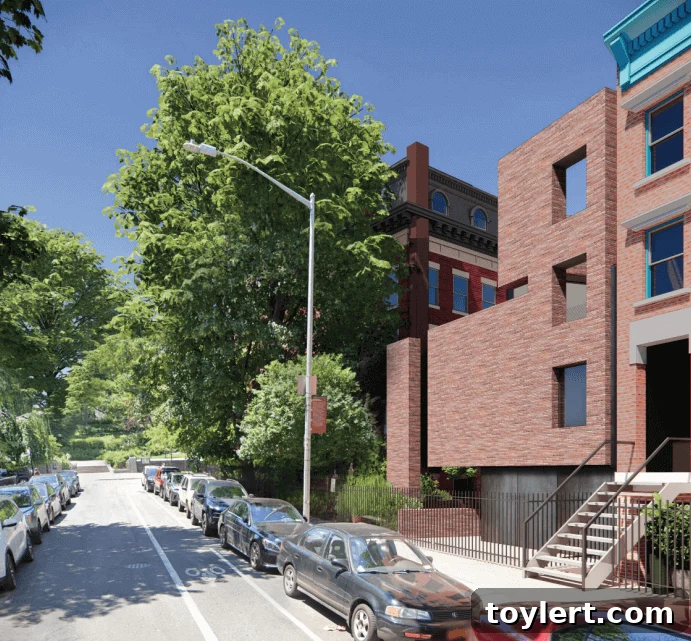
Fort Greene’s Architectural Future: LPC Approves Pritzker-Winning Design Alongside Historic Restoration
A landmark decision by the Landmarks Preservation Commission (LPC) on Tuesday afternoon has cleared the path for a transformative project in Fort Greene, Brooklyn. The approved proposal involves the meticulous restoration of an exquisite 1860s Italianate brownstone and the innovative construction of a new, cutting-edge modern home. This significant development, poised to redefine a prominent corner of the historic Fort Greene district, brings together a reverence for the past with a bold vision for contemporary architecture.
Situated at the esteemed address of 176 Washington Park, a coveted location directly across from the verdant expanse of Fort Greene Park and at the nexus of Willoughby Avenue, the project holds immense implications for the neighborhood’s evolving landscape. The core of the plan centers on rejuvenating the existing brownstone’s exterior to its original grandeur, a painstaking process that respects its historical integrity and architectural heritage. Internally, the structure, currently configured as a three-family residence, will undergo a sophisticated conversion into five luxury condominium units, catering to the growing demand for high-end urban living in one of Brooklyn’s most desirable locales.
Beyond the brownstone, the project introduces a striking modern “carriage house,” set to replace a structurally compromised garage located behind the townhouse. This contemporary addition is not merely a replacement structure; it is envisioned as a standalone architectural marvel. Its design originates from the distinguished mind of Thom Mayne, a Pritzker Prize-winning architect renowned for his provocative and influential work. Mayne, based in Los Angeles, brings a global perspective and an avant-garde sensibility to this historic Brooklyn setting, promising a dynamic interplay between old and new.
The Significance of LPC Approval in Historic Districts
The Landmarks Preservation Commission’s approval is a crucial milestone, underscoring the project’s adherence to stringent preservation guidelines while embracing contemporary design. The LPC’s mission is to safeguard New York City’s architectural, historical, and cultural heritage. For a project within a designated historic district like Fort Greene, every exterior alteration and new construction must undergo rigorous review to ensure it is appropriate to the district’s character and enhances its special qualities. This particular approval signifies the Commission’s recognition of the design’s sensitivity to the existing context, even as it introduces a starkly modern element. It speaks to a thoughtful balance between preservation and progressive urban development.
Gaining LPC approval is often a complex and lengthy process, involving detailed presentations, neighborhood engagement, and expert review. Developers must meticulously document existing conditions, propose materials that are historically appropriate, and justify design choices. The fact that a modern structure, particularly one designed by an architect with Mayne’s experimental reputation, received the green light in such a sensitive area highlights a progressive stance from the Commission, acknowledging that good contemporary architecture can respectfully coexist with and even enrich historic environments.
Fort Greene: A Tapestry of History and Modernity
Fort Greene is celebrated for its tree-lined streets, majestic brownstones, and vibrant cultural scene. Its historic district, designated in 1978, boasts a remarkable collection of 19th-century architecture, primarily Italianate and Neo-Grec brownstones. The neighborhood’s proximity to cultural institutions like the Brooklyn Academy of Music (BAM), Lafayette Avenue Presbyterian Church, and, of course, the iconic Fort Greene Park, makes it a highly coveted residential area. The park itself, designed by Frederick Law Olmsted and Calvert Vaux, offers residents a vital green oasis and a powerful connection to nature within the urban fabric.
The existing brownstone at 176 Washington Park is a prime example of the Italianate style, characterized by its low-pitched roofs, wide eaves supported by decorative brackets, elaborate window hoods, and often, rusticated stone bases. Restoring such an edifice involves meticulous work, including facade cleaning, brownstone repair, window and door restoration, and ensuring that all exterior elements – from cornices to stoops – are brought back to their authentic 19th-century appearance. This commitment to historical accuracy not only preserves the building’s individual beauty but also contributes to the overall aesthetic coherence of the Fort Greene Historic District.
The Visionaries Behind the Project: Thom Mayne and Tankhouse
The visionary behind the new modern carriage house is Thom Mayne, the illustrious founder of Morphosis Architects. A recipient of the Pritzker Architecture Prize in 2005, Mayne is known for his challenging, complex, and often deconstructivist approach to design. His work frequently explores the intersection of art, urbanism, and architecture, pushing the boundaries of form and function. Projects like the Cooper Union academic building in New York, the Caltrans District 7 Headquarters in Los Angeles, and the Phare Tower in Paris exemplify his ability to create structures that are both intellectually rigorous and visually arresting.
Mayne’s involvement in a Brooklyn historic district project signals a fascinating convergence of his distinctive modern aesthetic with a deeply rooted historical context. His design for the carriage house will undoubtedly be a conversation starter, inviting discussion on how contemporary architecture can engage with and re-interpret traditional urban typologies. The Pritzker Prize, often dubbed the “Nobel Prize of architecture,” ensures that the design will be scrutinized by the global architectural community, further elevating the project’s profile.
The owner and developer driving this ambitious undertaking is Sam Alison-Mayne, co-founder of Tankhouse, a Dumbo-based development firm. Sam’s collaboration with his father, Thom Mayne, adds a personal dimension to the project, intertwining family legacy with professional innovation. Tankhouse has established a reputation for developing distinctive residential properties that prioritize thoughtful design and high-quality construction. Their approach often seeks to integrate buildings seamlessly into their urban environments while introducing elements of modern luxury and sustainability. This particular project at Washington Park represents a significant venture for the firm, showcasing their commitment to sophisticated urban renewal and architectural excellence.
From Three-Family to Five Condos: Addressing Urban Demand
The internal conversion of the brownstone from a three-family dwelling into five condominium units reflects a broader trend in New York City’s real estate market, particularly in highly desirable neighborhoods like Fort Greene. As demand for luxury housing continues to outpace supply, developers are increasingly transforming existing structures to maximize residential density and offer modern amenities. These new condos will likely feature high-end finishes, state-of-the-art appliances, and potentially private outdoor spaces, appealing to affluent buyers seeking sophisticated urban residences.
This conversion strategy allows the brownstone’s historic exterior to be preserved, maintaining the streetscape’s character, while the interior is completely reimagined for contemporary living. It’s a pragmatic approach that meets market demands without sacrificing the architectural heritage that makes Fort Greene so unique. The introduction of multiple units also contributes to the economic vitality of the neighborhood, attracting new residents and stimulating local businesses.
The Modern Carriage House: A Dialogue with History
The concept of a “carriage house” in a historic context evokes images of a bygone era, when horses and carriages were common. These structures were typically utilitarian, housing vehicles and stables, often with living quarters above for coachmen or staff. In contemporary urban planning, the term “carriage house” is often reinterpreted to describe a secondary dwelling or ancillary building on a property, particularly one that replaces an original outbuilding.
Thom Mayne’s modern interpretation of a carriage house will be a stark contrast to the Italianate brownstone, yet it is designed to engage in a respectful architectural dialogue. This type of juxtaposition, where a new, overtly modern structure stands beside a meticulously restored historic building, requires exceptional design sensitivity. The challenge lies in creating a building that is unmistakably contemporary, reflecting the architectural language of the 21st century, while still acknowledging its context in terms of scale, massing, and materiality. Mayne’s genius will be in crafting a structure that adds a new layer to the site’s history, rather than merely clashing with it.
Such projects often become case studies in how cities can evolve while honoring their past. They demonstrate that preservation doesn’t mean stagnation, and innovation doesn’t necessitate erasure. Instead, a thoughtful integration of diverse architectural styles can create richer, more dynamic urban environments, inviting residents and visitors to appreciate the continuous narrative of a place.
Looking Ahead: Impact on Fort Greene
The approval and subsequent development of 176 Washington Park will undoubtedly have a multifaceted impact on Fort Greene. Architecturally, it will add a significant piece to the neighborhood’s collection, showcasing a rare collaboration between a Pritzker laureate and a historic brownstone restoration. For the real estate market, the introduction of five luxury condominiums and a bespoke modern residence will further solidify Fort Greene’s reputation as a prime destination for high-net-worth individuals seeking sophisticated urban living. Economically, the project generates construction jobs and contributes to the local tax base, while culturally, it provides a new point of interest and discussion for residents and architectural enthusiasts alike.
This project stands as a testament to the enduring appeal of Fort Greene and the progressive vision of its urban planners and developers. By carefully navigating the complexities of preservation and innovation, the team behind 176 Washington Park is set to deliver a unique architectural ensemble that honors the past, embraces the present, and points towards an exciting future for one of Brooklyn’s most cherished neighborhoods. The confluence of historical restoration and cutting-edge design, sanctioned by the vigilant Landmarks Preservation Commission, promises a legacy that will resonate for generations.