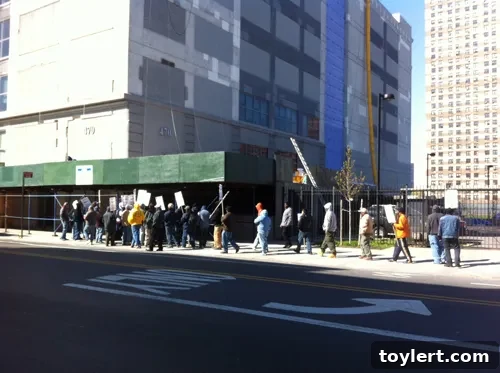
In the bustling heart of Fort Greene, Brooklyn, a significant development site at 470 Vanderbilt Avenue recently became the focal point of an impassioned protest. The vivid photograph above captures the scene, shared with us by a vigilant tipster, showing demonstrators gathered outside the premises. Their chants resonated through the neighborhood, a clear message directed at “Montec.” While the exact nature of their grievance remained specific to the moment, our source, and our own investigative efforts, strongly suggest that Montec refers to a contracting firm, likely Montec International, a name recognized in the construction sector. This demonstration underscores ongoing complexities surrounding the large-scale renovation of a facility destined to become a vital hub for New York City’s Human Resources Administration (HRA). The project, which has been under the community’s watchful eye, has seen its timeline shift, with the HRA now anticipating a move-in date sometime in Spring 2013. This incident highlights not only the critical stages of urban development but also the persistent vigilance of local communities and labor groups regarding contractor accountability and project management.
The protest at 470 Vanderbilt Avenue is more than just a fleeting moment of dissent; it represents a broader conversation about labor practices, community impact, and the transparency of public-private partnerships in major construction projects across New York City. While the specific demands shouted during the protest against “Montec” were not fully detailed, such demonstrations often stem from concerns regarding worker conditions, fair wages, safety standards, or even the engagement of local labor. In a vibrant and evolving neighborhood like Fort Greene, where new developments and renovations are a constant, the interaction between construction firms and the community, along with their workforce, is perpetually under scrutiny. The selection of contractors for significant public facilities like the future HRA office carries immense responsibility, not only to deliver a project on time and within budget but also to uphold ethical labor practices and contribute positively to the local economy. The presence of protesters, channeling their collective voice against a specific contractor, sends a powerful signal to all stakeholders involved in the 470 Vanderbilt Avenue project that their actions and decisions are being closely monitored.
The building at 470 Vanderbilt Avenue itself holds a prominent position within the Fort Greene landscape. Its transformation into a new HRA facility marks a significant chapter for both the structure and the community it will serve. The Human Resources Administration is a critical agency within New York City’s social services framework, providing essential support to thousands of residents through various programs, including food assistance (SNAP), cash assistance, housing aid, and employment services. The decision by the HRA to lease this expansive facility and embark on its substantial renovation project was announced some time ago, setting off expectations for increased accessibility to vital services for residents in Fort Greene, Clinton Hill, and surrounding areas. However, with large-scale projects come inherent challenges, from procurement and demolition to construction and final fit-out. These phases often involve a multitude of contractors, subcontractors, and various labor teams, making project oversight a complex endeavor. The community’s engagement, as evidenced by the recent protest, highlights the importance of accountability at every level of such a crucial public undertaking.
Renovations of this magnitude are rarely straightforward, and the journey of 470 Vanderbilt Avenue has been no exception. Initial reports outlined ambitious timelines for the facility’s readiness, but as is often the case with complex urban construction, delays can emerge. The HRA’s revised move-in projection of Spring 2013 indicates that the project has encountered, and continues to navigate, various hurdles. These delays can be attributed to a myriad of factors, including unexpected structural issues, supply chain disruptions, permitting processes, or, as implied by the protest, potential issues related to contractor performance or labor relations. When a public agency like the HRA is involved, such delays carry additional weight, as they directly impact the delivery of essential services to New York City’s most vulnerable populations. Every postponed opening translates to a longer wait for improved access to resources that many residents critically depend on for their well-being and stability. Therefore, the efficient and timely completion of the 470 Vanderbilt Avenue renovation is not merely a matter of construction logistics but a critical component of public service delivery.
The broader context of construction and community development in New York City often sees similar scenarios unfold. Rapid urbanization and constant redevelopment mean that protests against contractors are not uncommon. These demonstrations serve as vital mechanisms for raising awareness about potential labor exploitation, negligence, or a lack of commitment to community benefits. For firms like Montec International, if indeed they are the target, such public outcry can significantly impact their reputation and future project prospects. The ethical implications of how a construction project is managed, from the treatment of its workers to its engagement with the local community, are increasingly scrutinized. In a city as diverse and dynamic as New York, robust community engagement and transparent communication from both developers and public agencies are paramount. The citizens of Fort Greene, witnessing the transformation of 470 Vanderbilt Avenue, are clearly asserting their right to demand accountability and integrity throughout the entire development process. This ongoing dialogue between developers, city agencies, labor unions, and local residents is essential for fostering sustainable and equitable urban growth.
Looking ahead, the eventual opening of the HRA facility at 470 Vanderbilt Avenue in Spring 2013 is eagerly anticipated by many. Once operational, it is expected to significantly enhance the HRA’s capacity to serve a larger number of individuals and families, streamlining access to vital programs and resources. This will undoubtedly be a positive development for Fort Greene and its surrounding neighborhoods, providing a modern, accessible hub for social services. However, the path to its completion continues to be marked by community vigilance, as demonstrated by the protest. The incident serves as a powerful reminder that while progress is often celebrated, the journey to achieve it must be conducted with integrity, fairness, and respect for all stakeholders. The attention drawn to “Montec” highlights the critical role of contractors in the success, or controversy, of public projects and underscores the necessity for thorough vetting and ongoing oversight by city agencies. The unfolding story of 470 Vanderbilt Avenue will continue to be a testament to the dynamic interplay between urban development, public service, and community activism in the ever-evolving landscape of Brooklyn.
This ongoing situation at 470 Vanderbilt Avenue resonates deeply within the narrative of modern Brooklyn, where growth and gentrification often run parallel with demands for social equity and community voice. The initial reports detailing the HRA’s acquisition of the lease for this facility sparked considerable interest, as documented in articles such as Development Watch: 470 Vanderbilt Ave. and HRA Getting Lease at 470 Vanderbilt, both from Brownstoner. These earlier pieces established the groundwork for what was envisioned as a significant public-sector investment in the area. Now, with the added dimension of a public protest targeting a specific contractor, the narrative becomes richer and more complex, encompassing not just the physical transformation of a building but also the social and economic currents that shape a city. The eyes of the community, and indeed the city, will remain fixed on 470 Vanderbilt Avenue as it approaches its final stages of renovation and prepares to open its doors as a crucial service center. For those interested in pinpointing the exact location and understanding the urban fabric around it, a detailed view can be accessed via GMAP, while comprehensive building and permit information is available through the Department of Buildings (DOB) at DOB. These resources offer invaluable context for understanding the scope and regulatory aspects of this significant Fort Greene development.