The Gowanus Batcave’s Epic Transformation: From Underground Hub to Legitimate Arts Sanctuary
The industrial landscape of Gowanus, Brooklyn, has long been a canvas for urban legends and radical transformations. Few tales embody this spirit as vividly as that of the “Batcave” – a cavernous, abandoned industrial building that for years served as a pulsating heart for Brooklyn’s underground art scene and illicit gatherings. Its future, once shrouded in mystery and the grime of its past, is now charting a new course under the patronage of a singularly intriguing figure: the reclusive multimillionaire, Joshua Rechnitz.
Rechnitz, a known cycling enthusiast and philanthropist, has recently redirected his significant philanthropic ambitions towards this iconic Gowanus structure. This move comes after his highly publicized decision to withdraw his substantial offer to fund a state-of-the-art velodrome in Brooklyn Bridge Park. With that ambitious cycling project no longer on his immediate agenda, Rechnitz has now focused his vision on an equally transformative, albeit different, Brooklyn endeavor: turning the Batcave into a legitimate, vibrant arts center complete with dedicated studios and dynamic exhibition spaces.
Joshua Rechnitz: A Philanthropist’s Evolving Vision for Brooklyn
Joshua Rechnitz is a name whispered with a certain reverence and curiosity within New York City’s philanthropic circles. Known for his deep pockets and even deeper desire for privacy, Rechnitz operates largely outside the public eye, preferring to let his impactful investments speak for themselves. His previous commitment to funding the Brooklyn Bridge Park velodrome was a testament to his passion for cycling and community infrastructure, an endeavor that would have brought a world-class facility to the borough.
The velodrome project, however, faced considerable hurdles, including community opposition and logistical complexities, ultimately leading to Rechnitz’s decision to withdraw his funding. This pivotal moment did not, however, signal an end to his commitment to Brooklyn. Instead, it seems to have merely re-channeled his philanthropic focus, revealing a new direction that promises to leave an indelible mark on another crucial aspect of the borough’s identity: its flourishing arts community.
His shift towards the Gowanus Batcave suggests a broader interest in urban revitalization through cultural development. Rather than supporting a single sport, Rechnitz’s new project aims to cultivate creativity, nurture emerging talent, and provide much-needed infrastructure for artists in an increasingly unaffordable city. This transition from sports infrastructure to cultural endowment highlights Rechnitz’s versatile approach to philanthropy and his dedication to enriching the urban fabric of Brooklyn.
The Legendary Gowanus Batcave: From Abandoned Relic to Counter-Culture Hub
Before Rechnitz’s intervention, the building widely known as the Batcave was far more than just an abandoned industrial shell. Situated on 3rd Avenue near Carroll Street, this nondescript edifice had carved out a legendary reputation as a bastion of Brooklyn’s underground scene. For years, its vast, echoing interiors provided a clandestine sanctuary for an array of unauthorized activities, from sprawling rave parties that pulsed through the night to avant-garde art installations that defied conventional gallery spaces.
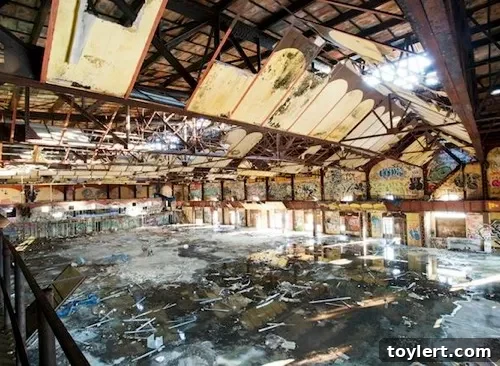
The photo above, taken in 2006, offers a glimpse into the raw, untamed aesthetic that defined the Batcave’s heyday. Its exposed brickwork, towering ceilings, and industrial remnants created a unique atmosphere, a fertile ground for creativity that thrived on its illegality and remoteness. Artists, musicians, performers, and revelers flocked to its hidden corners, drawn by the allure of freedom from oversight and the promise of authentic, unadulterated expression. It was a true melting pot of counter-culture, embodying the gritty, improvisational spirit that has long characterized parts of Brooklyn.
This period of unsupervised use saw the Batcave become a symbol of defiance and artistic liberation. It was a place where boundaries blurred, where the line between art and life often disappeared, and where a vibrant, if informal, community flourished amidst the industrial decay. Its name, “Batcave,” evoked images of a shadowy, hidden world, a perfect moniker for a space that operated largely out of sight, yet profoundly impacted the lives of those who discovered its secrets.
A New Dawn: Rechnitz’s Acquisition and the End of an Era
The era of spontaneous, unauthorized gatherings at the Batcave came to an abrupt, yet perhaps inevitable, end following Joshua Rechnitz’s acquisition of the property. In September 2012, Rechnitz purchased the building for a reported $7 million, a significant investment that signaled his serious intent for the site. Almost immediately after the sale, as reported by Gothamist, the doors that once welcomed countless revelers and artists were firmly shut.
This shutdown, while not entirely surprising given the nature of the transaction and the legal requirements that accompany such a purchase, carried a profound irony. A building that had organically fostered years of artistic activity was now being cleared of its informal occupants precisely to make way for a formal, legitimate arts center. This transition sparked mixed reactions within the community. While some lamented the loss of a truly free and unconventional space, others expressed excitement and optimism for the future, envisioning a well-resourced venue that could offer stability and support to the arts in a sustainable manner.
The cessation of illegal parties and underground exhibitions marked the close of a unique chapter in Gowanus’s cultural history. It was a necessary step, perhaps, to pave the way for a more structured future, but one that undoubtedly felt bittersweet to those who had found a sense of belonging and creative liberation within the Batcave’s unpoliced walls. The challenge now lies in harnessing that same spirit of innovation and community within a formalized structure.
Visioning the Future: An Arts Center for Gowanus
Joshua Rechnitz’s vision for the Batcave is clear: to transform it into a state-of-the-art arts center, providing much-needed studios and exhibition spaces for Brooklyn’s creative community. This ambitious rehabilitation project aims to convert the raw, industrial shell into a contemporary hub where artists can create, collaborate, and showcase their work to a broader audience. The specifics of the center’s programming and operational model are still emerging, but the intent is to foster a dynamic environment that supports artistic development across various disciplines.
The potential impact of such a center on Gowanus cannot be overstated. As a neighborhood undergoing significant gentrification and cultural redefinition, the establishment of a major arts institution can serve as an anchor, drawing in artistic talent and cultural enthusiasts. It promises to inject new energy into the local economy, potentially creating jobs and attracting visitors, while also solidifying Gowanus’s reputation as a vital cultural district within New York City. The center could become a cornerstone for community engagement, offering public programs, workshops, and events that make art accessible to all.
Early indications suggest that the project will embody a blend of serious artistic ambition and Brooklyn’s characteristic irreverence. A key figure already associated with the project is Josh Young, owner of the well-known Gowanus Ballroom. Young, whose creative contributions reportedly include building a staircase for Rechnitz’s house out of “whalebones and melted piano guts,” offers a glimpse into the unconventional yet highly creative ethos that might define the new Batcave. His enthusiastic declaration, “Whatever the Batcave project ends up being, it’s gonna be fucking cool,” perfectly encapsulates the hopeful, slightly wild spirit surrounding this transformation.
Gowanus: A Neighborhood in Flux and a Canvas for Change
The choice of Gowanus for this significant arts initiative is highly symbolic. The neighborhood itself is a microcosm of Brooklyn’s ongoing evolution, a blend of its industrial past and its rapidly gentrifying future. Defined by its infamous canal, a Superfund site currently undergoing extensive cleanup, Gowanus has long been a haven for artists and makers drawn to its affordable studio spaces and gritty, unpolished charm. However, with increasing development and rising property values, these creative havens are becoming increasingly scarce.
Rechnitz’s investment in the Batcave arrives at a critical juncture for Gowanus. It represents a commitment to preserving and enhancing the artistic character of the neighborhood amidst pressures of commercialization and luxury development. By providing stable, high-quality spaces for artists, the new arts center could play a pivotal role in shaping the cultural identity of Gowanus for decades to come, ensuring that creativity remains at its core as the area continues to transform.
Conclusion: A New Chapter for a Brooklyn Icon
The transformation of the Gowanus Batcave, orchestrated by the visionary Joshua Rechnitz, marks a compelling new chapter for one of Brooklyn’s most storied industrial landmarks. From its origins as an abandoned structure, through its legendary years as an underground art and party haven, to its impending rebirth as a legitimate arts center, the Batcave continues to reflect the dynamic, ever-evolving spirit of Gowanus. As the dust settles on its unauthorized past, the anticipation builds for a future where creativity, supported by philanthropic vision, will once again thrive within its historic walls, promising to be “fucking cool” indeed.
Read more about the Batcave’s history: Party’s Over at Gowanus Batcave [Gothamist]
Photo by Jake Dobkin for Gothamist