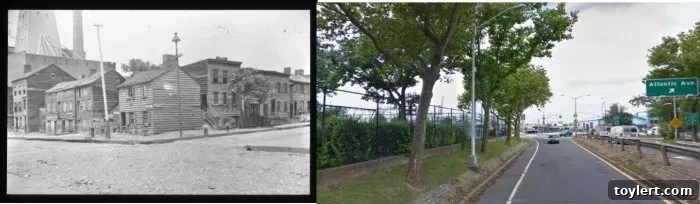
Brooklyn’s Enduring Spirit: A Journey Through Red Hook’s Past and Present
Red Hook, Brooklyn, stands as a captivating testament to the passage of time, a district where the echoes of a powerful industrial past resonate through its modern landscape. Like the robust remnants of a formidable civilization, the venerable structures of Red Hook’s industrial heart emerge from the contemporary urban fabric, offering a profound glimpse into a bygone era. While enough architectural integrity persists to evoke the grandeur of what once was, much has vanished, compelling us to rely on historical drawings, evocative photographs, and enduring narratives to truly comprehend the scale of what we’ve lost and the vibrancy that defined this unique corner of New York City.
This remarkable waterfront community was, in many respects, an astounding hub of activity and commerce. The Brooklyn waterfront, stretching majestically from the elegant brownstones of Brooklyn Heights down to the burgeoning neighborhoods of Sunset Park, once boasted an unparalleled concentration of shipping and warehouse capacity – dwarfing any other section of the vast metropolitan area. While Manhattan’s piers were undeniably bustling and often overcrowded, Brooklyn’s sprawling docks, especially in areas like Red Hook, presented a scene of prodigious activity, resembling a colossal anthill teeming with relentless purpose and energy, a spectacle truly unlike anything the world had ever witnessed.
The Echoes of Industry: Red Hook’s Enduring Legacy
The very streets of Red Hook tell a story etched in brick and cobblestone. Walking through this historic district today, one can almost feel the weight of history underfoot. The colossal brick warehouses, some still bearing the faded names of long-defunct shipping companies, and the skeletal remains of old docks reaching into the Gowanus Bay are more than just buildings; they are monuments to an era when Brooklyn was the commercial gateway to America. These structures, built for endurance and utility, now serve as a tangible link to a period of intense maritime trade and manufacturing that shaped not only New York but the nation.
These industrial relics, with their imposing facades and cavernous interiors, whisper tales of countless ships docking, goods being loaded and unloaded, and the arduous labor of generations. The metaphor of “ruins of a forgotten civilization” is particularly apt here. While not ruins in the classical sense, these structures have survived dramatic economic shifts and urban transformations, their original purpose having largely faded from the collective memory of many newer residents. Yet, their sheer scale and robust construction prevent them from completely disappearing, standing instead as silent sentinels, reminding us of the formidable economic engine that once roared here.
Brooklyn’s Maritime Dominance: A Waterfront Powerhouse
To fully grasp Red Hook’s historical significance, one must understand the pivotal role the Brooklyn waterfront played in global commerce. The assertion that Brooklyn’s shores housed more shipping and warehouse space than any other part of the metropolitan area is not an exaggeration but a historical fact. Several factors contributed to this dominance. Firstly, Brooklyn offered deeper water access in many of its basins, particularly crucial for the ever-larger steamships of the late 19th and early 20th centuries. Secondly, the sheer geographical expanse of Brooklyn’s shoreline provided ample room for expansion, allowing for the construction of vast warehouse complexes, extensive rail yards, and specialized piers that Manhattan, constrained by its island geography, simply couldn’t accommodate.
The commodities flowing through Brooklyn’s arteries were as diverse as the world itself. From the vast warehouses of the Bush Terminal to the grain elevators towering over the Gowanus Canal, goods poured in and out: coffee from Brazil, sugar from the Caribbean, spices from the Orient, lumber from the Pacific Northwest, cotton from the American South, and a myriad of manufactured goods destined for markets far and wide. This immense logistical network powered not just New York City but served as a crucial distribution point for the entire Northeastern United States. Brooklyn wasn’t just a borough; it was an international port, a vibrant nexus of global trade.
The “Vast Anthill”: Life and Labor on the Piers
The comparison of Brooklyn’s piers to a “vast anthill of activity” brilliantly captures the ceaseless energy that characterized the Red Hook waterfront during its zenith. This was a place of perpetual motion, a sensory kaleidoscope of sights, sounds, and smells. The air hummed with the rhythmic clang of cargo hooks, the shouts of longshoremen, the piercing whistles of tugboats guiding massive freighters, and the distant rumble of trains on the adjacent rail lines. The scent of coffee beans mingled with the aroma of spices, the salty tang of the sea, and the distinctive smell of coal smoke and diesel fumes.
Day and night, thousands of longshoremen, stevedores, and dockworkers toiled, their muscles straining as they loaded and unloaded ships by hand, or with the aid of rudimentary cranes and powerful winches. Barges shuttled goods between ships and warehouses, while horse-drawn carriages and later trucks navigated the bustling cobblestone streets, transporting cargo to its final destinations. This was a challenging life, physically demanding and often dangerous, yet it was also a community built on camaraderie and the shared purpose of keeping the economic heart of the city beating. It was a human endeavor on an epic scale, a stark contrast to the automated logistics and digital tracking systems that define modern global shipping.
The Tides of Change: Decline of an Industrial Empire
The industrial glory of Red Hook, like many great empires, eventually faced its decline, brought about by sweeping technological advancements and shifting economic paradigms. The most significant blow came with the advent of containerization in the mid-20th century. Standardized shipping containers revolutionized freight transport, allowing for faster, more efficient loading and unloading using massive gantry cranes. However, these new container ships were enormous, requiring deeper berths and vast marshalling yards that Brooklyn’s aging, cramped piers simply couldn’t accommodate. The shipping industry began migrating to newer, larger facilities in places like Port Elizabeth, New Jersey, which offered ample space for expansion and direct access to major interstate highways.
Concurrently, the rise of interstate trucking and the decline of rail as the primary mode of inland freight transport further marginalized Brooklyn’s maritime role. The dense urban fabric of Red Hook became an impediment rather than an advantage. Factories that once thrived on raw materials arriving by sea and finished goods departing the same way found it more economical to relocate to areas with better highway access and lower operating costs. The vibrant “anthill” gradually quieted, its once-bustling piers and warehouses falling into disuse, leaving behind an urban landscape of impressive, yet often empty, industrial architecture. This period marked a profound transformation, leaving many structures abandoned and leading to a significant economic downturn for the area.
Red Hook Reimagined: From Industry to Innovation
For decades, Red Hook endured a period of stagnation, its industrial grandeur a distant memory. However, in recent years, this resilient neighborhood has experienced a remarkable renaissance, transforming from a neglected industrial zone into a vibrant, eclectic community renowned for its unique blend of history and innovation. Artists, drawn by the spacious, light-filled warehouses and relatively affordable rents, began to establish studios and galleries. This creative influx laid the groundwork for a broader revitalization.
Today, many of the colossal brick warehouses and former factory buildings have been ingeniously repurposed. They now house an array of artisanal food producers, microbreweries, distilleries, furniture makers, design studios, and independent retailers. The very structures that once facilitated the movement of global commerce now foster local entrepreneurship and creativity. Residential development has also brought new life to the area, attracting a diverse population seeking Red Hook’s distinctive character, its waterfront views, and its strong sense of community. Despite these changes, a commitment to preserving the authentic, gritty charm of the neighborhood persists, ensuring that the new blends harmoniously with the old.
Preserving the Past, Building the Future
Red Hook’s journey from an industrial powerhouse to a modern cultural hub is a compelling narrative of urban evolution. The remaining structures are not just architectural artifacts; they are vital pieces of New York City’s historical tapestry, tangible links to an era when Brooklyn stood at the forefront of global trade. Efforts to preserve these historic buildings, often through adaptive reuse, ensure that future generations can appreciate the sheer scale and ingenuity of this past.
As Red Hook continues to evolve, it walks a delicate balance between honoring its profound history and embracing the opportunities of the future. It is a place where the echoes of bustling piers and diligent labor still resonate, even as new businesses thrive and new communities flourish. This unique fusion of old and new defines Red Hook’s enduring charm and makes it one of Brooklyn’s most fascinating and resilient neighborhoods, a living museum of urban transformation that continues to inspire and captivate both residents and visitors alike.