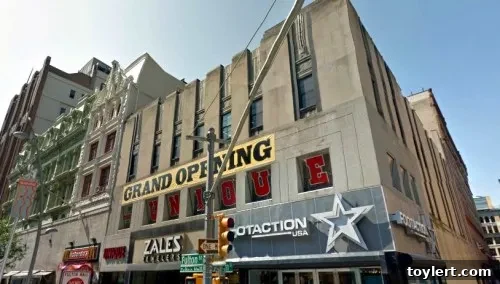
The Enduring Legacy of a Five-and-Dime: Unpacking 408-416 Fulton Street, Downtown Brooklyn
Brooklyn, a borough rich in history and architectural marvels, tells its story one building at a time. Among these, the structure at 408-416 Fulton Street stands as a silent testament to a bygone era of retail dominance and urban transformation. Once the bustling home of a pioneering F. W. Woolworth store, this building now houses an assortment of smaller retail establishments, reflecting the dynamic evolution of Downtown Brooklyn’s commercial landscape. Its enduring presence on the corner of Fulton Street and Gallatin Place offers a fascinating glimpse into the past while actively participating in the borough’s vibrant present.
Architectural Snapshot: 408-416 Fulton Street
This prominent Downtown Brooklyn edifice, constructed in 1937, represents a significant example of Late Art Deco architecture. Designed by A.F. Winter, an architect whose other known works include buildings in Minnesota, the structure embodies the streamlined elegance and functional aesthetic characteristic of its period. While it currently lacks individual landmark status, it is recognized as a valuable component of a proposed Fulton Street Historic District—a district whose realization, unfortunately, faces considerable challenges.
Building Details:
- Former Occupant: F. W. Woolworth store (now divided into smaller retail stores)
- Address: 408-416 Fulton Street
- Cross Streets: Corner Gallatin Place
- Neighborhood: Downtown Brooklyn
- Year Built: 1937
- Architectural Style: Late Art Deco
- Architect: A.F. Winter
- Other Work by Architect: Buildings in Minnesota
- Landmarked: No, but part of a proposed Fulton Street Historic District.
A Glimpse into Late Art Deco Design
The Late Art Deco style, prevalent in the 1930s, often emphasized functionality and modernism, moving away from the more ornate embellishments of earlier Deco forms. Buildings from this period frequently feature sleek lines, geometric patterns, and an emphasis on verticality, often utilizing materials like brick, terracotta, and polished stone to achieve a sense of sophisticated simplicity. While specific details of A.F. Winter’s design for 408-416 Fulton Street would require deeper architectural analysis, its 1937 construction date places it firmly within this aesthetic movement, suggesting a design that prioritized clarity and commercial appeal during a period of economic recovery and evolving urban design. The choice of a reputable architect like Winter for such a prime commercial location underscores the importance and prestige of a Woolworth’s establishment in the era.
Present-Day Transformation and Preservation Challenges
Today, the former Woolworth’s store at 408-416 Fulton Street has undergone adaptive reuse, a common practice in dense urban environments. The vast interior space, originally designed for a single large retailer, has been skillfully subdivided to accommodate multiple smaller shops. This transformation allows the building to remain a vital commercial asset, continually contributing to Downtown Brooklyn’s bustling economy. However, its future as a protected architectural entity remains uncertain. Despite its inclusion in a proposed Fulton Street Historic District, the path to landmark designation for such districts in rapidly developing areas like Downtown Brooklyn is often fraught with obstacles. Conflicting interests between preservationists, developers, and property owners frequently lead to an uphill battle, making the establishment of new historic districts a rare and hard-won victory.
The Enduring Legacy of F.W. Woolworth: A Retail Revolution
To fully appreciate the significance of 408-416 Fulton Street, one must delve into the extraordinary story of its original occupant: F. W. Woolworth. The chain, founded by Frank Winfield Woolworth, revolutionized American retail and left an indelible mark on consumer culture across the globe.
From Humble Beginnings: The Visionary Frank W. Woolworth
Frank W. Woolworth’s journey began in upstate New York, where he was born in Jefferson County in 1852. His early career saw him apprenticing in a dry goods store, where he gained invaluable insights into the retail business. It was during this period that he conceived a groundbreaking idea: selling merchandise at fixed, low prices. This concept, radical for its time, challenged the traditional haggle-and-barter system prevalent in stores. In 1879, he took the leap and opened his first “Woolworth” store in Utica, NY. However, initial success proved elusive, and the store failed after only a few months—a setback that might have deterred a lesser entrepreneur.
Undeterred and driven by an unwavering belief in his vision, Woolworth quickly regrouped. He rallied family members and close associates to join him as partners, demonstrating remarkable resilience and an astute understanding of collaborative business. Later that same year, he ventured once more into the retail world, opening a new store in Lancaster, Pennsylvania. This second attempt proved to be a resounding success, laying the foundation for what would become an unprecedented retail empire. Woolworth’s persistence and innovative approach to merchandising cemented his place as a pivotal figure in American business history.
The Birth of a Retail Revolution: The Five-and-Dime Concept
The success of the Lancaster store was primarily attributed to Woolworth’s pioneering “five-and-dime” concept. This simple yet revolutionary idea involved selling a wide array of everyday goods, from household items and stationery to toys and personal accessories, all for five or ten cents. This fixed-price model, combined with open displays that allowed customers to browse freely, dramatically transformed the shopping experience. Prior to Woolworth’s, many items in general stores were kept behind counters, and prices were often subject to negotiation, making shopping a potentially intimidating or time-consuming affair for some.
The five-and-dime stores made quality goods accessible to the masses, democratizing consumption and empowering ordinary citizens with greater purchasing power. This novel approach resonated deeply with the American public, particularly as industrialization led to the mass production of affordable goods. The stores became community hubs, offering a vast selection of practical and whimsical items in a friendly, no-pressure environment. Woolworth’s rapid expansion across the United States and eventually into other countries demonstrated the universal appeal and economic viability of this innovative retail model, solidifying its status as a global retail giant for decades.
Woolworth’s Impact on Brooklyn and Beyond
The presence of an F. W. Woolworth store on Fulton Street, then as now a premier commercial artery, was a clear indicator of the brand’s immense popularity and strategic expansion. For generations of Brooklynites, the Woolworth’s at 408-416 Fulton Street was more than just a store; it was a destination, a place where families could find everything from school supplies to lunch at the iconic soda fountain. These stores were vibrant centers of activity, integral to the social and economic fabric of their neighborhoods. They offered employment, contributed significantly to local economies, and shaped the consumer habits of millions.
Across the nation, Woolworth’s stores were instantly recognizable, known for their distinctive red-and-gold signage and their consistent promise of value. The company’s vast network of stores, including its prominent Brooklyn location, played a crucial role in establishing the modern chain store concept, influencing countless other retailers and setting benchmarks for efficiency and customer service. Although the original Woolworth’s department store chain eventually ceased operations in the late 20th century, its legacy as a retail innovator and a beloved institution lives on, particularly within the walls of buildings like 408-416 Fulton Street.
Downtown Brooklyn: A Canvas of Commercial Evolution
The neighborhood of Downtown Brooklyn itself has undergone continuous metamorphosis, and the building at 408-416 Fulton Street stands as a silent observer of these changes. Once a bustling commercial and civic center primarily catering to local residents, Downtown Brooklyn has evolved into a dynamic hub, blending residential high-rises, corporate offices, cultural institutions, and a diverse retail landscape.
Fulton Street’s Historic Commercial Heart
Fulton Street has historically been the beating heart of commerce in Brooklyn. From the late 19th century through much of the 20th century, it was lined with grand department stores, specialty shops, and, of course, the ever-popular five-and-dimes like Woolworth’s. Shoppers from across Brooklyn and beyond flocked to Fulton Street for its unparalleled selection and vibrant atmosphere. These stores were not merely places of transaction; they were social gathering spots, anchors of community life, and symbols of urban prosperity. The presence of a major Woolworth’s store here underscored Fulton Street’s status as a prime retail destination.
In recent decades, Fulton Street, like many traditional retail corridors, has adapted to changing consumer preferences and economic realities. While some historic structures have been replaced by modern developments, many, like the former Woolworth’s, have found new life through adaptive reuse. This continuous evolution highlights the resilience of the urban fabric and the ability of historic buildings to be reimagined for contemporary needs, even as they retain echoes of their past grandeur.
Navigating Preservation in a Dynamic Urban Core
The proposal for a Fulton Street Historic District, which includes 408-416 Fulton Street, represents a crucial effort to safeguard the architectural character and historical narrative of this vital commercial corridor. Such districts are designed to protect clusters of buildings that collectively tell a story about a specific period, architectural style, or cultural development. For Downtown Brooklyn, establishing a historic district on Fulton Street would ensure that the unique streetscape, with its blend of commercial architecture from different eras, is preserved for future generations.
However, the journey to designation is often complex and challenging. In an area undergoing intense development pressure, where land values are exceptionally high, the push for new, larger, and often glass-clad structures frequently clashes with preservation goals. Property owners may resist landmarking due to concerns about renovation restrictions or perceived impacts on property value. The “little chance of happening” sentiment often stems from the formidable economic and political forces at play in a rapidly gentrifying and redeveloping urban core. Despite these challenges, the conversation around the proposed district underscores the recognition of these buildings’ inherent value and their irreplaceable role in Brooklyn’s history.
Architectural Significance and the Call for Preservation
Beyond its historical association with F. W. Woolworth, the building at 408-416 Fulton Street holds intrinsic architectural merit. As a Late Art Deco commercial structure from the 1930s, it embodies a specific moment in architectural history, characterized by a transition from earlier, more decorative styles to a sleeker, more functional modernism. Its design likely incorporates distinctive elements such as geometric relief, robust construction, and perhaps unique window patterns or entrance details that mark it as a product of its time.
Preserving such commercial buildings is vital not only for their aesthetic qualities but also for their contribution to the collective memory and identity of a neighborhood. They are tangible links to the past, offering insights into the economic forces, social trends, and design sensibilities that shaped urban life. The former Woolworth’s building, with its robust structure and dignified facade, serves as a physical reminder of Downtown Brooklyn’s commercial heyday and the entrepreneurial spirit that built it. Protecting these structures through historic district designation ensures that the rich tapestry of urban architecture, rather than being replaced by homogeneous new builds, continues to tell a nuanced and layered story of Brooklyn’s evolution.
A Building’s Unfolding Narrative
The former F. W. Woolworth store at 408-416 Fulton Street stands as a powerful symbol of Brooklyn’s rich commercial history and its ongoing capacity for reinvention. From its origins as a cornerstone of the revolutionary five-and-dime concept to its current incarnation as a multi-tenant retail space, the building embodies resilience and adaptation. Its Art Deco architecture speaks to the design trends of its era, while its position within a proposed historic district highlights the enduring struggle and importance of urban preservation.
As Downtown Brooklyn continues its dynamic transformation, buildings like 408-416 Fulton Street serve as essential anchors to the past, reminding us of the visionary individuals like Frank W. Woolworth and the architectural styles that shaped our cities. Its story is far from over; it continues to unfold, brick by brick, storefront by storefront, as a living testament to Brooklyn’s enduring spirit and its commitment to blending history with progress.