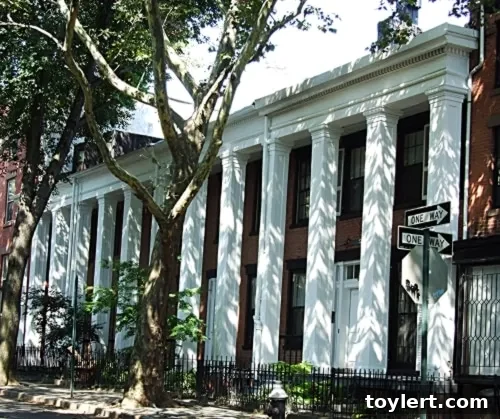
Colonnade Row: A Majestic Greek Revival Icon in Brooklyn Heights
Nestled within the enchanting and historically rich Brooklyn Heights Historic District, Colonnade Row stands as a magnificent testament to 19th-century architectural grandeur. This distinctive structure, with its commanding presence and classical elegance, offers a captivating glimpse into a bygone era when American cities embraced the stately beauty of Greek Revival design. Our exploration delves into the unique charm, historical context, and enduring legacy of this architectural gem, inviting you to appreciate its intricate details and significant place in New York City’s urban fabric.
Key Details: Colonnade Row at a Glance
- Address: 43-49 Willow Place, between Joralemon and State Streets
- Name: Colonnade Row
- Neighborhood: Brooklyn Heights (Part of the Brooklyn Heights Historic District)
- Year Built: 1846
- Architectural Style: Greek Revival
- Architects: Unknown
- Landmarked: Yes
The Enduring Charm of Colonnade Row: A Vision of Classical Grandeur
Colonnade rows, characterized by their impressive and uniform facades adorned with prominent columns, were a highly celebrated architectural trend during the 1830s and 1840s. These designs brought a profound sense of gravitas and classical interest to what might otherwise have been perceived as relatively straightforward residential structures. In the case of Colonnade Row, the massive, imposing columns are not merely decorative elements; they are the very essence of the Greek Revival style, projecting the houses proudly into the streetscape and creating an immediate, unforgettable impression of stateliness and dignity.
A Glimpse into Brooklyn Heights’ Past
Brooklyn Heights itself possesses a storied history, recognized as New York City’s first historic district. From its elevated position offering breathtaking views of Manhattan and the harbor, it has evolved from a prosperous farming community into a sought-after residential enclave. By the mid-19th century, when Colonnade Row was constructed, Brooklyn Heights was rapidly developing into a sophisticated urban neighborhood, attracting merchants, professionals, and families seeking elegant homes with easy access to Manhattan via ferries. The choice of Greek Revival for significant new constructions like Colonnade Row reflected the era’s prevailing taste and aspirations, symbolizing prosperity, democracy, and a connection to the classical ideals of ancient Greece.
The Greek Revival Aesthetic: Grandeur and Simplicity
The Greek Revival architectural style, prevalent in the United States from the 1820s to 1860s, was a profound expression of the young nation’s identification with ancient Greek democracy and ideals. It emerged as a powerful counterpoint to European influences, asserting a distinct American architectural identity. Key characteristics of this style, masterfully embodied by Colonnade Row, include:
- Stately Columns: Often Doric, Ionic, or Corinthian, these columns are the most defining feature, creating imposing porticos or, as seen here, extending across entire facades. Colonnade Row’s columns are particularly striking, offering a strong visual rhythm.
- Pediments and Entablatures: Though not always present in their full form on urban row houses, the influence of these elements can be seen in the general proportion and detailing.
- Symmetrical Design: A strong emphasis on balance and order is paramount, contributing to the sense of calm and formality.
- Subdued Ornamentation: While grand, the style often favored clean lines and less flamboyant decoration compared to some other Victorian styles, allowing the form and proportion to speak for themselves.
- Use of Materials: Often executed in brick or wood painted to resemble stone, these structures exuded a sense of permanence and classical solidity. Colonnade Row’s brick facade, complemented by its stone or stuccoed columns, perfectly captures this aesthetic.
Colonnade Row’s design skillfully applies these principles. The row of houses, built as a unified architectural statement, presents a continuous front of fluted columns that support an elegant entablature, creating a cohesive and impressive visual corridor along Willow Place. This design choice not only elevated the streetscape but also provided a unique architectural identity that differentiated it from other, less adorned rows of houses prevalent in the city.
Architectural Context: The Popularity of Colonnade Rows
The popularity of “colonnade rows” during the mid-19th century wasn’t merely a fleeting trend; it reflected a broader cultural and architectural movement. These structures offered a sophisticated and dignified residential solution for the burgeoning urban middle and upper classes. By incorporating grand classical elements typically reserved for public buildings like banks or courthouses, architects could imbue private residences with a sense of public gravitas and refined taste. This made them particularly attractive to those who sought to convey an image of stability, cultural awareness, and civic pride.
The extended columns, which literally push the building’s presence further into the public sphere, made a bold statement. They transformed a series of individual homes into a unified, monumental facade, elevating the architectural quality of the entire block. This collective grandeur was a powerful symbol in a rapidly growing city like Brooklyn, demonstrating a commitment to elegant urban planning and a desire for architectural distinction. The uniformity across the row, despite each being a separate dwelling, spoke to an ideal of communal harmony within an aspirational aesthetic framework.
Unveiling the Masterpiece: Colonnade Row’s Distinctive Features
Beyond the impressive columns, Colonnade Row boasts several design elements that contribute to its overall architectural significance. Each house within the row, while sharing the overarching Greek Revival theme, likely featured subtle variations in details such as window treatments, doorway surrounds, and interior layouts that were customized for the original owners. The windows, typically tall and proportioned to the classical scale of the façade, allow ample natural light, a hallmark of well-designed 19th-century homes. The entranceways, framed by pilasters or more modest surrounds, provide a transitional space from the public realm of the street to the private sanctuary of the home, all while maintaining the Greek Revival aesthetic. The careful detailing of the cornices and roofline further reinforces the classical proportions and finishes the composition with a refined touch.
The relationship between the structure and its immediate environment on Willow Place is also crucial. The choice of a relatively narrower street accentuates the height and projection of the columns, making them appear even more dominant and monumental. This thoughtful placement demonstrates an understanding of urban design principles, where architectural elements are strategically employed to maximize visual impact and create a distinct sense of place within the dense urban fabric of Brooklyn Heights.
A Pillar of Preservation: Landmarked Status and Historic District
Colonnade Row’s status as a “landmarked” building is immensely significant. In New York City, landmark designation by the Landmarks Preservation Commission (LPC) protects structures and sites that possess special historical, cultural, or architectural value. This designation ensures that the building’s exterior, and sometimes interior, cannot be altered without careful review and approval from the LPC, thereby safeguarding its original character and historical integrity for future generations. For Colonnade Row, this means that its iconic Greek Revival facade, including those defining columns, is protected from inappropriate modifications or demolition.
Furthermore, its inclusion within the Brooklyn Heights Historic District amplifies this protection. A historic district designation applies a similar layer of protection to an entire area, preserving the collective character and historical ambiance of the neighborhood. This integrated approach recognizes that the value of individual landmark buildings is often enhanced by their surrounding historic context. The district ensures that new developments or alterations within its boundaries maintain the aesthetic and historical sensibilities that define Brooklyn Heights, allowing residents and visitors alike to experience the neighborhood much as it appeared in centuries past, with Colonnade Row standing as a proud anchor of its architectural heritage.
The Legacy of an Unknown Architect
It is not uncommon for buildings of this era, particularly residential rows, to have “unknown” architects. In the mid-19th century, architectural practice was often less formalized than it is today. Many builders or master craftsmen served as both designers and constructors, and their names were not always meticulously recorded for posterity. The focus was often on the developer or the builder who oversaw the project, rather than the specific individual responsible for the design drawings. Despite the lack of a named architect, the sophisticated execution of Colonnade Row speaks volumes about the skill and architectural understanding of its creators. It stands as a testament to the collective craftsmanship and aesthetic sensibilities that shaped New York City during a period of rapid growth and architectural evolution.
Visiting Colonnade Row: A Journey Through Time
For those interested in history, architecture, or simply a beautiful urban stroll, a visit to Colonnade Row is highly recommended. Located on the serene Willow Place, a street known for its charming historic homes, the row offers a tranquil escape from the bustling city. Walking by its elegant facade allows one to appreciate the intricate details of the Greek Revival style up close, from the fluting on the columns to the precise proportions of the windows and doorways. It’s an opportunity to connect with the past, to imagine the lives of those who resided here over 170 years ago, and to witness firsthand how architectural beauty can profoundly shape the character of a neighborhood. Colonnade Row is not just a building; it is a living piece of history, an open-air museum that continuously inspires and educates.
Conclusion: Colonnade Row’s Lasting Impact
Colonnade Row remains an architectural marvel and a cherished landmark in Brooklyn Heights. Its Greek Revival design, characterized by an imposing yet harmonious array of columns, encapsulates the aspirations and aesthetic values of mid-19th century America. More than just a collection of houses, it represents a pivotal moment in urban development and architectural taste, demonstrating how classical ideals could be adapted to create grand residential statements in a burgeoning city. Its protected status ensures that this exquisite piece of history will continue to grace Willow Place for generations to come, standing as a proud symbol of Brooklyn’s rich architectural heritage and an enduring reminder of the timeless appeal of classical design. Colonnade Row truly embodies the essence of an interesting structure – old, important, and undeniably beautiful, continuing to captivate all who encounter its stately presence.