Brooklyn, one building at a time.
The Architectural Grandeur of 47 Graham Avenue: From Public National Bank to Bank of America in Williamsburg
Building Identity: Originally Public National Bank of New York, now Bank of America
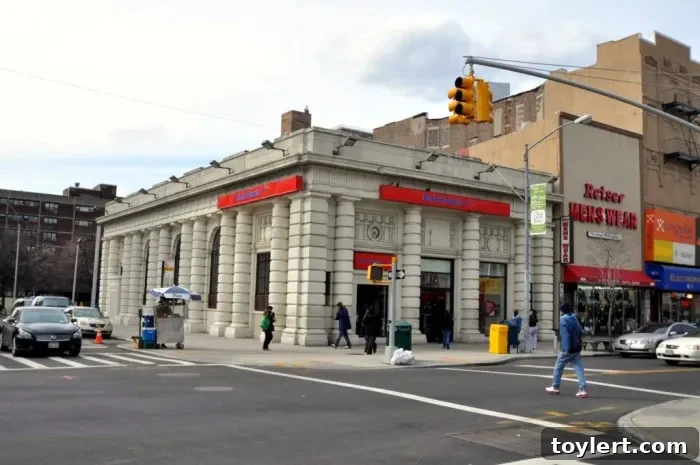
In the dynamic and historically rich neighborhood of Williamsburg, Brooklyn, stands an edifice that captures the imagination and tells a story of architectural evolution and community resilience. The building located at 47 Graham Avenue, which initially housed the venerable Public National Bank of New York and currently operates as a Bank of America branch, is far more than a mere commercial structure. It represents a significant landmark, distinguished by its unique adherence to the rare and elegant Vienna Secession architectural style. This building invites exploration, offering a fascinating glimpse into the early 20th-century design philosophies that shaped parts of New York City’s urban landscape, making it an essential piece of Brooklyn’s architectural narrative.
A Foundation of Trust: The Public National Bank of New York’s Early Years
The dawn of the 20th century marked a transformative era for Brooklyn. As waves of immigrants arrived and industries flourished, neighborhoods such as Williamsburg experienced rapid expansion, necessitating a robust financial infrastructure. Amidst this boom, the Public National Bank of New York was established in 1908. It quickly carved out a vital role for itself, becoming a cornerstone of the community by providing essential financial services to local businesses and residents alike. The bank symbolized stability, fostering an environment of economic growth and trust during a period of significant societal change.
The decision to commission a distinctive building for its Graham Avenue branch underscored the Public National Bank’s aspiration and dedication to its clientele. Unlike many of its contemporaries who leaned towards more traditional or neo-classical designs, the bank opted for a forward-thinking architectural expression. This choice was a deliberate statement, aiming to project an image that blended contemporary relevance with an undeniable sense of gravitas. The building transcended its functional purpose, evolving into a beacon of progress and community spirit, anchoring the financial lives of generations of Brooklynites within an ever-changing urban tapestry.
An Architectural Marvel: The Vienna Secession Influence at 47 Graham Avenue
What truly sets 47 Graham Avenue apart is its remarkable architectural lineage—a captivating and relatively rare manifestation of the Vienna Secession movement within the bustling streets of New York City. Originating in late 19th-century Austria, the Vienna Secession was a revolutionary artistic movement that broke away from traditional academic art, advocating for a synthesis of fine and decorative arts. It championed artistic freedom, characterized by its emphasis on geometric purity, simplified forms, and the thoughtful integration of symbolic ornamentation, offering a stark contrast to the more ornate and historically referential styles prevalent at the time.
The unknown architect behind the Public National Bank building, likely inspired by luminaries of the Secessionist movement such as Otto Wagner or Joseph Maria Olbrich, masterfully adapted these principles to a commercial structure. The facade of 47 Graham Avenue elegantly showcases several defining characteristics of the Vienna Secession style, making it a point of architectural interest for enthusiasts and casual observers alike:
- Geometric Precision: The building’s overall structure is defined by clean lines and bold, often rectangular or square forms, consciously moving away from the organic curves and naturalistic motifs commonly associated with the broader Art Nouveau movement.
- Integrated Ornamentation: While decorative elements are present, they are meticulously controlled and seamlessly integrated into the building’s fabric, rather than appearing as superficial embellishments. Observe the stylized patterns, often abstract or symbolic, that are thoughtfully embedded within the material itself.
- Material Honesty: The selection of materials, predominantly brick and stone with strategic metal accents, is celebrated for its inherent qualities. This choice contributes to the building’s rich textural appeal and its appearance of enduring solidity.
- Exquisite Craftsmanship: A high degree of artisanry is evident in every detail, from the intricate window frames to the refined entrance surrounds. This focus on meticulous execution reflects the Secessionist ideal of elevating applied arts to the same esteemed level as fine art.
- Harmonious Functionality: The design masterfully balances its aesthetic ambitions with the practical necessities of a banking institution, creating an environment that is both welcoming to the public and commanding of respect.
This architectural decision was audacious for Brooklyn, a borough historically characterized by its iconic brownstones and more conventional commercial buildings. The Public National Bank stood out as a beacon of modernity, showcasing an international artistic movement right in the heart of Williamsburg. It remains a powerful, albeit subtle, declaration of the city’s openness to groundbreaking ideas and its inherently cosmopolitan spirit.
47 Graham Avenue: A Witness to Williamsburg’s Transformation
The building at 47 Graham Avenue has stood steadfast, bearing witness to the dramatic and multifaceted evolution of Williamsburg itself. From its early 20th-century identity as a bustling industrial center and a vibrant haven for diverse immigrant communities, through periods of economic flux, to its more recent metamorphosis into a globally recognized cultural and trendy hotspot, Williamsburg has continuously reinvented its identity. Throughout these profound changes, the Public National Bank building has maintained its presence, serving as a tangible and enduring link to the neighborhood’s rich and complex past.
Its strategic placement on Graham Avenue, a thoroughfare that has historically functioned as a vital commercial and residential artery, guaranteed its prominence. For generations, the bank would have been a daily destination for countless residents, playing an indispensable role in their personal financial lives and contributing significantly to the local economy. Its architecture, distinct from the surrounding structures, contributed profoundly to the street’s unique character, imbuing the area with a palpable sense of place and establishing an unmistakable landmark within the dense urban fabric.
The Evolution: From Local Institution to National Presence
As is often the trajectory for regional financial entities, the Public National Bank of New York eventually became integrated into a larger financial conglomerate. Over the course of several decades, through a series of mergers and acquisitions that fundamentally reshaped the American banking industry, the institution transitioned into what is now a Bank of America branch. This significant shift, while marking the conclusion of the Public National Bank’s independent identity, simultaneously ensured the continued operational use and, importantly, the preservation of its magnificent architectural home.
Even today, both long-time residents and new visitors conduct their daily banking transactions within the very same walls that once housed a pioneering Brooklyn institution. While the corporate signage and branding have undoubtedly evolved, the building’s original architectural integrity has largely been maintained. This remarkable continuity is paramount, allowing a significant piece of Brooklyn’s financial and architectural history to persist, seamlessly integrated into the contemporary rhythm of urban life. It serves as a compelling reminder that even as institutions undergo profound transformations, their physical foundations can endure, carrying forward invaluable stories and legacies from preceding eras.
47 Graham Avenue: An Enduring Brooklyn Landmark and Architectural Treasure
Today, the building at 47 Graham Avenue transcends its identity as a mere functional bank branch; it is an irreplaceable Brooklyn landmark. Its profound historical significance, coupled with its singular expression of the Vienna Secession movement, makes it a compelling subject of study and admiration for historians, architects, urban planners, and anyone with a discerning appreciation for urban aesthetics. It offers a rare and tangible opportunity to experience an international art movement, expertly translated into the practical needs of an early 20th-century American city, underscoring New York City’s global architectural dialogue.
The ongoing efforts to preserve such historic structures are absolutely vital for safeguarding the distinctive character and unique identity of neighborhoods like Williamsburg. These buildings are not merely inert assemblies of bricks and mortar; they are living repositories of collective memory, embodying the aspirations, struggles, and triumphs of generations past. The former Public National Bank building serves as an invaluable educational resource, vividly illustrating how architectural choices directly reflect the cultural and economic climate of their time, and how the seeds of modernism began to take root in seemingly unexpected corners of the world, including a bustling Brooklyn street.
Whether you are a long-standing local resident, a curious tourist exploring the vibrant and ever-changing streets of Williamsburg, or a dedicated architectural enthusiast, taking a moment to observe and appreciate the facade of 47 Graham Avenue is an experience highly recommended. Its subtle yet undeniable grandeur and profound historical depth offer a quiet, contemplative counterpoint to the energetic pace of modern Brooklyn, providing a poignant and enduring connection to the borough’s continuous story, celebrated, as always, one remarkable building at a time.