Read Part 1 and Part 3 of this story.
Brooklyn’s Gilded Age: The McMahon Legacy and a Son’s Uncharted Path
In the vibrant tapestry of late 19th-century Brooklyn, a city rapidly transforming into a powerhouse of commerce and culture, certain names resonated with undeniable power and influence. Among these towering figures was James McMahon, a man whose journey from an astute shipping merchant to a formidable bank president epitomized the era’s spirit of ambition, enterprise, and immense opportunity. His saga, however, was not merely a chronicle of financial triumph but also a nuanced exploration of complex family dynamics, unfolding within the grand confines of a historic Stuyvesant Heights mansion.
James McMahon: Architect of Fortune and Civic Pillar
James McMahon’s ascent to prominence began well before the opulent glow of the 1890s. He initially forged his considerable fortune in the demanding world of shipping, a profession that positioned him at the very heart of America’s rapidly industrializing landscape. McMahon possessed a keen strategic mind, expertly navigating the nascent yet rapidly expanding railway systems that crisscrossed the East Coast. His operations were critical arteries, efficiently transporting a diverse array of goods between the bustling commercial centers of Boston and Baltimore. This early success was a testament to his profound understanding of logistics, market demands, and the inherent risks and rewards of large-scale trade, laying a robust financial foundation that would soon propel him into even more influential circles.
By the close of the 19th century, James McMahon had achieved an even more distinguished status. He presided as president over the Emigrant Industrial Savings Bank, an institution of paramount importance that stood as the largest and most successful savings bank in New York City. This was far more than a mere financial establishment; it was a cornerstone of the city’s economic growth, a vital engine providing stability and opportunity for countless working-class families and new immigrants seeking to build a life in America. McMahon’s leadership at such a prestigious and impactful institution solidified his reputation not just as a man of immense wealth, but as a crucial figure in shaping the financial architecture and social welfare of the burgeoning metropolis. His influence extended beyond the boardroom, touching the lives of thousands and deeply influencing the economic narrative of New York.
The MacDonough Street Mansion: A Symbol of Stuyvesant Heights Grandeur
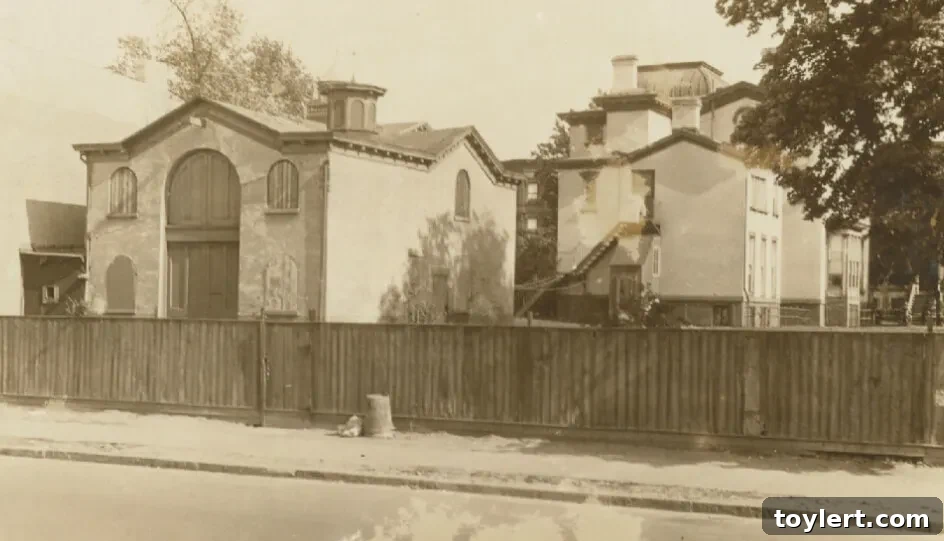
McMahon’s residential choices were a clear reflection of his elevated professional and social standing. He resided in a magnificent, free-standing brick mansion, meticulously constructed in 1863. This architectural masterpiece showcased a striking blend of Italianate and French Second Empire styles, popular during a period when opulence and grandeur were highly coveted. The mansion’s strategic location on MacDonough Street was no accident; it was one of the premiere, most coveted avenues in the upscale Stuyvesant Heights neighborhood, placing McMahon squarely among Brooklyn’s burgeoning elite. This district was already renowned for its stately residences, tree-lined streets, and vibrant community.
The estate itself was expansive, a veritable urban oasis sprawling over a full acre of meticulously landscaped lawn—a rare and luxurious commodity in an increasingly dense urban environment. This generous plot offered not only a verdant retreat but also an undeniable display of wealth and social status. Complementing the main house was a well-appointed carriage house, an absolute necessity for a family of their stature in an era preceding the automobile. Its entrance was conveniently situated on Macon Street, providing practical access while maintaining the grandeur of the main residence. This self-contained property was more than just a home; it was a private dominion, a sanctuary for James McMahon, his wife, and their impressive brood of seven children: Charles, James Jr., Mary Louise, Rosemary, Joseph, Henry, and Francis. The very walls of this grand residence undoubtedly bore silent witness to the daily ebb and flow of a prominent family’s life, from triumphs and celebrations to quiet struggles and profound challenges.
Faith, Philanthropy, and Community: McMahon’s Enduring Legacy
Beyond his formidable business acumen and significant domestic life, James McMahon was profoundly committed to his faith and community. He was an exceptionally active and influential member of the Catholic Church, an institution that served as a central pillar for many Irish-American families navigating life in the late 19th century. His wealth and unwavering dedication translated into tangible contributions, as he was proudly counted among the prominent Irish-American donors whose generous contributions facilitated the construction of Our Lady of Victory Church. This beautiful edifice, a spiritual beacon for the growing community, was strategically located merely a block from his own opulent home on MacDonough Street, symbolizing his deep roots and personal investment in the social, cultural, and religious fabric of Stuyvesant Heights. McMahon was not merely a wealthy individual; he was a true civic leader who actively shaped the moral and spiritual landscape of his cherished neighborhood.
Yet, beneath the polished surface of this seemingly perfect life of affluence, influence, and unwavering community involvement, a subtle current of unrest flowed within the McMahon household. Despite the outward appearance of seamless success and unwavering stability, a poignant and complex narrative of internal struggle was beginning to unfold, particularly concerning one of his sons. The immense pressures of inheriting such a prominent name and living up to an extraordinary legacy weighed heavily, and not every member of the family was destined or even desired to follow the predetermined path of conventional achievement.
James Jr.: The Burden of Expectation and a Divergent Path
The second son, James McMahon Jr., presented a stark and intriguing contrast to the family’s prevailing narrative of relentless achievement and societal integration. While his elder brother, Charles, had already carved out a highly successful career as an attorney at the prestigious Emigrant Industrial Savings Bank—the very institution his father so ably presided over—James Jr. appeared to struggle profoundly with finding his own direction and purpose. The immense weight of his family’s towering accomplishments seemed to cast an inescapable long shadow, making it exceptionally difficult for him to step into his own light and define his identity independently.
His sisters, too, charted their own distinctive and often unconventional paths. Mary Louise, for instance, made a deeply personal and profound decision to renounce the comforts, privileges, and societal expectations of her considerable family fortune. Instead, she chose a life of spiritual devotion, embracing the austere calling of becoming a nun. This choice, while undoubtedly admirable in its profound commitment, further highlighted James Jr.’s apparent inability to settle on a fulfilling vocation or even a stable personal life. Such significant decisions within wealthy, prominent families were not entirely unheard of but always carried substantial social and personal implications, marking a clear departure from the expected trajectory of inheritance, marriage, and societal contribution.
A Son Adrift: Health Challenges, Academic Struggles, and Failed Ventures
James Jr. was characterized by a delicate constitution, frequently described as “slight of build,” and often afflicted by “nervous prostration” and various other ailments. In the medical parlance of the late 19th and early 20th centuries, “nervous prostration” was a broad and somewhat ambiguous diagnosis, often encompassing a range of symptoms that we would now associate with anxiety disorders, chronic depression, persistent fatigue, or even psychosomatic conditions deeply rooted in psychological stress. These persistent health issues undoubtedly contributed significantly to his difficulties in navigating the rigorous expectations and demanding environment placed upon him by his formidable family.
His academic journey was similarly fraught with challenges and unfulfilled potential. He was notably unable to complete his college education at Georgetown University, a prominent and respected institution, further signaling a struggle with sustained focus, discipline, or perhaps a genuine lack of interest in traditional academic pursuits. After his truncated time at Georgetown, rather than settling into a defined career path, James Jr. embarked on a period of seemingly aimless travel. This wandering might have been a search for solace, self-discovery, or simply an escape, only to eventually return home to the familiar yet undeniably demanding environment of Brooklyn. This recurring pattern of enthusiastic starts followed by eventual stops painted a vivid picture of a young man perpetually searching for something tangible, yet consistently failing to grasp it or commit fully.
Despite these consistent setbacks, a curious and persistent contradiction existed in the perceptions held by those who knew James Jr. Many believed he possessed a sharp intellect and a shrewd business mind—qualities that, in theory, should have propelled him to considerable success, especially given his family’s resources. However, this inherent potential, tantalizingly glimpsed by others, never fully materialized into tangible or sustainable results. Time and again, his father, James McMahon Sr., with paternal hope and substantial financial backing, would bankroll various business ventures for his son, fervently hoping to ignite a spark of ambition and provide a solid foundation for his independence. Yet, each successive attempt, regardless of the generous financial backing or the father’s earnest goodwill, invariably failed to gain meaningful traction or yield positive returns. These repeated failures must have been a source of immense frustration and disappointment for both father and son, deepening the palpable rift between high expectation and harsh reality.
The Socialite’s Escape: Racetracks, Clubs, and Conspicuous Spending
Faced with a debilitating string of professional disappointments and perhaps overwhelmed by the sheer weight of his family’s illustrious legacy, James Jr. increasingly sought refuge and solace in the more hedonistic aspects of society. He became a familiar fixture at the racetrack, a popular and exhilarating pastime for the wealthy elite where fortunes could be won and lost on the thrilling turn of a horse. His days were also frequently spent frequenting his exclusive gentlemen’s clubs and mingling with a wide circle of friends throughout the vibrant social scenes of Manhattan. Within these indulgent social circles, he was known as a “great guy who was free with his money”—a descriptor that, while perhaps endearing to his companions, starkly hinted at a significant lack of financial prudence and a potential escape from personal responsibilities through lavish, often thoughtless, spending. His conspicuous generosity, while undoubtedly appreciated by his friends, likely further strained the already complex relationship with his fiscally conservative and disciplined father.
This lifestyle, while outwardly glamorous and seemingly carefree, masked a deeper underlying struggle for personal identity and genuine purpose. It was a world defined by fleeting pleasures and superficial connections, standing in stark contrast to the methodical, industrious world his father had so expertly navigated and conquered. The stark disparity between the elder McMahon’s disciplined pursuit of wealth and his son’s casual spending habits would have been a recurring point of quiet tension and open disagreement within the family, serving as a powerful emblem of a profound generational divide and a fundamental divergence in character and values.
A Glimmer of Hope: The Real Estate Venture with Charles
In what might have been a final, concerted effort to find his footing and prove his worth, James Jr. embarked on his latest professional endeavor: the burgeoning real estate business. This time, however, a significant and potentially transformative difference was in play. He was working collaboratively alongside his elder brother, Charles, the already successful and grounded attorney, from an office prominently situated on Montague Street. This crucial collaboration with a steady, accomplished, and trusted sibling offered a much-needed glimmer of hope for James Jr. Intriguingly, this particular venture, unlike his previous solo and often ill-fated attempts, “apparently was actually a success.” This suggests that perhaps with the invaluable structure, consistent guidance, or even just the steadying presence of his more grounded and disciplined brother, James Jr. was finally able to harness some of his perceived business acumen and contribute meaningfully to a profitable enterprise. It hints at a potential turning point, a fragile yet significant step towards personal redemption and perhaps, finally, discovering his authentic place within the formidable and demanding legacy of the McMahon family.
The story of the McMahon family, therefore, transcends a simple chronicle of wealth and influence in Brooklyn’s fabled golden age. It is a deeply nuanced exploration of familial expectations, the immense pressures imposed by a towering legacy, and the profoundly personal struggles of finding one’s unique path amidst the shadows of extraordinary parental success. It serves as a powerful reminder that even within the most privileged and outwardly perfect lives, the universal human quest for identity, purpose, and lasting fulfillment remains a profoundly personal and often arduous journey.