Brooklyn’s Enduring Legacy: A Journey Through Time at Nostrand and Parkside Avenues
New York City is a metropolis defined by its ceaseless evolution, a vibrant tapestry woven from layers of history, often built directly upon the remnants of its past. It’s a city perpetually in motion, driven by an unyielding desire for the new, the next, and the novel. While iconic landmarks are meticulously preserved and celebrated, countless other structures face an ongoing battle against the wrecking ball, succumbing to the powerful forces of real estate development and urban renewal. The narrative of demolition and reconstruction has echoed through the city’s streets since the very first Dutch settlers laid their foundations, establishing a precedent for constant transformation. New Yorkers, perhaps more than any other populace, have embraced the ethos of “new, newer, newest,” making the city a living museum of architectural ambition and relentless change.
However, Brooklyn, with its deep-rooted history and distinct character, often tells a slightly different story. Though not immune to the pressures of modernization, its development trajectory has historically been more residential, more intimately tied to the land and the diverse communities that call it home. Across its myriad neighborhoods, one can trace the architectural lineage from modest Dutch farmhouses and charming wood-framed dwellings to robust masonry structures, eventually culminating in the sleek glass-and-steel edifices that dot its skyline today. This layered history is what gives Brooklyn its unique soul, a place where echoes of the past often stand surprisingly resilient amidst the clamor of the present, inviting closer inspection and deeper appreciation.
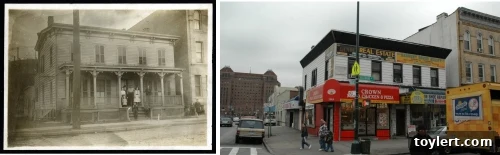
It was with this understanding of Brooklyn’s dual nature – its propensity for dynamic change and its unexpected pockets of steadfast preservation – that I encountered a compelling archival photograph. The image depicted a quintessential wood-framed house, its inviting porch graced by a family frozen in time, an idyllic scene from a bygone era. Given the city’s relentless pace of development, my immediate, almost instinctive thought was that such a structure, particularly one so seemingly fragile and common, must have long since vanished. The odds, I believed, were overwhelmingly stacked against its survival. Yet, as I would soon discover, my assumption was profoundly mistaken. The house at Nostrand and Parkside avenues, against all conventional expectations, stands today as a remarkable testament to Brooklyn’s enduring spirit.
New York City: A Canvas of Constant Reinvention and Urban Development
From its humble beginnings as New Amsterdam, New York City has been characterized by an insatiable appetite for growth and transformation. Each generation has left its indelible mark, often by erasing the footprints of its predecessors. The city’s landscape is a dynamic palimpsest, where every new skyscraper, every modern apartment complex, frequently rises from the ashes of an older structure. Real estate in New York isn’t merely property; it’s a commodity of unparalleled value, fueling a cycle where profit often dictates progress, and the venerable often makes way for the lucrative and contemporary.
This perpetual cycle of renewal is deeply ingrained in the city’s DNA. Landmark status protects a precious few – the grandest cathedrals, the most architecturally significant towers, the homes of historical titans. But for the vast majority of older buildings, especially those deemed ordinary, functionally obsolete, or simply past their prime, their fate is often sealed by developers eyeing opportunities for higher density, greater efficiency, or more contemporary aesthetics. The cultural narrative often favors the sleek, the modern, and the technologically advanced, inadvertently sidelining the charm, character, and historical context that define earlier eras. This mentality, while fostering innovation and economic vitality, also creates a poignant tension between what is lost and what is gained, between cherished memory and ambitious future development.
The skyline of Manhattan, an iconic symbol of human ambition and progress, is perhaps the most vivid illustration of this philosophy. Towers have continuously soared higher, pushing the boundaries of engineering and design, each new edifice striving to outshine its predecessors. While breathtaking, this constant upward trajectory has inevitably led to the systematic replacement of older urban fabric. The city’s rich history is not just found in its surviving monuments but also in the ghosts of countless buildings that once stood, their stories whispered in the wind that sweeps through newly erected canyons of glass and steel, a constant reminder of the city’s ceaseless evolution.
Brooklyn’s Unique Tapestry: History Rooted in Community and Architectural Heritage
In contrast to Manhattan’s skyward thrust and commercial dominance, Brooklyn has historically cultivated a more grounded, community-focused identity. Its growth was less about corporate towers and financial districts and more about vibrant neighborhoods, families, and residential comfort. For centuries, Brooklyn served as New York City’s agrarian breadbasket before evolving into a borough of distinct communities, each with its own rhythm, cultural heritage, and architectural vernacular. This enduring residential focus meant that while change was inevitable, it often unfolded at a more human scale, allowing for a greater sense of continuity and, frequently, preservation.
The architectural progression within Brooklyn is a fascinating journey through time, visibly etched into its streetscapes. One can still find rare vestiges of its rural past in the occasional surviving farmhouse, though these are increasingly treasured and scarce. More common are the elegant wood-framed homes that characterized much of the borough’s expansion in the 19th century, particularly in areas like Flatbush, Crown Heights, Prospect Lefferts Gardens, and Bushwick. These structures, with their intricate details, inviting porches, and distinct gables, represent a crucial chapter in Brooklyn’s development, embodying a sense of domesticity, community, and neighborliness that defined the era. As the city expanded and building codes evolved for greater durability and fire resistance, masonry structures – from the ubiquitous brownstones that give the borough its nickname to grander brick and stone edifices – began to dominate, offering greater permanence and architectural gravitas.
Today, Brooklyn’s architectural landscape is a rich pastiche of these diverse periods, a living testament to its layered history. Modern developments, too, have made their mark, often featuring contemporary designs and sustainable practices. However, they frequently sit side-by-side with century-old homes, creating a vibrant, sometimes jarring, but always compelling dialogue between eras. This eclectic blend is precisely what gives Brooklyn its distinctive charm and makes it a treasure trove for those who appreciate the visual narrative of urban evolution. It’s a place where history isn’t confined to museums but lives on in the very fabric of its streets, in the gables, cornices, stoops, and facades that tell silent stories of generations past, enriching the present with a tangible connection to what came before.
The Enduring Resonance of Architectural Heritage in a Modern City
Buildings are far more than just bricks, mortar, and wood; they are profound vessels of memory, silent witnesses to human lives, societal shifts, and cultural milestones. They provide a tangible link to our collective past, grounding us in a world that often feels in constant flux. The emotional connection people forge with old structures is profound, often stemming from personal histories – a cherished childhood home, a beloved local shop, a community gathering place where significant events unfolded. When such buildings are threatened or lost, it can feel as though a piece of personal or communal identity is also irrevocably erased, leaving a void that new construction, no matter how grand, can rarely fill.
Preserving architectural heritage is not merely an aesthetic choice; it is an act of deep cultural stewardship and a recognition of historical value. These structures offer invaluable insights into past architectural styles, building techniques, and social customs, allowing future generations to learn directly from the physical environment of their predecessors. They contribute significantly to the unique character and authentic sense of place that makes a neighborhood distinctive, fostering community pride and a deeper appreciation for history. In a rapidly globalizing and homogenizing world, retaining these unique markers becomes even more critical, ensuring that our cities don’t become indistinguishable landscapes of generic glass and steel, but maintain their unique stories and identities.
The challenge of preservation, however, is immense. Urban environments are dynamic ecosystems, constantly balancing the needs of growth and economic development with the equally strong desire for heritage conservation. The economic pressures can be overwhelming, often pitting the short-term gains of new construction against the long-term cultural value of existing structures. This ongoing tension creates a perpetual battle for advocates of preservation, who tirelessly work to identify, protect, and adapt historic buildings for contemporary use, ensuring their survival for future generations. Sometimes, however, against all odds and the prevailing trends, a truly unexpected gem endures, standing as a quiet beacon of resilience and a testament to the power of permanence amidst change.
A Glimpse Into the Past: The Resilient Home at Nostrand and Parkside
It was against this rich backdrop of urban transformation and the often-grim prospects for older buildings that my attention was captured by a particularly evocative archival photograph. The image was a captivating snapshot of early 20th-century Brooklyn life: a charming, two-story wood-framed house, its façade adorned with classic Victorian-era detailing, and a family posed on its inviting front porch, seemingly enjoying a warm afternoon. The entire scene spoke volumes of a quieter era, of neighborhood life unfolding at a leisurely pace, and of the prevalent architectural style that once defined much of outer Brooklyn. My mind, conditioned by years of witnessing historical structures disappear with alarming regularity, immediately concluded that this picturesque home must surely be a relic of the past, long since demolished to make way for something larger, newer, or simply more profitable.
Wood-framed houses, while undeniably beautiful and historically significant, are often perceived as less durable than their masonry counterparts, especially in a dense urban environment where the threats of fire, decay, and aggressive redevelopment are constant. The very materials and construction methods that lend them their unique charm can also render them more vulnerable to the relentless march of progress. Therefore, my assumption that this particular dwelling had fallen victim to the inevitable forces of urban growth felt entirely rational, even inevitable. It was a beautiful piece of history, I thought, now existing only in monochrome, a phantom of a forgotten time. The notion that it could still stand, essentially intact, in the vibrant, ever-evolving landscape of contemporary Brooklyn seemed almost fanciful, a romantic ideal rather than a present reality.
But my initial assessment, rooted in the conventional wisdom of urban development, proved to be delightfully and profoundly incorrect. Driven by a lingering curiosity and a flicker of hope, I decided to verify my assumption, to trace the exact location shown in the photograph. What I discovered upon visiting the site was a truly remarkable and heartening sight: the very same wood-framed house, albeit with the undeniable patina of age and some subtle, thoughtful modifications, still proudly occupied its original corner at Nostrand and Parkside avenues. It was a moment of genuine surprise and immense satisfaction, a powerful reminder that history sometimes holds on with unexpected tenacity, defying the often-harsh realities of urban change.
Today, the house stands not just as a structure, but as a living testament to time’s passage and architectural resilience. While the family on the porch from the old photograph is long gone, replaced by new residents who undoubtedly appreciate its unique character, the essential form and charm of the structure remain remarkably consistent. Its clapboard siding, though perhaps repainted multiple times over the decades, still evokes its original warmth. The intricate trim work, the inviting porch, and the overall silhouette are undeniably recognizable from the old photograph, bridging the decades with remarkable integrity. It might now be flanked by more contemporary buildings, have updated windows, or boast subtle modern amenities within, but its historic essence is undeniable and palpable. This survival is not just an architectural curiosity; it’s a tangible, breathing link to Brooklyn’s rich past, eloquently defying the often-ruthless realities of urban development and serving as a beacon of enduring heritage.
Why These Architectural Survivals Matter: Tangible Links to Our Past
The discovery of the Nostrand and Parkside house, still standing against the relentless tide of change, is more than just a quaint anecdote; it’s a powerful illustration of the profound resilience of history within the urban fabric. These surviving structures serve as invaluable anchor points, offering tangible connections to a past that might otherwise feel distant and abstract, confined to history books or faded photographs. They allow us to walk through the same doorways, gaze from the same windows, and imagine the lives of those who came before us, fostering a deeper sense of continuity, empathy, and belonging within our communities.
Such discoveries challenge the prevailing narrative that everything old must eventually yield to the new. They remind us that preservation isn’t always exclusively about grand, architecturally significant monuments; it’s also, and perhaps more importantly, about the everyday buildings that formed the backbone of communities, the homes that sheltered generations, and the streetscapes that shaped countless ordinary lives. Each preserved building, no matter its scale, tells a unique story, contributing immeasurably to the rich, layered narrative of a city. The wood-framed house at Nostrand is a silent historian, whispering tales of Brooklyn’s residential evolution, its community spirit, and the enduring appeal of its vernacular architectural styles, offering invaluable lessons from a bygone era.
Moreover, these unexpected survivals inspire a profound sense of hope and a renewed appreciation for the tireless efforts of preservationists, local historical societies, and engaged community members. They demonstrate that with vigilance, careful stewardship, and sometimes just sheer luck, precious pieces of our urban heritage can indeed be saved, adapted, and celebrated. They encourage residents and visitors alike to look beyond the obvious, to seek out the hidden histories embedded in their surroundings, and to question the assumptions about what true progress entails. Is it always about replacing the old with something entirely new, or can it sometimes be about integrating, adapting, and reverently celebrating what already exists, ensuring that the past informs and enriches the present?
Balancing Progress and Heritage: Brooklyn’s Future Landscape
The story of the Nostrand and Parkside house underscores a critical ongoing debate in urban planning: how to effectively balance the undeniable need for progress and economic development with the equally vital imperative of preserving our architectural and cultural heritage. Cities like Brooklyn are constantly grappling with this tension. While new construction brings essential economic opportunities, modern infrastructure, and often much-needed housing solutions, it can also threaten the very unique character and historical charm that makes these places distinct and desirable, risking the homogenization of urban spaces.
In this delicate balance, community activism, robust zoning regulations, and the tireless work of historical societies play increasingly crucial roles. Initiatives promoting adaptive reuse – thoughtfully transforming historic buildings for new purposes rather than demolishing them – offer innovative and sustainable solutions that honor the past while effectively serving contemporary needs. Such forward-thinking approaches recognize that sustainable urban development isn’t solely about building anew but also about intelligently leveraging existing assets, respecting historical context, and fostering a deep sense of continuity across generations, creating truly livable and historically rich environments.
In conclusion, Brooklyn stands as a magnificent testament to the layers of history that profoundly define New York City. It is a borough where the past and present coexist in a dynamic, sometimes harmonious, sometimes challenging dialogue. The surprising endurance of the wood-framed house at Nostrand and Parkside is a potent and inspiring symbol of this resilience. It reminds us that even in the most rapidly developing urban environments, whispers of earlier eras can persist, offering profound insights into the city’s complex journey. These architectural survivors are not just old buildings; they are precious, tangible links to our collective memory, inviting us to look closer, to appreciate the myriad stories embedded in every street corner, and to cherish the enduring spirit of a city that truly never sleeps, but always, always remembers.