Unveiling the Hidden World: Jehovah’s Witnesses’ Subterranean Tunnels Beneath Brooklyn Heights
Beneath the historic and picturesque streets of Brooklyn Heights, a secret world once thrived, largely unseen by the bustling city above. This hidden network of subterranean tunnels served as a vital, yet private, artery for the Jehovah’s Witnesses, connecting their extensive portfolio of properties in a logistical marvel of urban infrastructure. Far from the stuff of urban legend, these passageways offered practical solutions for a religious organization that had made Brooklyn its global headquarters for over a century, leaving behind a fascinating legacy that continues to intrigue residents and historians alike.
The Jehovah’s Witnesses, with their distinct presence and formidable real estate holdings, were an integral part of the Brooklyn landscape for many decades. Their departure from Brooklyn to their new headquarters in Warwick, New York, marked the end of an era, but the echoes of their unique footprint, particularly their underground infrastructure, remain a captivating chapter in the borough’s history. These tunnels represent more than just connecting pathways; they symbolize the intricate planning and self-sufficiency that characterized the Watchtower Society’s operations in New York City.
The Watchtower’s Enduring Legacy in Brooklyn Heights and DUMBO
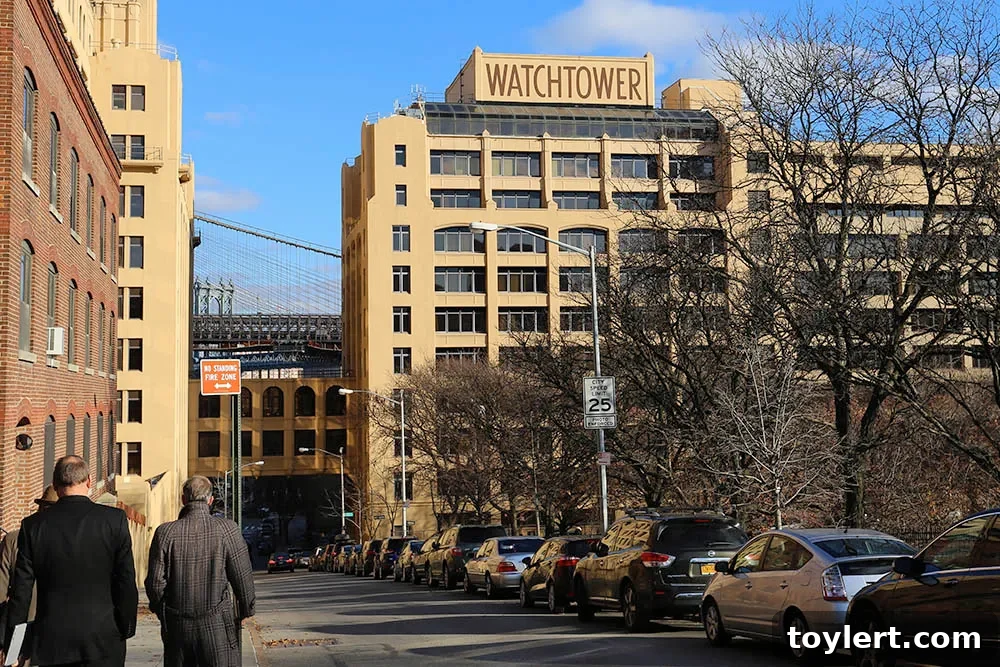
For over a century, the Jehovah’s Witnesses established a profound and indelible presence in Brooklyn, transforming large sections of Brooklyn Heights and the then-industrial DUMBO neighborhood into their operational hub. Arriving in Brooklyn in 1909, the Watchtower Society began steadily acquiring properties, eventually amassing a sprawling portfolio of commercial and residential buildings. These weren’t just any buildings; they included iconic structures like the former Squibb pharmaceutical complex, historic industrial loft buildings converted into printing facilities, and numerous residential buildings for their members.
This massive real estate footprint wasn’t merely for administrative offices; it supported a vast, self-sufficient community. The Jehovah’s Witnesses ran their own printing presses, producing millions of publications annually that were distributed worldwide. They maintained their own residences, dining facilities, and support services for thousands of volunteers who dedicated their lives to the organization’s mission. Their impact on the local economy and urban fabric was undeniable, even if their internal operations remained largely private and distinct from mainstream Brooklyn life.
The concentration of their properties, often spread across multiple city blocks in a dense urban environment, necessitated innovative solutions for connectivity and efficiency. Moving personnel, materials, and utilities between buildings on busy city streets presented logistical challenges that led to the development of their remarkable subterranean network. This network became an unseen but crucial element of their self-contained world, a testament to their dedication to operational excellence.
Delving into the Depths: The Structure and Purpose of the Tunnels
At the heart of this unique infrastructure were a series of at least four subterranean tunnels, designed as private pedestrian walkways. These hidden passageways snaked beneath some of Brooklyn Heights’ most prominent thoroughfares, specifically Orange Street, Columbia Heights, and Willow Street. Their strategic placement allowed seamless movement between several key Watchtower Society properties, bypassing the need for surface-level travel and the associated traffic, weather, and security concerns.
The primary function of these tunnels was to provide convenient, interconnecting passageways for members of the Jehovah’s Witnesses. This allowed personnel to move efficiently between their residences, offices, and printing facilities without ever having to step onto the public streets. Imagine the ease of transitioning from a residential building to a workplace during harsh winter weather or peak traffic hours, all within a climate-controlled, secure environment. This level of internal connectivity fostered a sense of community and operational fluidity that was paramount to the Watchtower’s highly organized structure.
Beyond pedestrian transit, some of these tunnels were ingeniously utilized for utility services. This is a common practice in modern urban planning and large institutional campuses, but for a private entity operating under public streets, it represented a significant feat of engineering and negotiation. These utility tunnels likely housed essential infrastructure such as power lines, data cables, water pipes, and perhaps even heating and cooling conduits, further enhancing the self-sufficiency and operational resilience of the Watchtower’s Brooklyn complex. By channeling utilities underground, the organization reduced reliance on overhead lines and surface-level disruptions, contributing to the aesthetic and functional integrity of their properties.
Reality vs. Urban Myth: The True Appearance of the Watchtower Tunnels
When the idea of secret underground tunnels beneath a bustling city like Brooklyn Heights is invoked, the imagination often runs wild. Tales of dark, cavernous, perhaps even mysterious or haunted passages might spring to mind, fueled by urban myths and fictional narratives. However, the reality of the Jehovah’s Witnesses’ tunnels was far more pragmatic and, in some ways, even more fascinating for its sheer ordinariness.
As one image published in the New York Times revealed, these passageways bore little resemblance to the dramatic settings of speculative lore. Instead, they were designed with function and efficiency in mind, appearing much more like the sterile, well-maintained corridors of a modern hospital than any shadowy, hidden lair. Descriptions consistently highlight their practical aesthetic: linoleum flooring, characteristic fluorescent lighting that bathed the passageways in a consistent, bright glow, and light-colored walls. This design choice speaks volumes about their intended use – not for clandestine activities, but for safe, clean, and efficient daily transit and utility management.
The clean, brightly lit environment ensured safety and ease of navigation for hundreds, if not thousands, of individuals moving between buildings daily. The choice of durable, easy-to-clean materials like linoleum underscored a commitment to practicality and maintenance, reflecting the Watchtower Society’s meticulous approach to managing their extensive facilities. This stark contrast between public perception and actual design only adds to the unique allure of these tunnels, highlighting their role as a highly functional, if largely unseen, component of the organization’s daily life in Brooklyn.
The Legal Framework: Navigating Public Space for Private Use
The existence of private infrastructure beneath public streets in a dense urban environment like New York City is not a simple undertaking. It requires meticulous planning, stringent engineering, and, crucially, robust legal agreements with city authorities. The Jehovah’s Witnesses’ tunnels were allowed to exist and operate under a specific 10-year contract with two pivotal city departments: the Department of Transportation (DOT) and the Department of Information Technology and Telecommunications (DIT).
The Department of Transportation’s involvement is self-evident, as any subterranean construction beneath city streets directly impacts public thoroughfares and potentially public utilities. The DOT ensures that such projects are structurally sound, do not compromise the integrity of the street above, and adhere to all safety regulations. Their oversight is critical for managing the vast network of pipes, cables, and subway lines that already exist beneath New York City’s streets.
The Department of Information Technology and Telecommunications’ role further highlights the modern utility of these tunnels, particularly in accommodating data cables and other communication infrastructure. In an era where digital connectivity is paramount, the DIT’s involvement underscores that these tunnels were not just for physical movement but also for the flow of critical information, vital for a global organization like the Watchtower Society. These contracts would have outlined specific terms regarding maintenance, liability, access, and potential renewal clauses, ensuring that the private use of public subterranean space was properly regulated and managed.
This contractual framework demonstrates the Watchtower Society’s ability to navigate complex urban regulations and secure the necessary permissions to realize their unique infrastructural vision. It underscores the institutional weight and logistical prowess required to execute such a project in one of the world’s most densely populated cities.
The Great Exodus: The Fate of the Tunnels After the Watchtower’s Departure
The early 2010s marked a monumental shift for the Jehovah’s Witnesses as they embarked on a phased move of their world headquarters from Brooklyn to a sprawling new campus in Warwick, New York. This relocation precipitated the sale of their vast and valuable real estate holdings in Brooklyn Heights and DUMBO, a process that captivated the New York real estate market and fundamentally reshaped the character of these historic neighborhoods.
With the sale of numerous buildings, a critical question arose: what would become of the unique subterranean tunnels? Were they simply filled in, or did they transfer with the properties above them? The answer, as it turns out, is a mix of practicality and ongoing intrigue. Many of the tunnel sections were indeed sold along with the properties they connected. For instance, the iconic Watchtower complex at 25 Columbia Heights, which included some of the main tunnel connections, was acquired by a consortium including Kushner Companies, CIM Group, and LIVWRK. The new owners reportedly expressed interest in reactivating and repurposing these unique underground links.
The potential for these tunnels to be redeveloped and integrated into new commercial or residential complexes presents an exciting prospect. They could once again serve as private conduits, perhaps connecting different sections of a large mixed-use development, offering convenience for residents or employees, and even housing modern utility infrastructure. The legacy of these tunnels continues, evolving from serving a religious community to potentially facilitating the needs of a new generation of Brooklyn residents and businesses.
A Hidden Piece of Brooklyn’s Enduring Charm
The Jehovah’s Witnesses’ subterranean tunnels are more than just a forgotten relic; they are a fascinating footnote in the rich tapestry of Brooklyn’s urban development. They represent a unique chapter where a private organization, through careful planning and negotiation, carved out its own infrastructure beneath the very foundations of one of New York City’s most storied neighborhoods. They challenge our perceptions of what lies beneath our feet and remind us that even in the most familiar urban landscapes, hidden layers of history and engineering await discovery.
Today, as Brooklyn Heights and DUMBO continue their dynamic evolution, these tunnels serve as a subtle, often unseen, reminder of the Watchtower Society’s profound and pragmatic impact. They stand as a testament to ingenuity, efficiency, and the complex interplay between private enterprise and public space in the ever-changing narrative of New York City.