By Suzanne Spellen (aka Montrose Morris)
The Enduring Legacy of the Sol Goldman Pool: A Red Hook Icon
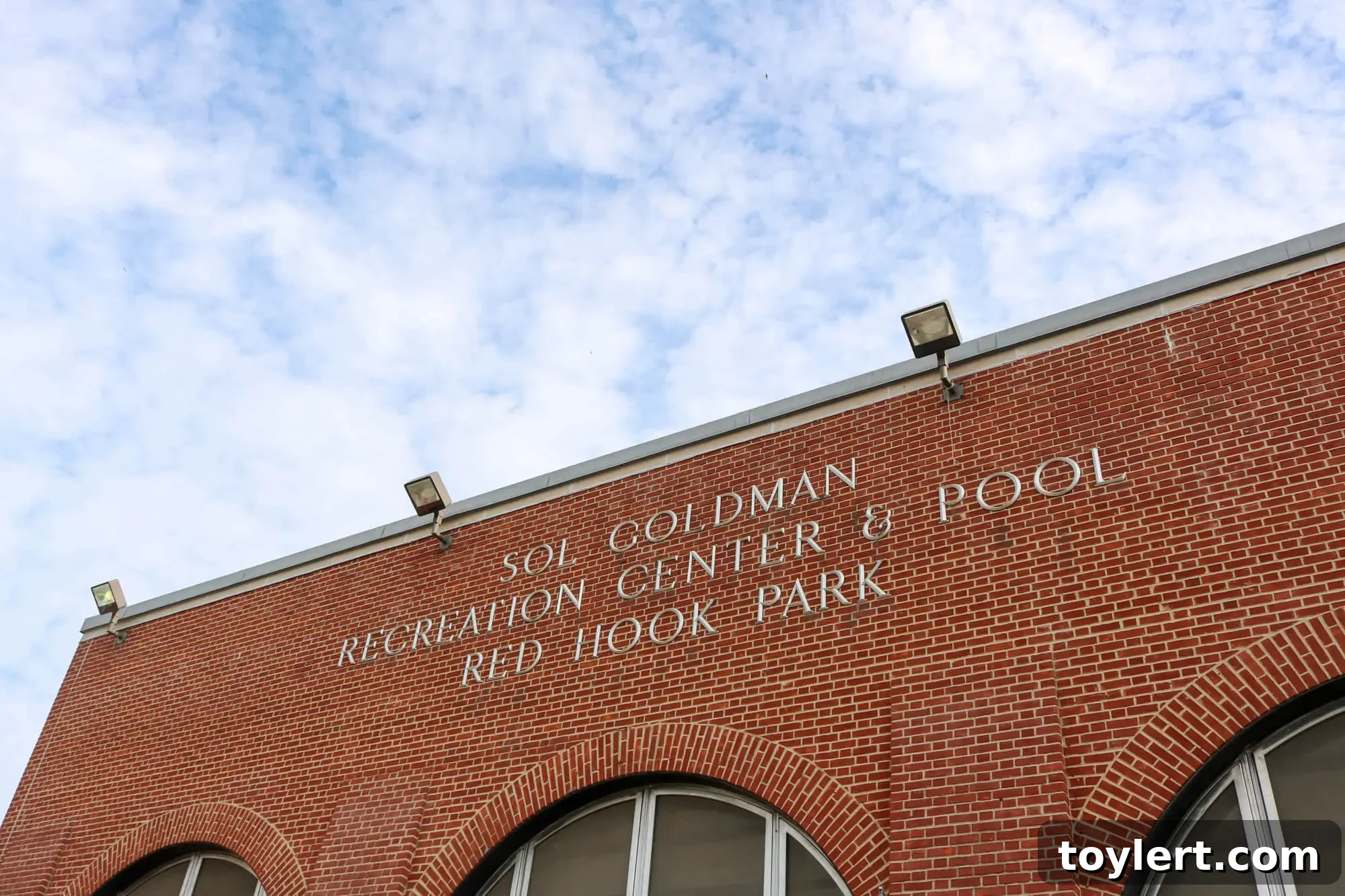
In the vibrant heart of Red Hook, Brooklyn, stands a testament to resilience, community, and forward-thinking urban planning: the Sol Goldman Pool, nestled within the historic Red Hook Play Center at 155 Bay Street. This magnificent public swimming pool, an emblem of New York City’s architectural and social history, owes its very existence to a challenging era – the Great Depression – and the ambitious vision of legendary urban planner Robert Moses. Opened to an eager public in 1936, this landmarked Art Moderne complex, also known as the Red Hook Recreation Center, was designed not just for leisure but as a crucial intervention to improve public health and provide much-needed relief to residents in Brooklyn’s dense, crowded neighborhoods, far removed from the city’s recreational beaches.
Born from Necessity: Public Works During the Great Depression
The 1930s were a period of unprecedented hardship across the United States, and New York City was no exception. The Great Depression cast a long shadow, leading to widespread unemployment, poverty, and a significant decline in public welfare. In response to this crisis, President Franklin D. Roosevelt’s New Deal initiated numerous public works projects aimed at stimulating the economy, putting people back to work, and improving the nation’s infrastructure. In New York City, these efforts were spearheaded by figures like Robert Moses, then the Commissioner of Parks. Moses, a controversial but undeniably influential figure, saw an opportunity to transform the city’s recreational landscape, believing that access to green spaces and public facilities was essential for the well-being of its citizens.
The construction of public pools was a cornerstone of Moses’s ambitious plan. Prior to the 1930s, many New Yorkers, especially those in working-class districts, lacked access to clean, safe swimming facilities. The city’s beaches were often a distant, expensive journey, leaving countless families with limited options for cooling off during scorching summer months. This lack of access contributed to unsanitary conditions and public health concerns. Moses envisioned a network of modern, large-capacity public pools strategically located throughout the five boroughs, designed not only for swimming but as comprehensive recreational centers. The Sol Goldman Pool in Red Hook was a prime example of this grand vision, one of eleven major pools built between 1934 and 1936 with funding from the Works Progress Administration (WPA), a key New Deal agency.
Red Hook: An Industrial Powerhouse and a Community in Need
At the time of the pool’s conception, Red Hook was a bustling industrial hub, a vital artery of New York City’s port operations. Its docks teemed with activity, connecting Brooklyn to global trade routes. Warehouses, factories, and maritime industries dominated the landscape, employing thousands of local residents. This industrial vibrancy, however, often came with its own set of challenges for the community. Housing was frequently dense and modest, and open green spaces or modern recreational facilities were scarce. The working-class families of Red Hook faced long hours and demanding labor, and the summer heat in a port district could be particularly oppressive.
The decision to place such a significant public amenity in Red Hook was a deliberate one. It reflected a commitment to improving the quality of life for the industrial workforce and their families. The pool wasn’t just a place to swim; it was a sanctuary, a community gathering point, and a symbol of hope and progress during an otherwise bleak period. It provided an accessible, affordable escape, fostering a sense of community and offering vital health benefits through exercise and hygiene. The sheer scale of the project, designed to accommodate over 4,462 people simultaneously, underscored the anticipated demand and the city’s dedication to serving its underserved populations.
Architectural Splendor: The Art Moderne Masterpiece
The Red Hook Play Center, with its central Sol Goldman Pool, is a remarkable example of Art Moderne architecture, a style that emerged in the 1930s as a sleeker, more streamlined evolution of Art Deco. Characterized by its monumental scale, smooth wall surfaces, rounded corners, large windows, and an emphasis on functionality and efficiency, Art Moderne was perfectly suited for large public buildings. The complex was meticulously designed by a team of architects from the NYC Parks Department, showcasing a forward-thinking aesthetic combined with practical utility. Its layout included not only the massive main pool but also diving pools, wading pools for children, bathhouses, gymnasiums, and various outdoor recreation areas.
The choice of materials and construction techniques reflected the era’s focus on durability and modern engineering. Reinforced concrete, brick, and often glazed tiles were used, creating a clean, crisp, and robust structure. The streamlined forms and subtle decorative elements of the Red Hook complex evoke a sense of movement and modernity, capturing the optimism that public works projects aimed to instill. This architectural distinction earned the Red Hook Play Center its well-deserved landmark status, recognizing its significance not just as a recreational facility but as a cultural and historical monument. It stands as a physical embodiment of the era’s belief in progress and the power of public investment in improving urban life.
A Grand Opening and Enduring Impact
When the Red Hook Play Center officially opened its doors in 1936, it was met with immense excitement and celebration. The fanfare surrounding its inauguration was a reflection of the profound impact such facilities had on communities starved for recreational outlets. Thousands flocked to witness the grand unveiling, eager to experience a piece of the modern world that promised leisure and respite. For many children and adults in Red Hook, it was their first opportunity to swim in a state-of-the-art facility, a stark contrast to swimming in the polluted Gowanus Canal or the often-inaccessible shores.
Over the decades, the Sol Goldman Pool has continued to serve as a cornerstone of the Red Hook community. It has witnessed generations learn to swim, families gather for summer fun, and individuals find a place for exercise and relaxation. Despite the ebb and flow of urban development and social changes, the pool has maintained its essential role as an accessible public space. Its continued operation is a testament to the enduring value of well-planned public amenities and the foresight of those who championed its creation during one of the nation’s most challenging periods.
The Legacy of Public Pools in NYC Today
The Sol Goldman Pool is one of many public pools across New York City that continue to be vital community resources. These pools, many of which are WPA-era masterpieces, represent a significant part of the city’s historical infrastructure and social fabric. They provide safe, supervised environments for swimming, a critical life skill, and a healthy activity that remains accessible to all New Yorkers, regardless of income or background. In an increasingly privatized world, these public facilities stand as symbols of democratic access to recreation and well-being.
The story of the Sol Goldman Pool is more than just the story of a swimming facility; it is a narrative of community resilience, governmental investment in public welfare, and architectural innovation. It reminds us how powerful thoughtful urban planning can be in shaping lives and fostering vibrant communities. From the depths of the Great Depression, an enduring landmark emerged in Red Hook, a place where history, recreation, and community converge, continuing to serve as a cool oasis and a cherished gathering place for Brooklynites to this very day.