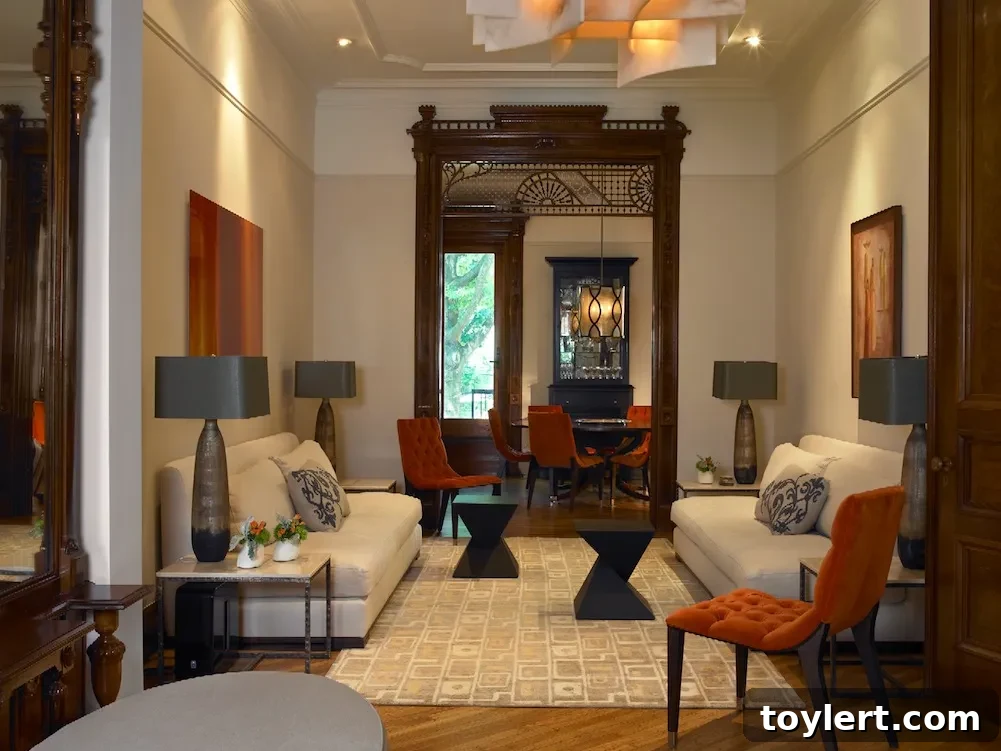
Revitalizing Historic Brownstones: A Masterclass in Blending Old and New in Park Slope
For prospective homeowners in Brooklyn, the allure of an authentic brownstone is often irresistible. This is especially true in sought-after neighborhoods like Park Slope, where the architectural grandeur and historical richness are palpable. High on the “want” list for many is the preservation of intact original woodwork—a feature that instantly connects a residence to its past. Yet, once these cherished properties are acquired, a common and fascinating design challenge emerges: how does one harmoniously integrate elaborately carved moldings, ornate doors, and intricate millwork, often legacies of Victorian artistry, with the clean lines and functional demands of contemporary living?
This precise dilemma presented itself to a family who recently purchased a magnificent four-story, one-family brownstone in Park Slope. This particular late Victorian edifice was a treasure trove of historical detail. Its interior boasted woodwork in superb, original condition, featuring intricate carvings that hinted at the sophisticated influences of Classical Revival and the artistic nuances of the Aesthetic Movement, charmingly interspersed with touches of what might be described as “gingerbread” detailing. For the new homeowners—a couple deeply involved in education and raising a young son—these meticulously preserved architectural elements were a significant draw, representing the home’s rich heritage.
The Vision: Modern Sensibility Meets Historic Grandeur
Despite their profound appreciation for the brownstone’s historical integrity and its stunning original details, the family harbored a clear vision for its interiors: they desired a decidedly contemporary feeling. They aspired to create a home that resonated with their modern lifestyle, offering comfort, functionality, and a fresh aesthetic, all while respectfully honoring the building’s inherent antique charm. Achieving this delicate equilibrium required a seasoned design professional who could deftly bridge the gap between two distinct design eras.
Recognizing the specialized nature of such a project, the homeowners wasted no time in engaging the expertise of acclaimed Brooklyn Heights designer, Kathryn Scott. Tasked with furnishing the house in its entirety—the family brought with them only a couple of cherished chairs and some personal artwork from their previous residence—Scott embarked on crafting a cohesive and harmonious environment from the ground up. Her mission was to artfully reinterpret the ornate Victorian aesthetic through a modern lens, culminating in spaces that felt both timelessly elegant and decidedly current.
Kathryn Scott’s Design Philosophy: Neutralizing Ornate Detail with Simplicity
Kathryn Scott’s approach to the Park Slope brownstone project was founded on a deep reverence for the home’s historical provenance, seamlessly combined with an acute understanding of contemporary design principles. As Scott herself articulated, her guiding strategy was to “gravitate toward simplicity to neutralize the ornate detail.” This philosophy transcends mere stylistic preference; it represents a strategic design decision calculated to foster visual harmony and allow the home’s historical elements to truly flourish, rather than being overshadowed or overwhelmed by competing decorative features.
At its core, Scott’s method involved a thoughtful reduction of visual complexity. Rather than introducing additional intricate patterns, heavy fabrics, or elaborate furnishings that might vie for attention, she opted for a streamlined and understated aesthetic. This choice created a serene and uncluttered backdrop, against which the elaborate Victorian woodwork could emerge as the undeniable artistic focal points. By deliberately simplifying the surrounding elements, Scott masterfully ensured that the home’s original character remained the celebrated star of the show, telling its story without undue competition.
The Power of a Strategic Color Palette and Clean-Lined Furnishings
A cornerstone of Scott’s transformative design strategy was the careful curation of a pale, muted wall color palette. These soft, often neutral hues served multiple crucial functions: they beautifully reflect natural light, thereby enhancing the sense of spaciousness and airiness throughout the interiors. More importantly, they provided a calm, unobtrusive canvas that allowed the rich tones and intricate carvings of the Victorian woodwork to gain a heightened sense of presence and depth. This deliberate choice of light, understated colors effectively makes the warmth and detail of the wood “pop,” transforming what could potentially be an overwhelming historical feature into an exquisite, integrated highlight.
To complement the serene wall colors, Scott meticulously selected furnishings described as “pared-down” and “clean-lined.” This meant choosing pieces characterized by simple silhouettes, minimal ornamentation, and a clear sense of functional elegance. Imagine inviting sofas with subtle, textured upholstery, streamlined coffee tables crafted from natural materials, and lighting fixtures that offer sophisticated illumination without demanding undue attention. These contemporary furniture choices create a striking yet harmonious contrast with the historic architectural details. This carefully considered juxtaposition prevents the interiors from feeling heavy, dated, or museum-like, instead infusing them with a refreshing sense of modern sophistication and livability.
Enhancing Beauty by Diminishing Distractions
The true brilliance of Kathryn Scott’s design approach resides in its profound ability to enhance the intrinsic beauty of the brownstone’s original features by strategically “diminishing other distractions that would compete.” This principle is absolutely central to achieving a balanced and elegant aesthetic within historic homes. When every single element in a room clamors for attention, the overall effect can quickly become chaotic and visually fatiguing. Scott, however, meticulously curated a space where each component plays a specific, supportive role, working in concert to celebrate the home’s unique and preserved character.
By consciously opting for simplicity across furniture, textiles, and decorative accessories, Scott ensured that the eye is naturally drawn to the architectural marvels embedded within the brownstone. The intricately carved fireplace mantels, the detailed wainscoting that lines the walls, and the grand, sweeping staircases are no longer mere background elements; they are elevated to cherished pieces of art within the home. This intentional restraint in decorative choices allows the exquisite craftsmanship of a bygone era to be truly appreciated in a contemporary context, definitively proving that modern living and a deep reverence for history can not only coexist but flourish beautifully together.
A Holistic Approach to Historic Home Renovation
Redesigning and revitalizing a historic brownstone demands significantly more than just selecting decor; it requires a comprehensive and holistic understanding of the structure itself, its rich history, and its latent potential for modern living. Scott’s all-encompassing approach, which involved furnishing the entire house, vividly demonstrates the invaluable benefit of a unified design vision. From the moment one steps into the entrance foyer to the privacy of the uppermost living quarters, every space was thoughtfully considered as an integral part of a larger, coherent narrative. This meticulous planning allowed for seamless transitions and the maintenance of a consistent aesthetic that gracefully flows throughout all four stories of the brownstone, creating a truly unified sanctuary.
Furthermore, the discreet integration of modern amenities was undoubtedly a key consideration in this comprehensive renovation. While the article does not explicitly detail every technological upgrade, a designer of Kathryn Scott’s caliber would invariably ensure that contemporary conveniences—ranging from smart home technology to state-of-the-art kitchen appliances and luxurious bathroom fixtures—are incorporated in a manner that profoundly respects the historical envelope. The overarching goal is always to forge a fully functional and comfortable 21st-century home that never feels anachronistic or out of place within its elegant 19th-century shell. It’s about empowering modern living within a historical context.
The Enduring Appeal of Blending Eras and Creating Timeless Spaces
The resounding success of this Park Slope brownstone project lies in its masterful demonstration of how to honor and preserve historical architecture while simultaneously embracing the demands and aesthetics of modern living. It powerfully challenges the conventional notion that historic homes must be meticulously preserved as time capsules, instead proving that they can gracefully evolve and adapt to meet contemporary needs and tastes. The seamless fusion of intricate Victorian detailing with clean, minimalist design elements results in interiors that are not only sophisticated and aesthetically pleasing but also profoundly inviting and comfortable for daily life.
This innovative design approach offers invaluable lessons for anyone contemplating the renovation of a historic property. It underscores the paramount importance of thoughtful curation, strategic simplification, and harnessing the transformative power of contrast. By allowing the original character of a home to inform and dictate certain design choices, and then carefully introducing well-chosen modern counterparts, homeowners can achieve a truly unique, personalized, and deeply resonant space. This space not only tells a compelling story of past and present but also serves as a comfortable, functional sanctuary. The brownstone now stands as a beacon of balanced design, a comfortable family home that proudly showcases its heritage while fully embracing the dynamism and vibrancy of modern Brooklyn life.
In essence, Kathryn Scott’s exceptional work on this Park Slope brownstone serves as an inspiring blueprint for sophisticated contemporary brownstone interior design. It beautifully exemplifies how expert design can ingeniously transform a potential design conflict—the ornate versus the modern—into a harmonious, breathtaking, and deeply livable resolution. Such projects ensure that historic homes are not merely preserved relics, but dynamic, vibrant, and cherished spaces for generations to come, embodying the best of both worlds.