The Strand Theatre: A Landmark Reimagined for the Digital Age in Brooklyn’s BAM Cultural District
Brooklyn’s cultural landscape is perpetually evolving, a vibrant tapestry woven from historical legacies and innovative futures. At the heart of this dynamic transformation stands the iconic Strand Theatre, a building with a rich, multifaceted past now brilliantly reimagined for the 21st century. What was once a grand vaudeville palace, then a movie house, a bowling alley, and even a manufacturing space, has undergone a breathtaking $40 million renovation, positioning it as a pivotal hub within the bustling BAM Cultural District.
This ambitious revitalization project, highlighted in a Wall Street Journal story, showcases a visionary approach to adaptive reuse, blending historical reverence with a bold embrace of modernity. The transformation, helmed by the renowned architect Thomas Leeser, is more than a mere facelift; it’s a philosophical statement, aiming to redefine how historical structures can serve contemporary artistic and community needs. The Strand Theatre is not just being restored; it’s being reinvented as a “citizen of the digital age,” a place where art, technology, and community converge.
A Storied Past: Tracing the Strand Theatre’s Legacy
The history of the Strand Theatre is a quintessential Brooklyn narrative, reflecting the borough’s own journey through the decades. Built in 1918, during the golden era of live entertainment, it first opened its doors as a magnificent vaudeville theatre. Vaudeville, with its eclectic mix of comedians, musicians, dancers, and novelty acts, was the dominant form of popular entertainment in America, and the Strand would have bustled with excited crowds, eager to witness the spectacle on its grand stage.
As the tastes of the nation shifted with the advent of motion pictures, the Strand seamlessly transitioned into a glamorous movie house, becoming a beloved local spot where residents could escape into the magic of the silver screen. The theatre bore witness to the evolution of cinema, from silent films to talkies, and through Hollywood’s most iconic periods.
However, like many grand entertainment venues, the Strand faced new challenges in the mid-20th century. By the 1950s, it took on an entirely different persona, being converted into a bowling alley – a testament to changing leisure activities and the need for buildings to adapt. This period further cemented its place in the community, albeit in a different guise. Later still, it served as a manufacturing space, a reflection of Brooklyn’s industrial heritage, its walls silently holding the memories of past grandeur and bustling production.
This remarkable lineage underscores the building’s resilience and its deep connection to Brooklyn’s social and economic history. The current renovation project recognizes this rich past, not by erasing it, but by weaving it into a forward-looking design, ensuring the Strand’s legacy continues for generations to come.
The Visionary Renovation: Reimagining a Cultural Icon
Thomas Leeser’s “Deliberate Irreverence”: A Bold Architectural Statement
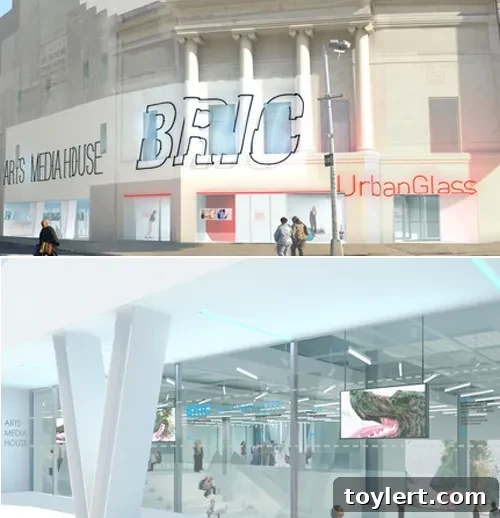
At the heart of the Strand Theatre’s rebirth is the provocative vision of architect Thomas Leeser. His approach to renovation is anything but conventional, characterized by what he terms “deliberate irreverence.” This philosophy is most strikingly evident at the theatre’s entryway, where the traditional Ionic columns – symbols of classical architecture and theatrical grandeur – are treated with a modern, almost playful defiance. Instead of meticulously restoring them to their original state, Leeser’s plans involve a bold intervention: spelling out the word “BRIC” in vibrant fluorescent lights directly on the entryway. This decision, as Leeser himself articulates, aims to “eliminate this classical, iconic facade as the symbol of all theaters,” instead imbuing the building with a contemporary identity that speaks to its new purpose.
This artistic choice is a powerful commentary on the dialogue between history and innovation. It challenges preconceived notions of preservation, suggesting that honoring a building’s past doesn’t always mean rigid replication. Instead, it can involve a dynamic reinterpretation that acknowledges history while firmly planting the structure in the present and future. Leeser’s design is not just about aesthetics; it’s about making a statement, transforming the Strand from a static monument into an active participant in contemporary cultural discourse.
A New Home for Creativity: BRIC Arts and Urban Glass
The driving force behind the Strand Theatre’s transformation is its new role as the permanent home for two of Brooklyn’s most esteemed cultural organizations: BRIC Arts and Urban Glass. This strategic co-location creates a powerful synergy, establishing a dynamic hub for diverse artistic expression.
- BRIC Arts: As a leading presenter of free and low-cost cultural programming, BRIC Arts champions artistic innovation and community engagement. Its mission encompasses a broad spectrum of disciplines, including performing arts, contemporary art, and community media. By housing BRIC, the Strand Theatre becomes a vibrant incubator for new works, a stage for compelling performances, and a crucial platform for local artists and media creators. This move significantly expands BRIC’s capacity to serve Brooklyn’s diverse communities, offering accessible pathways to artistic discovery and participation.
- Urban Glass: Complementing BRIC’s multidisciplinary focus is Urban Glass, one of the nation’s largest and finest public access glass centers. Urban Glass provides state-of-the-art facilities for glass artists, offering workshops, studio space, and exhibitions. Its presence within the Strand complex introduces a unique visual arts dimension, fostering craftsmanship and innovation in glass artistry. The juxtaposition of a historic theatre space with the cutting-edge practices of glassmaking creates an exciting cross-pollination of ideas and audiences.
The shared space allows both organizations to collaborate, innovate, and reach wider audiences, solidifying the Strand’s position as a multifaceted cultural beacon. This integrated approach leverages the strengths of each institution, creating a truly unique artistic ecosystem.
Becoming a “Citizen of the Digital Age”: Interactive Art and Technology
A central tenet of the Strand’s reinvention is its aspiration to become a “citizen of the digital age.” This concept extends beyond mere technological integration; it embodies a philosophy of interactivity, accessibility, and dynamic engagement. The renovation strategically incorporates digital elements that redefine the visitor experience, making art more approachable and immersive.
A prime example of this digital transformation can be found on the Rockwell Place side of the building. Here, “monitors installed in modules in front of the lobby’s seating allow visitors to view interactive art projects.” This innovative feature transforms passive viewing into active participation. Visitors are not just observers; they become part of the artistic narrative, engaging with digital installations that respond to their presence or input. This fusion of architecture, technology, and art creates a living, breathing space that constantly evolves and offers new perspectives.
This embrace of digital media reflects a broader trend in cultural institutions, acknowledging the pervasive influence of technology in contemporary life. By integrating interactive digital art, the Strand Theatre positions itself at the forefront of cultural innovation, offering experiences that resonate with a digitally-native audience while also inviting those less familiar with digital art to explore its possibilities. It’s a testament to the belief that historical spaces can gracefully accommodate, and even champion, the art forms of tomorrow.
The BAM Cultural District: A Hub of Innovation
The Strand Theatre’s revitalization is inextricably linked to its location within the Brooklyn Academy of Music (BAM) Cultural District. This vibrant nexus in Fort Greene, Brooklyn, is home to a concentrated collection of world-class arts organizations, educational institutions, and creative businesses. The district’s evolution into a thriving cultural destination has been a decades-long effort, aimed at creating a diverse and accessible arts ecosystem.
The integration of the reimagined Strand Theatre, housing BRIC Arts and Urban Glass, significantly amplifies the district’s offerings. It adds another layer of artistic diversity and community engagement, reinforcing BAM Cultural District’s reputation as a dynamic hub for performing, visual, and media arts. This concentration of cultural assets not only enriches the lives of Brooklyn residents but also draws visitors from across the city and beyond, stimulating local economic growth and fostering a palpable sense of community pride.
Investment in the Future: The $40 Million Transformation
The scale of this project is underscored by its substantial $40 million budget. Such a significant investment reflects a profound commitment to cultural enrichment and urban renewal. Funding for projects of this magnitude typically comes from a blend of public and private sources, including government grants, philanthropic donations, and capital campaigns. This financial commitment signals the value placed on preserving architectural heritage while simultaneously fostering contemporary artistic expression and community development.
The ambitious timeline set for the renovation aimed for completion in 2013, a testament to the urgency and vision behind transforming this historic structure into a modern cultural powerhouse. This investment was not merely in bricks and mortar; it was an investment in Brooklyn’s future, in its artistic community, and in its enduring appeal as a vibrant urban center.
Adaptive Reuse and Urban Renewal: A Model for Sustainable Development
The renovation of the Strand Theatre stands as a powerful exemplar of adaptive reuse – the process of repurposing old buildings for new functions. In an era where sustainability and the intelligent use of existing resources are paramount, adaptive reuse offers numerous benefits:
- Environmental Sustainability: It reduces the demand for new construction materials and minimizes demolition waste.
- Preservation of Heritage: It safeguards historical structures, maintaining the unique character and narrative of urban environments.
- Economic Revitalization: It can breathe new life into neglected areas, attracting investment and creating jobs.
- Community Identity: It reinforces a sense of place and continuity, linking past, present, and future generations.
The Strand Theatre project demonstrates how a building that has served multiple purposes throughout its history can be reinvented yet again, not just surviving but thriving. By transforming a former vaudeville theater and manufacturing space into a cutting-edge cultural center, the project highlights the immense potential of existing urban fabric to meet contemporary needs and aspirations.
Conclusion: The Strand Theatre’s Enduring Legacy
The reinvention of the Strand Theatre is a testament to Brooklyn’s spirit of innovation and its deep appreciation for the arts. From its grand beginnings as a vaudeville stage to its current incarnation as a “citizen of the digital age,” the Strand has continuously adapted, reflecting the ever-changing pulse of its borough. Under Thomas Leeser’s visionary hand and with the vibrant presence of BRIC Arts and Urban Glass, the theatre has transcended its historical forms to become a truly modern cultural landmark.
This $40 million transformation represents more than just a building renovation; it is a profound commitment to fostering creativity, engaging communities, and celebrating the dynamic interplay between heritage and innovation. The Strand Theatre now stands not merely as a relic of the past, but as a living, breathing institution, poised to inspire, entertain, and educate for generations to come, a shining beacon within Brooklyn’s illustrious BAM Cultural District.
Designing Brooklyn’s Future [WSJ]