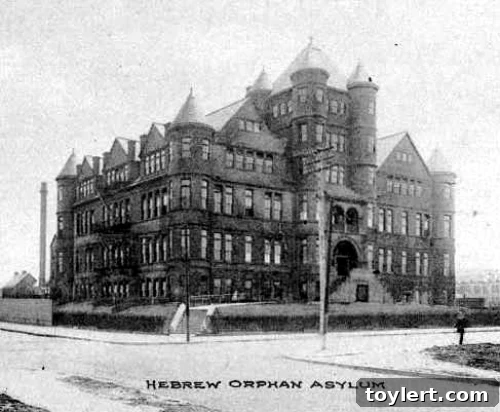
The Genesis of Compassion: Establishing Brooklyn’s Hebrew Orphan Asylum
The closing decades of the 19th century heralded an era of profound transformation for New York City, a vibrant melting pot where diverse communities sought new beginnings and forged their identities. Amidst this rapid urbanization and growth, the Jewish community experienced an unprecedented expansion, fueled by waves of immigration, primarily from Eastern Europe. These newcomers, seeking refuge from persecution and the promise of a better life, brought with them both incredible resilience and significant social challenges. Chief among these was the pressing need to care for the most vulnerable members of their society: orphaned children.
It was against this backdrop of surging population and urgent humanitarian concern that a pivotal event unfolded in 1878. A dedicated group of German Jewish philanthropists converged at Temple Beth Elohim on Keap Street in Brooklyn, united by a singular, compassionate purpose: to establish a dedicated institution for the protection and shelter of Jewish orphans within their borough. This gathering marked a crucial turning point, signaling Brooklyn’s burgeoning self-sufficiency and its commitment to caring for its own.
The Growing Crisis: Overwhelmed Resources and Unmet Needs in 19th Century New York
Before this momentous assembly, the responsibility for Brooklyn’s Jewish orphans largely fell to the Hebrew Orphan Asylum of the City of New York, a venerable and expansive institution located in Manhattan on East 77th Street. While this asylum performed an invaluable service, its capacity and reach were increasingly strained by the relentless demographic shifts of the late 1800s. The city’s Jewish population had swelled dramatically, making New York home to over 60,000 Jewish residents in 1878 – the largest Jewish community in the entire United States.
In contrast, Brooklyn’s Jewish population, though growing, was considerably smaller, numbering approximately 13,000. However, the continuous influx of immigrants meant that the existing Manhattan asylum, despite its significant resources, found itself increasingly overwhelmed. It struggled to accommodate the burgeoning number of orphaned children from both Manhattan and Brooklyn, leading to a critical shortage of care. For the Jewish orphans residing in Brooklyn, this meant a precarious future. With the Manhattan institution at capacity and no local alternative, these vulnerable children often found themselves without a safe haven, facing the grim prospects of the streets or the impersonal care of non-Jewish public institutions that could not cater to their cultural and religious needs. The call for a local solution in Brooklyn grew louder and more urgent.
Brooklyn’s Philanthropic Spirit: German Jewish Leaders Championing a Cause
The German Jewish community in Brooklyn, by the late 19th century, had established itself as a vibrant and increasingly prosperous segment of the borough’s society. Characterized by a strong sense of communal responsibility and a deep-rooted tradition of philanthropy, known in Hebrew as tzedakah, its leaders were keenly aware of the challenges facing their expanding community. Many of these prominent philanthropists were successful merchants, entrepreneurs, and professionals who understood that the welfare of their people was intrinsically linked to their collective strength and self-reliance.
The meeting at Temple Beth Elohim was therefore not merely a reactive response to an existing crisis, but a proactive demonstration of this profound commitment to communal care. These farsighted leaders envisioned an institution that would offer more than just basic shelter and sustenance. Their aim was to create a nurturing, culturally sensitive environment where Jewish children, deprived of parental care, could receive a comprehensive education, acquire essential vocational skills, and, crucially, be steeped in Jewish faith, traditions, and values. The ultimate goal was to equip these children with the tools and spiritual foundation necessary to become self-sufficient, dignified, and contributing members of society, fostering a strong sense of identity and belonging to their heritage.
Temple Beth Elohim: A Cornerstone of Brooklyn’s Jewish Life
Temple Beth Elohim, strategically located on Keap Street, was far more than a mere house of worship; it stood as a dynamic epicenter for Brooklyn’s thriving German Jewish community. Established decades earlier, it had evolved into a spiritual sanctuary, a vibrant cultural hub, and a central forum for civic engagement and charitable initiatives. Its hallowed halls had borne witness to countless deliberations on community welfare, cultural preservation, and the advancement of Jewish life within Brooklyn. It was, therefore, a profoundly fitting and symbolic venue for such a momentous gathering, underscoring the deep-seated commitment of its congregation and leadership to address the critical needs of their community.
The atmosphere at that 1878 meeting must have been charged with a powerful mix of earnest concern and resolute determination. Discussions undoubtedly delved into the practicalities of bringing such an ambitious undertaking to fruition: meticulously planning fundraising campaigns, exploring suitable locations for construction, considering architectural designs, and formulating a progressive pedagogical approach. The philanthropists likely drew inspiration from successful orphanages elsewhere, carefully adapting best practices to align with the specific requirements and ethical framework of the Jewish faith. The vision was crystal clear: Brooklyn urgently needed its own dedicated institution, conceived, funded, and operated by its community, to safeguard the welfare and future of its most vulnerable generation.
Designing a Sanctuary: The Blueprint for Brooklyn’s Hebrew Orphan Asylum
The pivotal discussions that began in that crucial 1878 meeting laid the foundational groundwork for what would soon become an indispensable institution in Brooklyn’s social history. The proposed Hebrew Orphan Asylum in Brooklyn was conceived not merely as a shelter, but as a true sanctuary – an environment meticulously designed to provide holistic care for its young residents. Diverging sharply from the often impersonal and sometimes harsh conditions found in large public almshouses of the era, the Jewish community sought to create a genuine “home away from home,” a place where children could thrive, not merely survive.
Architecturally, such institutions of the late 19th century often embodied a blend of grandeur and practicality. While designed to be imposing and dignified, signifying communal pride, the internal layout prioritized functionality, hygiene, and the specific needs of children. A typical design would have encompassed well-ventilated dormitories, bright and spacious classrooms, large dining halls, designated play areas, and, crucially, a dedicated synagogue or prayer space. This ensured that religious instruction and observance remained an integral and central component of the children’s daily lives and overall upbringing. Beyond the physical structure, the overarching ethos of the asylum – one of profound care, comprehensive education, and the instillation of enduring Jewish values – was paramount. These children were not just to be housed; they were to be nurtured, educated, and meticulously prepared for successful, independent integration into adult society.
Life Within the Asylum: Education, Faith, and Future Prospects
For the countless children who would eventually pass through its welcoming doors, the Hebrew Orphan Asylum in Brooklyn would become a profoundly formative experience. Daily life within the asylum was structured and disciplined, yet carefully imbued with a powerful sense of purpose and belonging. Mornings typically commenced with communal prayers, followed by a wholesome and nutritious breakfast. Education formed a cornerstone of their development, with children attending well-equipped classrooms where they received instruction in both secular subjects – including reading, writing, arithmetic, history, and geography – and comprehensive religious studies, encompassing the Hebrew language, Jewish texts, and cultural traditions.
Beyond academic learning, vocational training emerged as a critical component of the asylum’s educational philosophy, specifically designed to equip older children with practical, marketable skills for future employment. Boys might be trained in trades such as carpentry, printing, shoemaking, or tailoring, while girls often received instruction in domestic sciences, sewing, or clerical work. This robust emphasis on self-sufficiency was vital, aiming to break potential cycles of poverty and provide a clear pathway to economic independence and social mobility. Furthermore, the asylum diligently organized a wide array of recreational activities, fostering a strong sense of camaraderie, shared experience, and belonging among the children, who, in essence, formed an extended family, supporting one another through their shared journeys.
A Legacy of Resilience, Compassion, and Community Building
The visionary establishment and dedicated operation of the Hebrew Orphan Asylum in Brooklyn stand as a powerful and enduring testament to the resilience, profound compassion, and exceptional organizational prowess of the borough’s Jewish community. It was a direct, proactive, and deeply humanitarian response to a pressing social need, born out of an unwavering sense of communal responsibility for the welfare of Jewish children who had tragically lost their parents, often due to widespread diseases, devastating accidents, or the sheer, unforgiving hardships inherent in immigrant life.
This remarkable institution transcended its role as a mere provider of shelter; it actively fostered and empowered generations of young people who, despite facing immense early adversities, were meticulously equipped with the essential tools, comprehensive education, and a steadfast moral compass to not only survive but to thrive. It significantly strengthened the social fabric of the Jewish community in Brooklyn, unequivocally demonstrating its remarkable capacity for autonomous self-governance and robust internal welfare provision. The asylum evolved into a potent symbol of hope, a sanctuary where vulnerability was met with unparalleled communal strength, and where the promise of a brighter, more secure future was thoughtfully extended to every single child entrusted to its devoted care. Its compelling story remains an integral, inspiring chapter in the expansive and rich narrative of Brooklyn’s diverse history, powerfully illustrating how a dedicated community united to protect and uplift its most precious and vulnerable resource: its children.