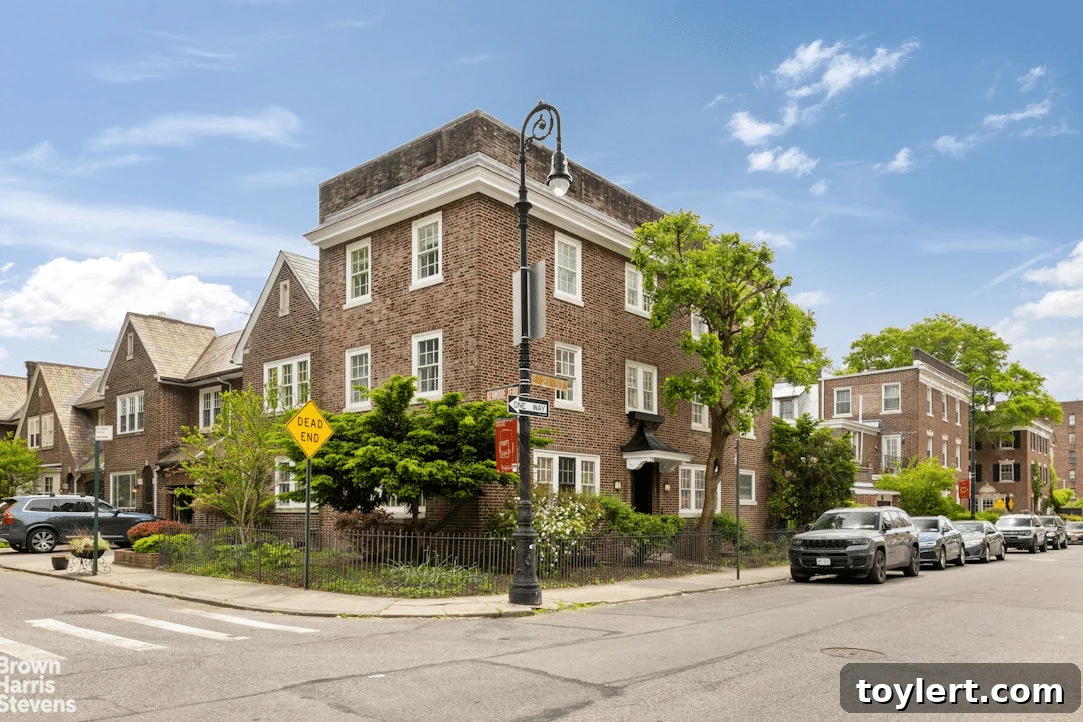
In the vibrant heart of Brooklyn, nestled within the esteemed Albemarle-Kenmore Terrace Historic District, stands a testament to early 20th-century architectural ambition: 221 East 21st Street. This distinguished brick single-family residence, along with its charming neighbors, was initially heralded as one of the era’s “artistic English colonial homes” upon its completion. Designed by the influential architectural firm Slee & Bryson, this particular house commands a prominent position on the corner of Kenmore Terrace in Flatbush, embodying a unique blend of historical grandeur and timeless appeal.
The Albemarle-Kenmore Terrace Historic District itself is a meticulously planned enclave, conceived during a period of significant urban expansion in Brooklyn. Recognized for its cohesive architectural style and picturesque streetscapes, the district offers a captivating glimpse into the residential development trends of the early 1900s. Its designation as a historic district underscores its importance in preserving the architectural integrity and community spirit of Flatbush. The vision for these homes was to create an idyllic suburban oasis within the bustling city, offering residents a distinctive living experience marked by elegance and comfort.
A crucial element in the district’s formation, and indeed the design of 221 East 21st Street, was the architectural prowess of Slee & Bryson. This firm, acclaimed by architectural historians like Suzanne Spellen as one of early 20th-century Brooklyn’s most significant, left an indelible mark on the borough’s built environment. Their work in Albemarle-Kenmore Terrace showcased their mastery in crafting cohesive yet individually distinctive homes. They ingeniously designed rows of houses that gracefully filled two cul-de-sac streets, reserving more substantial and often corner-positioned properties for enhanced architectural expression—a category into which 221 East 21st Street perfectly falls.
The specific design philosophy of Slee & Bryson often blended elements of the Colonial Revival and Neo-Federal styles, appealing to a burgeoning middle class that sought homes reminiscent of America’s early architectural heritage. Their designs were characterized by thoughtful layouts, quality craftsmanship, and an aesthetic that evoked a sense of tradition and permanence. For 221 East 21st Street, their design articulated a refined interpretation of these styles, making it a stellar example of their contribution to Brooklyn’s architectural landscape and earning it a place among the area’s most coveted residences.
This particular residence at 221 East 21st Street stands as a prime example of the Neo-Federal details prevalent throughout the enclave. Its façade is crafted from striking red brick laid in a distinctive Flemish bond pattern, a hallmark of superior masonry work where headers and stretchers alternate in each course, creating an attractive and durable surface. Complementing the brickwork is elegant trim composed of both limestone and wood, adding layers of texture and sophistication. The Kenmore Terrace-facing facade is graced by a classic Palladian window, an architectural feature renowned for its central arched opening flanked by two narrower rectangular lights, symbolizing balance and classical proportion. The entrance on East 21st Street, while more understated, features a simple door hood adorned with charming ornamental brackets, inviting residents and guests alike into a home rich with character.
Beyond its inherent architectural beauty, the house benefits from a privileged historical vantage point. It directly overlooks the former parsonage of the Flatbush Dutch Reformed Church, a structure of immense historical significance itself. Originally built in 1853, this venerable parsonage underwent a remarkable relocation in 1918, precisely as the Albemarle-Kenmore Terrace development was taking shape under the guidance of Midwood Associates for property owner Mabel Bull. This juxtaposition of a newly developed, artistically designed home against a backdrop of deeply rooted Flatbush history creates a compelling narrative, connecting the district’s modern ambition with the area’s centuries-old legacy.
Flatbush: A Historic Brooklyn Enclave
The neighborhood of Flatbush, from which the district draws its charm, boasts a history stretching back to the Dutch colonial era. It was one of the original six towns of Long Island, and its character has evolved through centuries, transitioning from agrarian landscapes to a thriving suburban hub. The early 20th century marked a significant period of growth for Flatbush, as improved transportation links, particularly the subway extensions, made it an increasingly desirable location for new residential developments. Developers like Midwood Associates capitalized on this demand, creating planned communities that promised modern amenities alongside the charm of traditional architecture.
The development of Albemarle-Kenmore Terrace was a strategic move to cater to a growing demographic seeking high-quality, single-family homes in a well-planned environment. Advertisements of the period eloquently pitched these properties as “a unique idea in one-family houses,” highlighting their distinctive design and superior construction. Priced at approximately $9,250 during a time when such a sum represented a considerable investment, these homes were marketed towards affluent families looking for more than just a dwelling—they sought a lifestyle. The price point and the architectural quality underscore the premium nature of these homes within the Brooklyn real estate market of the era.
The meticulous planning extended beyond the individual houses to the overall street layout, with the use of cul-de-sac streets promoting a sense of community and reduced through-traffic. This design choice contributed to the district’s serene and family-friendly atmosphere, qualities that continue to attract residents today. The enduring appeal of the Albemarle-Kenmore Terrace Historic District lies not only in its architectural consistency but also in its successful creation of a cohesive neighborhood identity, a testament to the foresight of its original planners and architects.
Preserving Architectural Heritage in Brooklyn
Today, homes like 221 East 21st Street are highly valued for their historical integrity and their contribution to Brooklyn’s rich architectural tapestry. The preservation efforts within the Albemarle-Kenmore Terrace Historic District ensure that these elegant structures retain their original charm and continue to stand as symbols of a bygone era of meticulous craftsmanship and architectural vision. Owners of these homes are often stewards of history, contributing to the ongoing narrative of Flatbush and Brooklyn as a whole. The district serves as a living museum, where every brick, every window, and every ornamental bracket tells a story of urban development, architectural style, and community evolution.
Investing in a property within such a district means more than acquiring a home; it means owning a piece of Brooklyn’s heritage. The combination of its prime corner location, the distinguished Neo-Federal architectural details, the historical significance of its surroundings, and its provenance from a leading architectural firm makes 221 East 21st Street a particularly noteworthy example within this remarkable district. It encapsulates the ideal of the “artistic English colonial home” envisioned by its creators, offering a beautiful blend of aesthetic appeal, historical depth, and a connection to one of Brooklyn’s most cherished neighborhoods. Its continued presence stands as a vibrant reminder of the enduring quality and timeless design principles that shaped early 20th-century residential architecture in New York City.