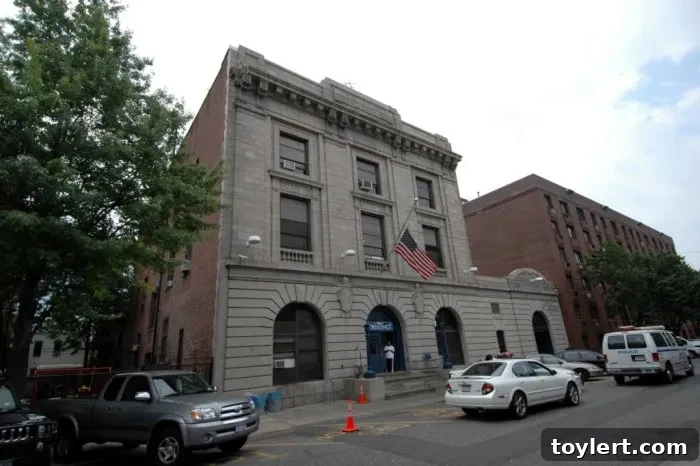
Brooklyn’s Enduring Legacy: The Historic 70th Precinct House
Welcome to a journey through Brooklyn’s rich architectural and civic tapestry, explored one distinguished building at a time. In this feature, we delve into the fascinating history and architectural grandeur of the 70th Precinct House of the New York City Police Department (NYPD). More than just a functional law enforcement facility, this venerable structure stands as a testament to Brooklyn’s evolving identity, a guardian of public safety, and a prominent landmark within the vibrant Flatbush and Ditmas Park neighborhoods.
Nestled at 170 Lawrence Avenue, the 70th Precinct House is a cornerstone of its community, embodying decades of history, architectural distinction, and unwavering service. Its robust presence reflects an era of meticulous craftsmanship and civic pride, offering a tangible link to Brooklyn’s past while actively shaping its present and future.
A Shifting Identity: From 72nd to 70th Precinct
The journey of the 70th Precinct House is marked by an intriguing evolution in its designation, mirroring the dynamic administrative reorganizations within the NYPD over more than a century. Originally established as the 72nd Precinct, it later transitioned to the 74th Precinct before finally settling into its current and long-standing identity as the 70th Precinct House. These shifts weren’t merely bureaucratic; they often reflected changes in district boundaries, population density, and the evolving needs of a burgeoning Brooklyn. Each name change represents a chapter in its continuous saga of adaptation and commitment to serving the borough’s diverse communities.
This historical fluidity underscores the building’s resilience and its deep roots in the public consciousness. Despite the numeric alterations, the core mission of safeguarding Brooklyn residents remained constant, with the building itself serving as a steadfast anchor through periods of significant urban growth and transformation.
Architectural Grandeur: A Romanesque Revival Masterpiece
The 70th Precinct House, erected in 1892, is a magnificent example of Romanesque Revival architecture, a style renowned for its solidity, distinctive archways, and often fortress-like appearance. Designed by the esteemed architect John Snook, this building perfectly encapsulates the period’s preference for robust and aesthetically imposing public edifices. Snook, a prominent architect of his time, left an indelible mark on Brooklyn’s streetscape with several notable commissions, and the 70th Precinct stands as one of his most enduring legacies.
Characteristic features of the Romanesque Revival style are immediately apparent in the building’s facade. Its prominent round-arched windows and doorways, heavy masonry construction, and rich textural variations in brickwork and stone detailing convey a sense of strength, authority, and permanence. The choice of materials, including deep red bricks and contrasting stone trim, creates a visually striking presence that commands respect and admiration. Details such as corbelling, decorative lintels, and intricate patterns in the brickwork further enhance its architectural appeal, inviting closer inspection and appreciation.
Inside, the building likely boasted equally impressive features, designed to accommodate the functional requirements of a late 19th-century police station while maintaining an air of civic dignity. While operational needs have certainly evolved, the inherent design integrity of Snook’s work continues to provide a distinctive and historically significant setting for modern policing.
A Pillar of the Community: Flatbush and Ditmas Park
Situated in the heart of Flatbush, bordering the historic Ditmas Park neighborhood, the 70th Precinct House has always been more than just a place where laws are enforced. It is a vital community institution, deeply woven into the fabric of daily life for generations of Brooklynites. Its location on Lawrence Avenue places it strategically within a bustling commercial and residential district, making it a constant presence and a visible symbol of public order and assistance.
The surrounding areas, particularly Ditmas Park, are celebrated for their distinctive Victorian homes, tree-lined streets, and a strong sense of community. The presence of a stately, historic precinct house complements this architectural landscape, adding another layer of historical depth and civic importance. For residents, the precinct house represents a tangible link to local governance and a source of security, fostering a sense of belonging and collective responsibility.
Over the decades, the 70th Precinct has witnessed and responded to countless changes in the demographic and socio-economic makeup of its patrol area. From periods of rapid immigration to urban development and revitalization efforts, the building has stood as a silent observer and active participant in the ongoing narrative of Flatbush and Ditmas Park, adapting its services to meet the evolving needs of a diverse and dynamic population.
Evolution of Policing and the Building’s Adaptation
The construction of the 70th Precinct House in 1892 coincided with a transformative era in American policing. The late 19th and early 20th centuries saw the professionalization of police forces, a move away from politically appointed watchmen towards a more structured and disciplined law enforcement body. Buildings like the 70th Precinct were designed to reflect this newfound professionalism, providing dedicated spaces for patrolmen, administrative offices, holding cells, and community engagement.
From horse-drawn patrol wagons to modern patrol cars, from telegraph communication to sophisticated digital networks, the operations within the 70th Precinct have continually evolved. The building itself, while maintaining its original architectural envelope, has undergone numerous internal modifications to accommodate technological advancements and changes in policing strategies. These adaptations include updating communications systems, improving forensic capabilities, modernizing detainee facilities, and creating more community-friendly spaces for public interaction.
The history of the 70th Precinct is therefore a microcosm of the broader history of urban policing in New York City. It tells a story of constant adaptation, technological integration, and an ongoing effort to balance effective law enforcement with community relations and civil liberties. The building serves as a physical reminder of this complex and vital evolution.
Preservation and Enduring Significance
Recognized for its architectural and historical merit, the 70th Precinct House stands as a protected landmark, ensuring its preservation for future generations. Landmark status is crucial for buildings like this, as it safeguards their unique character against indiscriminate alterations or demolition, allowing their stories to continue to be told. This designation acknowledges not only its aesthetic value but also its deep civic and cultural significance to Brooklyn.
As a living piece of history, the 70th Precinct House continues to function as a vital police facility today, proving that historic architecture can be both beautiful and highly practical. It reminds us of a time when public buildings were designed with a sense of permanence and grandeur, intended to inspire trust and represent the strength of civic institutions. Its enduring presence contributes significantly to the visual identity and historical narrative of its surrounding neighborhoods.
A Legacy of Service and Community
The 70th Precinct House is more than just an address or a designation; it is a symbol of steadfastness and service in the heart of Brooklyn. From its initial days as the 72nd and 74th Precincts to its current role as the 70th, it has consistently served as a guardian of peace, a beacon of justice, and an integral part of the community’s social fabric. Its Romanesque Revival architecture, designed by John Snook, stands as a proud monument to Brooklyn’s rich heritage and the enduring values of its people.
As Brooklyn continues to evolve, the 70th Precinct House remains a constant, a powerful reminder of the past, and a resilient guardian for the future. It stands tall on Lawrence Avenue, a silent witness to history, still actively contributing to the safety and vibrancy of one of New York City’s most dynamic boroughs, truly embodying the spirit of “Brooklyn, one building at a time.”