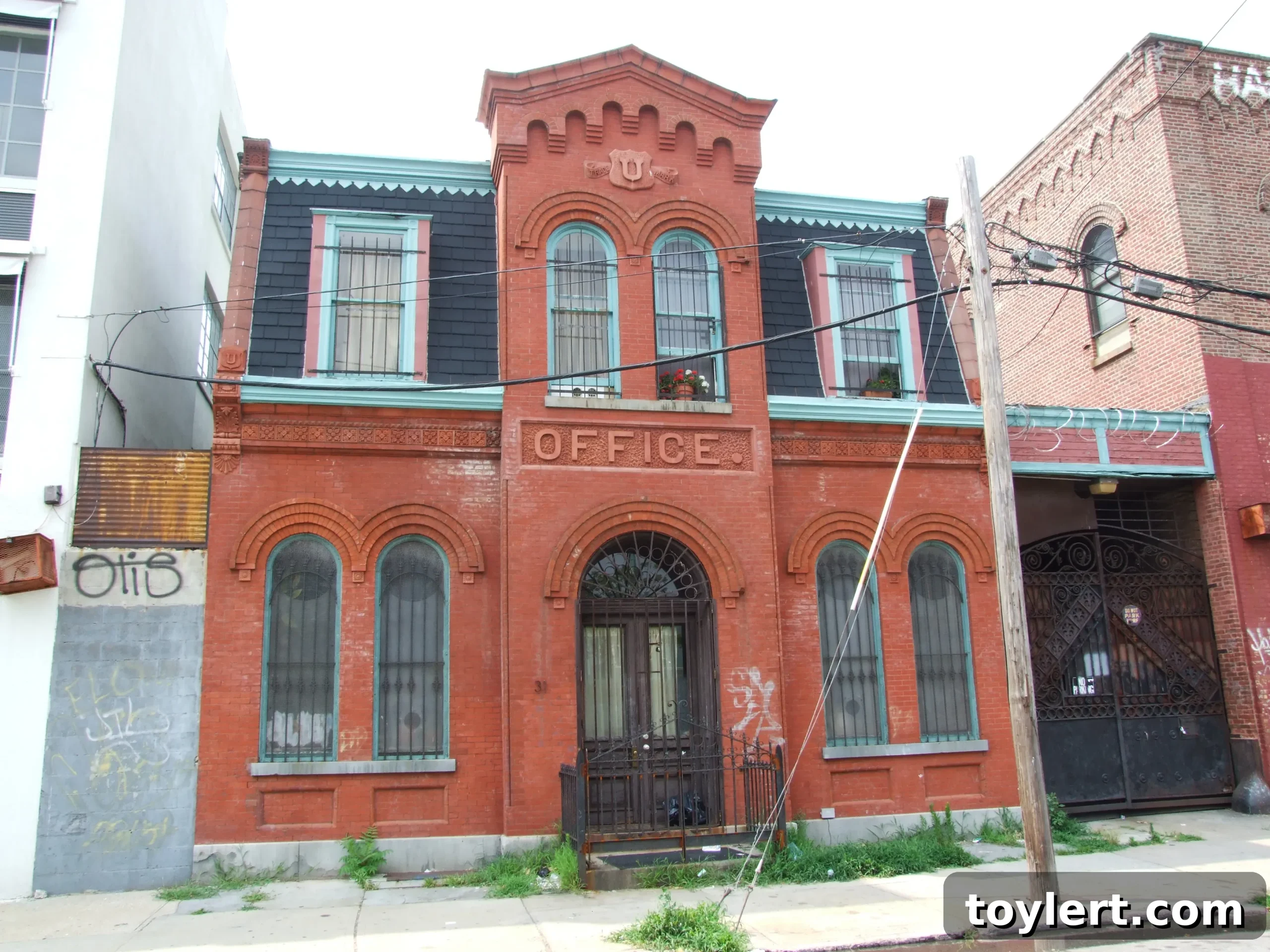
The Enduring Legacy of the Ulmer Brewery Office: A Bushwick Landmark
Address: 31 Belvidere Street, between Beaver St. and Broadway, Bushwick, Brooklyn, NY
Name: Office of the Ulmer Brewery Complex
Neighborhood: Bushwick
Year Built: 1885
Architectural Style: Romanesque Revival/Rundbogenstil
Architect: Theobald Engelhardt
Landmarked: Yes. Landmarked with the rest of the Ulmer Brewery complex in 2010.
Nestled in the vibrant heart of Bushwick, Brooklyn, stands a structure that is much more than just an old office building: the Ulmer Brewery Office. This architectural marvel at 31 Belvidere Street is a familiar and deeply admired landmark for anyone with an appreciation for Brooklyn’s rich history and stunning industrial architecture. As a pivotal part of the expansive William Ulmer Brewery complex, it serves as a tangible link to an era when Bushwick reigned supreme as the undisputed capital of Brooklyn’s prolific brewing industry. While undeniably an amazing piece of architecture in its own right, its true significance and splendor are best understood when viewed as an integral component of the larger, remarkably preserved Ulmer Brewery complex.
A Glimpse into Brooklyn’s Brewing Past: The Ulmer Brewery Complex
The Ulmer Brewery complex represents one of the few remaining large-scale brewery operations from the 19th century that has largely survived intact in Brooklyn. Its remarkable preservation offers an unparalleled window into the industrial heritage that once defined neighborhoods like Bushwick. The office building, strategically positioned at mid-block on Belvidere Street, is merely one facet of this sprawling industrial empire. The main brewery buildings stretch majestically from the corner of Beaver Street along Belvidere, culminating at the grand office structure. Venturing behind the primary brewery structures, on Locust Street, one discovers the ancillary yet crucial stables and storage buildings, essential for the transport and distribution of Ulmer’s renowned beers.
This comprehensive layout underscores the self-sufficient nature of 19th-century breweries. These were not just factories for producing beverages; they were intricate ecosystems that encompassed every stage from raw material intake to final product delivery. The administration of such a vast operation, the marketing, and the interaction with clients and suppliers all transpired within the walls of the distinctive office building, making it the public face and brain of the entire enterprise. The sheer scale and thoughtful design of the Ulmer complex reflect the prosperity and ambition of its founder, William Ulmer, and the golden age of brewing in Brooklyn.
Architectural Grandeur: The Romanesque Revival Masterpiece
The Ulmer Brewery Office, constructed in 1885, stands as an exquisite example of the Romanesque Revival style, specifically exhibiting characteristics of the German Rundbogenstil (round arch style). This architectural movement, popular in the mid-to-late 19th century, drew inspiration from medieval Romanesque architecture, characterized by its robust and monumental appearance. The building’s design features impressive brickwork, typically in rich reds and browns, accented by decorative terracotta elements and intricate stone carvings. Its most defining features are the prominent round-arched windows and doorways, which impart a sense of solidity and timeless elegance. The use of heavy masonry, often rusticated, contributes to its formidable yet inviting presence.
The architect behind this masterpiece was Theobald Engelhardt, a prolific and highly respected architect who shaped much of Brooklyn’s industrial and residential landscape during his career. Engelhardt was a master of the Romanesque Revival, and his work on the Ulmer Brewery complex, particularly the office building, showcases his adeptness at combining functionality with ornate aesthetics. His designs often incorporated elements of historical European styles, adapted to the American context, creating buildings that were both practical for industrial use and visually striking. The Ulmer Office, with its elaborate brick patterns, corbelled cornices, and decorative lintels, is a testament to Engelhardt’s skill and the prevalent architectural tastes of the era, reflecting a period of immense industrial growth and civic pride in Brooklyn.
William Ulmer: From German Immigrant to Brewing Magnate
The story of the Ulmer Brewery is inextricably linked to the remarkable journey of its founder, William Ulmer. Like many successful entrepreneurs of his time, Ulmer was an immigrant who arrived in America with ambition and a strong work ethic. He emigrated from Germany in the 1850s, a period when Brooklyn was rapidly expanding and attracting a large influx of German immigrants, many of whom brought with them a deep-rooted knowledge and appreciation for brewing traditions. Ulmer began his career in the brewing industry by working for his uncle’s brewery, undoubtedly learning the intricacies of the craft and the business from the ground up.
Through dedication, strategic vision, and an unwavering commitment to quality, William Ulmer steadily built his own brewing empire. By the late 19th century, the William Ulmer Brewery had become one of Brooklyn’s most successful and recognizable brands. The construction of the grand Belvidere Street complex in the 1880s was the culmination of his decades-long career, a physical manifestation of his entrepreneurial spirit and the thriving enterprise he had meticulously cultivated. Ulmer’s success was not just a personal triumph; it contributed significantly to the economic prosperity of Bushwick and established his name as a titan in Brooklyn’s vibrant industrial sector.
Bushwick: The Heart of Brooklyn’s Brewing Boom
During the late 19th and early 20th centuries, Bushwick was more than just a neighborhood; it was a veritable powerhouse of the brewing industry, earning its moniker as the “Beer Capital of Brooklyn.” The convergence of several factors created this unique industrial landscape. The area boasted excellent natural water sources, crucial for brewing quality beer. A large German immigrant population provided both a skilled workforce and a robust consumer base with a strong cultural attachment to beer. Furthermore, Bushwick’s strategic location offered advantageous access to raw materials and efficient transportation networks, enabling breweries to distribute their products widely throughout New York City and beyond.
At its peak, Bushwick was home to dozens of breweries, each contributing to the distinct aroma that permeated the neighborhood streets. Brands like Trommer’s, Schaefer, Piel’s, and Rheingold became household names, but William Ulmer Brewery stood out for its quality and the architectural splendor of its facilities. This golden age of brewing, however, was not destined to last forever. The advent of Prohibition in the 1920s delivered a devastating blow to the industry, forcing many breweries to close or drastically alter their operations. While some managed to survive or adapt, the post-Prohibition era saw a consolidation of the industry, leading to the eventual decline of Bushwick’s prominence as a brewing hub. Yet, the architectural remnants, like the Ulmer complex, serve as powerful reminders of this influential chapter in Brooklyn’s history.
Landmarking for Posterity: Preserving a Precious Heritage
The decision to landmark the Ulmer Brewery complex in its entirety in 2010 was a monumental step in recognizing and preserving Brooklyn’s industrial heritage. By that time, many of the borough’s historic industrial sites had either been demolished or significantly altered. The Ulmer complex, remarkably, stood as a largely intact example of a large 19th-century brewery, making its protection paramount. The landmark designation ensures that this significant site, including the iconic office building, is safeguarded from inappropriate development and alterations, allowing future generations to appreciate its historical, cultural, and architectural value.
The landmarking process involves extensive research and evaluation by the Landmarks Preservation Commission, considering criteria such as architectural significance, historical association, and cultural importance. The Ulmer complex easily met these criteria, representing a high point of industrial architecture and a vital part of Bushwick’s development. This protective status reflects a broader understanding of the importance of preserving not just grand public buildings or elite residences, but also the industrial structures that fueled the city’s growth and shaped its unique character. The Ulmer Brewery Office, now a protected landmark, stands as a symbol of resilient preservation efforts and a proud testament to Brooklyn’s rich and multifaceted past.
An Enduring Symbol of Bushwick’s Identity
Today, the William Ulmer Brewery Office and its surrounding complex continue to be a defining feature of the Bushwick streetscape, offering a powerful connection to the neighborhood’s storied past. It stands as a majestic reminder of a period of immense prosperity and innovative industrial design. Far from being a mere relic, this architectural gem actively contributes to the cultural fabric of modern Bushwick, inspiring awe and curiosity in residents and visitors alike.
The building’s enduring presence speaks volumes about the quality of its original construction and the foresight of those who fought for its preservation. It’s a testament to the fact that even utilitarian industrial buildings can possess profound beauty and historical significance. The Ulmer Brewery Office is more than just brick and mortar; it is a narrative etched in stone, telling the compelling story of German immigration, American enterprise, architectural ingenuity, and the vibrant history of Brooklyn’s beer capital. As Bushwick continues to evolve, the Ulmer Brewery complex remains a steadfast anchor, grounding the neighborhood in its rich heritage while looking forward to a future that respects and celebrates its unique identity.