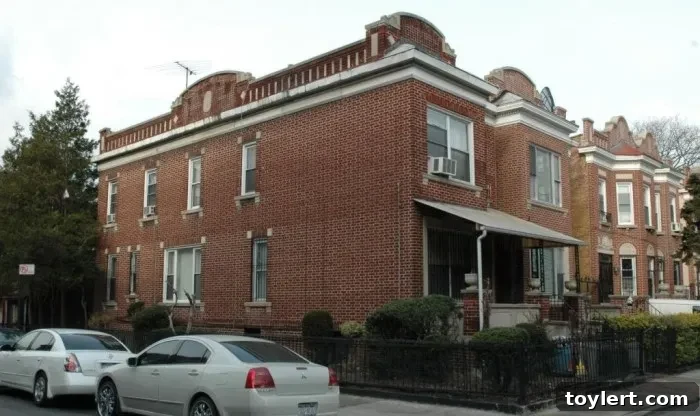
Martense Court: A Glimpse into Early 20th-Century Brooklyn Charm in Flatbush
Nestled within the vibrant and historically rich Flatbush neighborhood of Brooklyn, Martense Court stands as a captivating testament to a pivotal era of urban development and architectural design. This secluded cul-de-sac, home to fourteen distinct semi-detached row houses, offers a unique blend of historical resonance, aesthetic appeal, and a quiet residential atmosphere that often surprises visitors amidst the borough’s energetic pace. Constructed between 1915 and 1916, these residences exemplify the Colonial Revival architectural style, subtly enriched with Flemish details, making them a significant point of interest for anyone fascinated by Brooklyn’s extensive architectural legacy and its storied past.
Martense Court is more than just a collection of impressive homes; it embodies a thoughtfully conceived micro-community. It was brought to life through the vision of pioneering developers and the skilled hands of prominent architects, reflecting the progressive aspirations and innovative building practices prevalent at the dawn of the 20th century. Even the name “Martense” itself connects this serene street directly to the foundational history of Flatbush, linking contemporary residents to key figures who shaped the very fabric of the community during momentous periods.
Architectural Elegance: The Colonial Revival Masterpieces of Martense Court
The residences located at 1-14 Martense Court serve as prime examples of the Colonial Revival style, a popular architectural movement that swept across the United States from the late 19th through the mid-20th centuries. This style consciously aimed to evoke the perceived grandeur, simplicity, and patriotic spirit of early American colonial architecture, often drawing profound inspiration from the Georgian and Federal periods. The homes on Martense Court beautifully showcase the definitive characteristics of Colonial Revival design:
- Symmetrical Facades: A hallmark of the style, these houses typically feature perfectly balanced window placements and a centrally positioned main entrance, creating an overarching sense of order, dignity, and classical formality.
- Durable Brick Construction: Chosen for its enduring quality and timeless aesthetic, brick was a highly favored construction material. Here, it is often laid in patterns that contribute to the visual richness and textural depth of the facades.
- Multi-Pane Sash Windows: True to their colonial antecedents, these windows are a defining feature, often framed by decorative lintels or sills that enhance their traditional appeal.
- Subtle Classical Detailing: While not overtly ornate, the homes incorporate refined classical elements. These might include understated pediments above doorways, decorative cornices along the roofline, or pilasters that frame entranceways, all serving as elegant allusions to the classical architectural principles that profoundly influenced colonial builders.
A distinctive element that truly sets Martense Court apart is the thoughtful integration of “Flemish details.” These specific architectural nuances, though not always immediately dominant, can be observed in various aspects. They might manifest in specific brick bonding patterns, such as the classic Flemish bond (where headers and stretchers alternate within each course), or more subtly in the shaping of stepped gables, unique window trims, or decorative elements along the roofline. These details subtly recall Dutch and Belgian architectural traditions, creating a sophisticated and unique aesthetic. This fusion provides a fascinating variation on the more standard Colonial Revival themes prevalent throughout Brooklyn during this dynamic period, perhaps even serving as an homage to Flatbush’s own rich Dutch origins.
The adoption of semi-detached construction was, in its time, a significant innovation for residential developments. Unlike the more common attached row houses of the era, semi-detached homes share only one common wall with a neighboring property. This design advantageously allows for windows on three sides of each dwelling, dramatically increasing the influx of natural light and improving cross-ventilation. This offered a noticeably more desirable and airy living environment compared to their fully attached counterparts. Furthermore, these homes were conceived with “garages out back”—a remarkably forward-thinking amenity that directly addressed the burgeoning automobile culture of the 1910s. As personal car ownership began its transition from an exclusive luxury to a more attainable aspiration for the expanding middle class, the inclusion of integrated or easily accessible private garages became a highly coveted feature, significantly boosting the homes’ modernity and long-term appeal.
Cantor & Dorfman: Shaping Brooklyn’s Residential Landscape
The architectural firm responsible for the distinctive design of Martense Court, Cantor & Dorfman, played a crucial, albeit often unsung, role in shaping the built environment of Brooklyn during the early decades of the 20th century. While Martense Court itself has not been designated as a city landmark, the consistent quality, functional design, and aesthetic coherence of their work across Flatbush and other parts of southern Brooklyn speak volumes about their expertise and influence. Their extensive portfolio, which included “similar houses and apartment buildings and garages,” suggests a specialization in creating cohesive, practical, and visually appealing residential developments. These designs were crafted to meet the diverse demands of a rapidly expanding urban population, successfully balancing aesthetic appeal with essential practical considerations to provide comfortable, well-appointed, and modern homes for Brooklyn’s growing professional and merchant classes.
The Deep Roots of Martense Court: A Revolutionary War Legacy
The very name, Martense Court, provides an immediate and profound connection to the earliest foundational history of Flatbush. Both the street and the subsequent cul-de-sac are named after Joris Martense, a pivotal figure whose life story perfectly encapsulates the complex loyalties, personal dilemmas, and shifting political tides of the American Revolutionary War era. Born into one of Flatbush’s most prominent and established families, Joris Martense was the grandson of Martin Adriance, a historical figure who once held the prestigious distinction of being the largest landowner in Flatbush. This formidable lineage firmly placed Joris Martense at the very heart of the community, endowing him with significant influence, substantial property interests, and a prominent social standing.
During the tumultuous and uncertain years of the Revolutionary War, Martense found himself in the precarious position of navigating a deeply fractured and dangerous political landscape. Flatbush, much like the broader area of Long Island, was a highly contested territory, experiencing direct British occupation following the strategically crucial Battle of Long Island in 1776. In such a volatile environment, the allegiance of prominent citizens was often fraught with severe risks and profound uncertainties. Historical accounts suggest that Joris Martense adopted a remarkably pragmatic, if ethically nuanced, approach: he “hedged his bets.” While he outwardly offered support to the British Crown—a shrewd and strategic move for self-preservation given the overwhelming British military presence and control—he simultaneously made substantial covert investments in the patriot cause, providing both essential funds and crucial weaponry.
This dual allegiance, while appearing contradictory, was not entirely uncommon among wealthy and influential citizens whose fortunes and stability were inextricably linked to the peace and order of the region, regardless of which power ultimately prevailed. Such a strategy allowed Martense to maintain his social standing and safeguard his substantial property interests, while also prudently ensuring he would be viewed favorably should the American colonies ultimately achieve independence. Remarkably, Martense’s calculated risk ultimately paid off. Following the successful conclusion of the war and the securing of American independence, he was not only pardoned for his apparent loyalties to the Crown but also played an instrumental role in the crucial post-war reconstruction and development of his community. His profound civic dedication was further exemplified by his role as one of the founding citizens of the esteemed Erasmus Hall School, an institution established in 1786. This venerable school, recognized as one of the oldest and most respected secondary educational institutions in the United States, stands today as a lasting monument to the foresight, commitment, and community spirit of individuals like Joris Martense, who were instrumental in rebuilding and shaping the future of Flatbush.
Charles Goell: The Visionary Developer Behind a Brooklyn Legacy
The imaginative design and construction of the semi-detached houses that define Martense Court were the direct result of the visionary leadership of developer Charles Goell. Goell’s life story is a classic embodiment of the American dream: a truly remarkable figure whose journey from a young immigrant boy to an immensely influential and prolific builder stands as a testament to ambition and perseverance. Born in Dvinsk, Russia, Goell arrived in the United States as a mere 13-year-old, confronting the daunting challenges of a new language, an unfamiliar culture, and a completely different way of life. Yet, his innate drive, exceptional intelligence, and remarkable adaptability shone through almost immediately. He rapidly mastered English, a pivotal achievement that not only facilitated his swift integration into American society but also provided him with the essential toolset to excel in the burgeoning world of commerce and construction.
Goell’s boundless ambition led him directly into the rapidly expanding building trades. With a natural entrepreneurial spirit and an incredibly keen eye for opportunity, he secured his very first job as a construction foreman at the remarkably young age of 17. This swift ascent from a recently arrived immigrant youth to a significant supervisory role speaks volumes about his inherent capabilities, burgeoning leadership potential, and an extraordinary capacity for quickly grasping complex construction practices. It was not long before Goell capitalized on this invaluable early experience to establish his own highly successful company, thereby embarking on a prolific and impactful career that would significantly transform the urban fabric of Brooklyn.
His earliest projects were crucial in laying the groundwork for his burgeoning reputation as a prolific and highly effective developer. Goell’s first substantial undertaking involved the impressive construction of 350 houses in the then-rapidly developing areas of East New York and Brownsville. This monumental contribution to Brooklyn’s housing stock not only solidified his standing in the industry but also unequivocally demonstrated his remarkable capacity to conceive, manage, and deliver large-scale residential projects with efficiency and quality. By the first three decades of the 20th century, Charles Goell had firmly established himself as a prominent Jewish developer, whose influence and extensive work extended across several key Brooklyn neighborhoods. These included Flatbush, Crown Heights South, and East New York. His developments were instrumental in providing modern, well-built, and desirable homes for the city’s rapidly expanding middle class, expertly catering to families who sought comfortable, suburban-style living within a dynamic urban context.
Goell’s deep understanding of evolving market demands, coupled with his unwavering commitment to quality and thoughtful design, enabled him to create thriving communities that profoundly resonated with homebuyers. The innovative semi-detached design of Martense Court, thoughtfully paired with the crucial inclusion of private garages, perfectly illustrates his forward-thinking and responsive approach to development. He astutely recognized the evolving needs and desires of homeowners, anticipating the growing demand for more living space, abundant natural light, and the critical convenience of automobile access. His numerous developments played a pivotal role in defining the residential character of vast swathes of Brooklyn, meticulously crafting appealing and enduring neighborhoods that continue to thrive and remain highly desirable today.
Martense Court Today: A Lasting Testament to Brooklyn’s Rich Heritage
While Martense Court has not, to date, received formal landmark designation, its profound historical significance and remarkable architectural integrity remain largely preserved. This makes it a living museum, offering a tangible glimpse into early 20th-century Brooklyn. The unique cul-de-sac design continues to foster a strong sense of community and an exceptional quietude, a truly rare and cherished commodity in a bustling and densely populated borough like Brooklyn. Both residents and visitors alike can appreciate the meticulous planning, thoughtful design, and superior craftsmanship that characterize these homes, from the intricate brickwork patterns to their inviting and well-proportioned facades. Martense Court stands as a powerful and enduring reminder of a dynamic period of exponential growth, profound innovation, and dedicated community building in Brooklyn’s rich history, a period profoundly shaped by the visionary developers like Charles Goell and the indelible legacy of foundational figures such as Joris Martense.
Ultimately, Martense Court is far more than just a residential address; it represents a cherished piece of Brooklyn’s very soul. It beautifully embodies the confluence of influential architectural trends, compelling historical narratives, and the indomitable immigrant spirit that collectively built one of the world’s most iconic and vibrant cities. Its unassuming yet dignified presence, gracefully situated just off Martense Street, subtly invites contemplation of a rich and layered past, while its continued vitality and desirability speak volumes about the enduring quality and brilliant foresight of its original conception. For anyone seeking to connect deeply with the rich, diverse tapestry of Flatbush and Brooklyn’s unparalleled architectural heritage, Martense Court offers a compelling, beautifully preserved, and truly enriching experience.