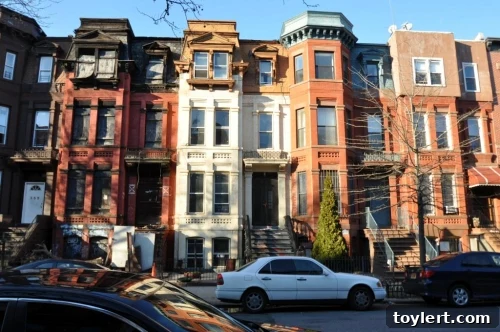
(Photo:Christopher Bride for Property Shark, 2012)
Exploring Brooklyn’s Enduring Charm: The Historic Row Houses of Jefferson Avenue
Brooklyn is a borough celebrated globally for its unique character, vibrant communities, and rich architectural heritage. At the heart of this identity lie its iconic row houses, magnificent structures that tell a story of urban development, changing styles, and enduring appeal. Among the many streets adorned with these architectural gems, Jefferson Avenue stands out as a prime example, showcasing the elegance and historical significance of Brooklyn’s residential landscape, one meticulously crafted building at a time.
The term “row house” evokes images of stately facades, intricate details, and tree-lined streets that define much of Brooklyn’s most desirable neighborhoods. These homes are more than just residences; they are monuments to a bygone era of craftsmanship and community planning. Our journey into Brooklyn’s past and present often begins with these structures, and on Jefferson Avenue, between its bustling avenues and quiet corners, we find a particularly well-preserved collection that exemplifies the borough’s architectural evolution.
A Legacy in Stone: The Genesis of Brooklyn’s Row Houses
The proliferation of row houses in Brooklyn began in earnest during the 19th century, spurred by a rapidly growing population and the need for efficient urban housing. As Brooklyn transformed from a series of independent villages into a major city, and later a borough of New York City, developers and architects embraced the row house model as an ideal solution. This period, particularly from the 1840s through the early 1900s, saw a boom in construction, laying the foundation for the picturesque streetscapes we admire today.
The early row houses were often built speculatively, meaning developers would construct entire blocks or stretches of houses without a specific buyer in mind, anticipating demand. This approach led to a remarkable uniformity in scale but also allowed for diverse architectural expressions within a cohesive street design. Materials were typically locally sourced or easily transported, with brownstone becoming the most iconic choice, lending its name to the famous “brownstones” of Brooklyn.
Beyond brownstone, builders also utilized red brick, often with intricate detailing, and later, limestone and terra cotta, reflecting shifts in architectural fashion and available resources. The foundational principle, however, remained consistent: elegant, multi-story single-family homes or two-family dwellings, built adjacently to maximize land use and create a sense of urban enclosure and community.
Architectural Splendor: Styles and Details on Jefferson Avenue
Jefferson Avenue, like many of its counterparts in Brooklyn’s historic districts, is a living museum of 19th-century architectural styles. Walking along this storied street, particularly the stretch encompassing 353-363 Jefferson Avenue, one can observe a fascinating progression and blend of designs that reflect the tastes and trends of their respective eras. While specific details for 353-363 Jefferson Avenue might vary, the general characteristics of Brooklyn row houses apply universally.
Many of these homes feature the distinctive high stoop, a hallmark of Brooklyn row houses, which served both practical and aesthetic purposes. Practically, it elevated the main living floor above the street level, providing privacy and protection from street grime. Aesthetically, it offered an elegant entry sequence and a prime vantage point for observing neighborhood life. Ornate iron railings often flank these stoops, adding a touch of Victorian grandeur.
Common architectural styles prevalent on Jefferson Avenue include:
- Neo-Grec: Popular in the 1870s and 1880s, characterized by angular lines, incised ornament, and a focus on geometric forms, often seen in the lintels above windows and door frames.
- Romanesque Revival: Emerging in the late 1880s and early 1890s, identifiable by its heavy, rustic stone bases, rounded arches, and rich, often sculptural ornamentation, frequently incorporating foliate or animal motifs.
- Queen Anne: Though less common for entire row house blocks due to its emphasis on asymmetry and varied materials, elements like turrets, bay windows, and decorative shingles can be found integrated into the facades of some row houses, particularly around the turn of the century.
- Renaissance Revival: Often seen in more stately homes from the late 1890s and early 1900s, featuring classical motifs, smooth stone facades, and balanced compositions.
Each house, even within a uniform block, often possesses unique elements – from carved keystones and intricate cornices to variations in window pediments and door surrounds. The rhythmic repetition of facades, punctuated by these individualistic touches, creates a harmonious yet captivating streetscape. The use of bay windows became increasingly popular, providing more light and space to interior rooms while adding visual interest to the exterior.
Jefferson Avenue: A Portrait of Community and Modern Living
Today, Jefferson Avenue continues to embody the enduring allure of Brooklyn living. The historic row houses here are not just relics of the past; they are vibrant homes, meticulously maintained and often thoughtfully updated to meet contemporary needs while preserving their original charm. Residents of these homes are custodians of history, contributing to the ongoing narrative of the neighborhood.
The community surrounding Jefferson Avenue is characterized by its strong sense of place and local pride. Tree-lined sidewalks, community gardens, and local businesses foster a walkable and engaging environment. The proximity to parks, cultural institutions, and convenient transit options further enhances the appeal of living in such a historically rich area. The blend of historic architecture with modern amenities and a diverse, active population creates a truly unique urban experience.
Preservation efforts play a crucial role in maintaining the integrity and beauty of streets like Jefferson Avenue. Local historic district designations and community organizations work tirelessly to ensure that new developments respect the architectural context and that existing structures are cared for in a way that honors their original design. This commitment to preservation safeguards Brooklyn’s distinctive character and protects the significant investment in its architectural heritage.
The Value of Architectural Preservation in Brooklyn
The meticulous preservation of Brooklyn’s row houses, particularly those found on Jefferson Avenue, extends far beyond mere aesthetics. It represents a commitment to cultural identity, economic stability, and sustainable urban development. These historic homes anchor their neighborhoods, providing a tangible link to the past and contributing to a sense of continuity in a rapidly changing world.
From an economic perspective, properties in historic districts often maintain higher values and are more resilient to market fluctuations. Their unique character and limited availability make them highly desirable. For residents, owning a piece of Brooklyn’s architectural history is not just an investment in real estate, but an investment in a lifestyle rich with character and community.
Environmentally, the adaptive reuse of existing buildings is inherently sustainable. It reduces the demand for new construction, minimizes waste, and preserves the embodied energy already present in the materials and labor of the original structures. The robust construction of these 19th-century homes also means they are built to last, offering durability that often surpasses modern counterparts.
Brooklyn, One Building at a Time: A Timeless Perspective
The adage “Brooklyn, one building at a time” beautifully encapsulates the spirit of appreciation for the borough’s architectural tapestry. It encourages us to pause, look closely, and understand the individual stories embedded within each facade, each stoop, and each window. On Jefferson Avenue, this perspective is particularly rewarding, as the street reveals block after block of homes that, while part of a larger whole, possess their own distinct character and history.
These row houses stand as testaments to the vision of earlier generations of builders, residents, and communities. They remind us that urban environments are not static but dynamic, evolving through continuous cycles of construction, habitation, and preservation. The journey through Brooklyn’s architectural landscape, exemplified by the elegant row houses of Jefferson Avenue, is an ongoing discovery—a testament to the enduring beauty and resilience of one of the world’s most beloved boroughs.