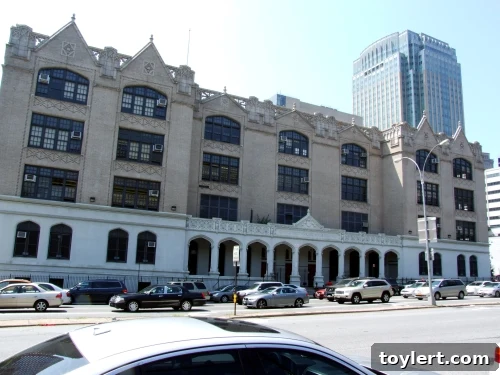
The Enduring Legacy of 285 Jay Street: George Westinghouse High School in Brooklyn
Brooklyn is a borough defined by its rich history, vibrant communities, and iconic architecture. Among its countless structures, some buildings stand as silent sentinels, echoing the narratives of generations. One such landmark is the imposing edifice at 285 Jay Street, home to what was originally the George Westinghouse Vocational and Technical High School, and now proudly hosts the G.W. Informational Technology High School. This building is more than just bricks and mortar; it is a repository of educational innovation, a testament to industrial progress, and a crucial piece of Brooklyn’s evolving identity.
From its inception, 285 Jay Street was envisioned as a beacon of practical education, equipping young minds with the skills necessary to thrive in a rapidly industrializing nation. Its story is deeply intertwined with the educational philosophy of the early 20th century, which sought to bridge the gap between academic theory and real-world application. This article delves into the architectural grandeur, historical significance, and enduring impact of this remarkable Brooklyn institution, exploring how it has adapted and continued to serve its community for nearly a century.
A Foundation Built on Vision: The Dawn of Vocational Education
The early 20th century saw a significant shift in educational paradigms across the United States. As industrialization surged, so did the demand for skilled laborers, engineers, and technicians. Recognizing this crucial need, New York City embarked on a mission to establish specialized schools that could provide practical, hands-on training alongside traditional academic subjects. It was within this context that the vision for the George Westinghouse Vocational and Technical High School began to take shape.
Named after the illustrious American entrepreneur and engineer George Westinghouse, a pioneer in the electrical industry, the school was designed to embody his spirit of innovation and practical application. Westinghouse’s contributions to alternating current (AC) electricity and countless other inventions revolutionized modern life, making him an apt namesake for an institution dedicated to technical excellence. Opened in 1930, at the precipice of the Great Depression, the school represented a commitment to preparing students for viable careers, offering hope and opportunity during an era of economic uncertainty. Its establishment at 285 Jay Street, strategically located in the heart of Downtown Brooklyn, underscored its importance as a central hub for vocational learning.
During its formative years, George Westinghouse Vocational and Technical High School quickly established itself as a leading institution for technical training. Its curriculum was comprehensive and forward-thinking, encompassing a wide array of trades such as electrical engineering, automotive mechanics, printing, carpentry, and various industrial arts. Students received rigorous instruction, combining classroom theory with extensive workshop experience, ensuring they graduated with both theoretical knowledge and practical proficiency. This hands-on approach was revolutionary for its time, setting a high standard for vocational education within the New York City public school system and making it an attractive option for countless families in Brooklyn and beyond.
Architectural Grandeur: A Landmark in Downtown Brooklyn
The building at 285 Jay Street is an architectural marvel that commands attention within the urban landscape of Downtown Brooklyn. Designed in the Art Deco style, prevalent during the period of its construction, it reflects the optimistic and forward-looking spirit of the 1920s and 30s. Art Deco, characterized by its sleek lines, geometric patterns, and often elaborate ornamentation, was a popular choice for public buildings, symbolizing progress, modernity, and a sense of enduring strength.
The architects responsible for this grand structure were William H. Gompert and Walter C. Martin, both Superintendents of School Buildings for the NYC Board of Education. Their design for Westinghouse High School successfully blended functionality with aesthetic appeal. The building’s exterior features a robust brick facade, punctuated by rows of large windows that allowed ample natural light into the classrooms and workshops. The careful detailing, from the stone accents to the subtle decorative motifs, speaks to the craftsmanship of the era and the intention to create a dignified and inspiring environment for learning. Its substantial size and imposing presence were deliberate, signifying the monumental importance placed on the education it provided.
Inside, the school was designed to accommodate its specialized vocational programs. Workshops were equipped with state-of-the-art machinery and tools, classrooms were spacious, and laboratories were prepared for scientific and technical experimentation. The layout facilitated the practical curriculum, allowing for efficient movement between academic lessons and hands-on training sessions. The building itself became an integral part of the educational experience, a dynamic space where students could not only learn theory but also apply it directly in realistic settings. As Downtown Brooklyn has undergone significant redevelopment over the decades, 285 Jay Street has remained a steadfast reminder of the area’s historical roots and its enduring commitment to education.
Evolution and Adaptation: From Trades to Technology
The late 20th and early 21st centuries brought profound changes to the global economy and the job market. As manufacturing jobs declined in urban centers like New York City, and the digital revolution took hold, the demand for traditional vocational trades began to wane, while the need for skills in information technology and computer science skyrocketed. Educational institutions, including George Westinghouse High School, faced the challenge of adapting their curricula to meet these new demands.
In response to these evolving societal and economic shifts, the George Westinghouse Vocational and Technical High School underwent significant transformations. Like many large urban high schools, it eventually transitioned and adapted its focus, giving rise to specialized smaller learning communities within its historic walls. This strategic restructuring led to the establishment of the G.W. Informational Technology High School, an institution specifically designed to prepare students for careers in the rapidly expanding tech sector.
Today, the G.W. Informational Technology High School at 285 Jay Street continues the legacy of its predecessor by providing relevant, high-quality technical education. The modern curriculum focuses on areas such as computer programming, network administration, cybersecurity, web development, and digital media. Students are equipped with cutting-edge technological skills, critical thinking abilities, and problem-solving techniques essential for success in the 21st-century workforce. This evolution showcases the building’s remarkable adaptability and the enduring commitment of its educators to provide students with the most pertinent skills for their future, ensuring that the spirit of innovation and practical application instilled by George Westinghouse lives on.
Impact on the Community: Shaping Generations
Beyond its architectural presence and educational programs, 285 Jay Street has had an indelible impact on the Brooklyn community. For nearly a century, thousands of students have walked through its doors, emerging as skilled professionals, engaged citizens, and leaders in their respective fields. The school has served as a vital pathway to economic mobility and personal growth for countless individuals, particularly those from immigrant families and underserved communities who sought practical skills for a better life.
The graduates of George Westinghouse Vocational and Technical High School have contributed significantly to New York City’s infrastructure, industries, and technological advancements. From electricians who powered the city’s growth to mechanics who kept its vehicles running, and now to IT professionals who design and secure its digital future, the alumni have played diverse and crucial roles. The school fostered not just technical proficiency but also a strong work ethic, discipline, and a sense of community among its students. Many former students recount the sense of pride and camaraderie that defined their time within its halls, highlighting the profound personal and professional development they experienced.
As the G.W. Informational Technology High School, it continues to be a cornerstone of educational opportunity in Downtown Brooklyn, a neighborhood that itself has seen dramatic redevelopment and growth. By focusing on critical IT skills, the school empowers a new generation to participate fully in the digital economy, helping to bridge the digital divide and ensure that Brooklyn’s youth are prepared for the challenges and opportunities of the future. The school’s consistent ability to adapt and remain relevant underscores its deep commitment to the community it serves, ensuring that it remains a source of talent and innovation for years to come.
285 Jay Street Today: A Continuing Legacy
In an ever-changing urban landscape, 285 Jay Street stands firm, a tangible link to Brooklyn’s educational past and a vibrant part of its present. The building itself has been meticulously maintained, preserving much of its original Art Deco character while adapting its interior to modern pedagogical needs. It remains an active and vital educational institution, constantly evolving to meet the demands of a dynamic world.
The presence of G.W. Informational Technology High School within its walls ensures that the building’s original purpose—to provide specialized, practical education—continues unabated. It serves as a testament to the foresight of its founders and the enduring value of hands-on learning. As Downtown Brooklyn transforms into a bustling commercial and residential hub, with new skyscrapers rising around it, 285 Jay Street maintains its unique identity, representing continuity and stability amidst rapid change.
The story of 285 Jay Street is a powerful narrative about resilience, adaptation, and the enduring power of education. It’s a story of a building that has not only witnessed the growth of Brooklyn but has actively shaped it, one student, one skill, and one technological advancement at a time. Its legacy is not just etched in its impressive architecture but also in the lives of the countless individuals it has educated and empowered, contributing significantly to the fabric of New York City. The George Westinghouse legacy continues, vibrant and relevant, at the heart of Brooklyn’s educational landscape.