Unraveling the Fabric of New York: A Deep Dive into Brooklyn’s Evolving Class Divide
New York City, a global icon of diversity and opportunity, often presents a complex tapestry of cultures, ethnicities, and socio-economic realities. Yet, beneath this vibrant surface, a profound transformation has been quietly reshaping its urban landscape: an escalating class divide. Recent analyses by publications like Business Insider have brought this critical issue into sharp focus, highlighting how America’s largest cities, New York among them, are becoming increasingly segregated by income. This phenomenon isn’t unique to the Big Apple, but its scale and implications here are particularly significant, especially within a borough as dynamic and diverse as Brooklyn.
A comprehensive report by the Pew Research Center sheds further light on this trend, revealing that residential segregation between upper and lower-income households has intensified across a staggering 27 of the country’s 30 largest metropolitan areas. Alarmingly, this report also documented a significant decline in middle-income neighborhoods, signaling a shrinking middle class and a growing chasm between the affluent and the working poor. New York City perfectly exemplifies this national pattern. Over the past few decades, it has witnessed a substantial loss of stable, middle-income manufacturing jobs that once provided a pathway to prosperity for many families. Simultaneously, the city has seen an explosive growth in both low-paying service sector positions and highly compensated knowledge, professional, and creative jobs. This economic restructuring has inexorably led to a city more sharply divided by class than at any point in recent memory.
The Shifting Economic Landscape: A Tale of Two New Yorks
Understanding the modern class divide in New York requires an examination of its evolving economic structure. The post-industrial era has fundamentally altered the types of jobs available and where they are concentrated. Manufacturing, once a bedrock of the city’s economy, has largely relocated or been automated, leaving a void for workers who relied on these well-paying, often unionized positions. In their place, two distinct sectors have flourished:
- **The Knowledge and Creative Economy:** This sector encompasses fields like finance, technology, media, arts, and professional services. These jobs typically require advanced education and offer high salaries, attracting a highly skilled workforce.
- **The Service Economy:** Comprising retail, hospitality, healthcare support, and personal services, this sector provides essential functions for urban life but often features lower wages, fewer benefits, and limited opportunities for upward mobility.
The disparate growth and compensation within these sectors have been the primary drivers of income inequality and subsequent residential segregation. As the economy bifurcates, so too do the communities, creating distinct enclaves based on income and profession.
Mapping the Divide: A Closer Look at Brooklyn’s Class Geography
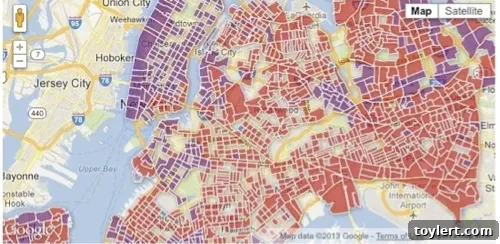
The aforementioned analyses often visualize this class stratification through detailed maps, offering a striking representation of economic geography. Though we cannot zoom into the specific map here, the insights it provides are crucial for understanding Brooklyn’s current state. The map typically highlights areas predominantly occupied by distinct economic classes, painting a vivid picture of disparity.
The Ascendance of the Creative and Knowledge Class in Brooklyn
On such maps, areas depicted in purple frequently signify neighborhoods dominated by creative and knowledge workers. These individuals, earning an average of approximately $87,625 annually (a figure that has likely increased since initial reporting), constitute a significant, albeit concentrated, portion of the metropolitan area’s workforce. Despite making up only about 36 percent of all workers across the larger metro region, their presence is overwhelmingly concentrated in specific Brooklyn enclaves.
Neighborhoods like **Park Slope**, **Brooklyn Heights**, and **Cobble Hill** stand out as prime examples, with over 80 percent of their residents falling into this high-income category. These areas represent some of the highest concentrations of creative and knowledge workers in the entire region. Characterized by historic brownstones, upscale boutiques, acclaimed restaurants, and proximity to cultural institutions, these neighborhoods offer a quality of life that commands premium housing prices. The influx of this affluent demographic has dramatically reshaped these communities, driving up property values, altering local businesses, and contributing to the broader narrative of gentrification that defines much of contemporary Brooklyn.
The vibrant energy and economic investment in these areas are undeniable, yet they also pose challenges. The exclusivity created by high costs of living often pushes out long-term residents and local businesses that cater to a more diverse income bracket, leading to a homogeneity that can diminish the very diversity New York City prides itself on. The amenities and opportunities available in these districts, while desirable, often remain inaccessible to those outside this high-earning bracket, reinforcing the class divisions.
The Backbone of the Service Sector: Brooklyn’s Essential Workers
In stark contrast, other parts of Brooklyn are home to a high percentage of service workers, who earn a considerably lower average wage, around $34,241. These are the individuals who keep the city running – the retail associates, healthcare aides, restaurant staff, cleaners, and transportation workers. Their contributions are indispensable, yet their compensation often leaves them struggling to afford the rising cost of living in the very city they serve.
Neighborhoods identified with high concentrations of service workers in Brooklyn include **Sheepshead Bay**, **Manhattan Beach**, **Canarsie**, as well as what the analysis terms **Bedford/Clinton Hill**, and several parts of **East New York**. These communities, while diverse in their own right, face different socio-economic pressures than their high-income counterparts. Housing is often more affordable (though still rapidly appreciating), and local economies are structured around different needs and price points. The residents of these areas often commute long distances to their jobs, relying on public transit, and dealing with varying levels of access to quality services, schools, and green spaces.
The economic vulnerability of service workers, exacerbated by the lack of affordable housing and stagnant wages, creates a precarious existence for many. These communities often grapple with issues of economic stability, access to upward mobility, and the pressure of gentrification encroaching from wealthier areas. Preserving the character and affordability of these neighborhoods is crucial for maintaining a truly diverse and functioning Brooklyn.
The Fading Echo of the Working Class in Brooklyn
Perhaps one of the most poignant aspects of the shifting class landscape is the near disappearance of the traditional working-class population from Brooklyn. While working-class employees still make up approximately 16 percent of the broader region’s workforce, the analysis reveals that none of the top locations for this demographic are found within Brooklyn. Instead, these concentrations are now primarily located in neighboring New Jersey. This geographical shift signifies a profound economic and social change.
Historically, Brooklyn was a stronghold of the working class, with robust industrial sectors and thriving communities built around blue-collar employment. The decline of manufacturing and the escalating cost of living have systematically pushed these populations out of the borough. Families who once found stable employment and affordable homes in Brooklyn are now compelled to seek opportunities and housing across the river, fragmenting communities and altering the borough’s socio-economic identity. This exodus not only represents a loss of economic diversity but also a depletion of the social fabric and history that define Brooklyn.
The Broader Implications of Class Segregation
The author of the initial analysis rightly concludes: “While our cities may be increasingly diverse in terms of nationality, ethnicity, and sexual orientation, they are becoming ever-more divided by class. These mounting divides threaten both their underlying economic dynamism and potentially their social and political stability as well.” This statement underscores the multifaceted dangers inherent in growing class segregation.
Threats to Economic Dynamism
A city thrives on innovation, a diverse talent pool, and the free flow of ideas. When communities are rigidly divided by income, it can stifle economic dynamism. Lack of access to quality education, healthcare, and economic opportunities for lower-income residents means a significant portion of the population cannot reach its full potential, leading to untapped human capital. Moreover, extreme class segregation can create economic monocultures in certain areas, making the entire city vulnerable to market fluctuations in specific industries. A healthy urban economy requires a broad base of consumers and workers across all income levels.
Challenges to Social Cohesion and Political Stability
Beyond economics, class divisions can erode the very social cohesion that makes cities vibrant. When residents of a city live in increasingly separate worlds, with vastly different daily experiences, amenities, and challenges, it fosters a sense of alienation and resentment. This can lead to decreased civic engagement, political polarization, and a diminished sense of shared identity. Social mobility becomes harder, and stereotypes can flourish. In extreme cases, deep-seated class divides have historically contributed to social unrest and political instability, posing a serious threat to the long-term health and governance of a city like New York.
Addressing the Divide: The Path Forward for Brooklyn
Recognizing the profound impact of this class divide is the first step toward addressing it. For Brooklyn, this means a multi-faceted approach. Policies aimed at preserving and expanding affordable housing are paramount, ensuring that essential workers and middle-income families can continue to live in the borough. Investments in public education and job training programs in underserved communities can create pathways to higher-paying jobs within the growing knowledge economy. Equitable urban planning that distributes amenities and resources more evenly across neighborhoods, rather than concentrating them in affluent areas, is also critical.
Furthermore, fostering a robust dialogue about the importance of class diversity can help bridge divides. Understanding the interconnectedness of all residents, regardless of income, is vital for building a resilient and equitable Brooklyn. Encouraging mixed-income developments, supporting local businesses that serve diverse communities, and advocating for fair wages are all crucial components of a strategy to mitigate class segregation.
The Importance of Class Diversity to Brooklyn’s Health
This leads us back to the central question: How important is class diversity to the health of Brooklyn? The answer is unequivocally “extremely important.” A healthy Brooklyn is not merely a collection of affluent enclaves and struggling service communities; it is a vibrant mosaic where people from all walks of life can live, work, and thrive. Class diversity fosters a richer cultural landscape, promotes innovation through varied perspectives, and builds a more resilient local economy. It ensures that the borough remains a place of opportunity, rather than a gilded cage for the few and a struggle for the many.
Without class diversity, Brooklyn risks losing its soul – the very grit, creativity, and community spirit that have long defined it. It risks becoming less adaptable, less equitable, and ultimately, less sustainable. Reversing the trend of escalating class division is not just a matter of social justice; it is a fundamental imperative for the long-term vitality and enduring success of Brooklyn.
What do you think? How critical is it for Brooklyn to actively cultivate and maintain its class diversity in the face of these ongoing economic shifts? Share your perspective on the challenges and potential solutions for fostering a more inclusive and equitable borough.