Editor’s note: For an updated perspective on this historic property, please refer to our latest feature here.
Continue reading the next segment of this architectural exploration: Part 2 of the Jacob Dangler House Story.
Unveiling the Enduring Mystery of the Jacob Dangler House in Bed-Stuy, Brooklyn
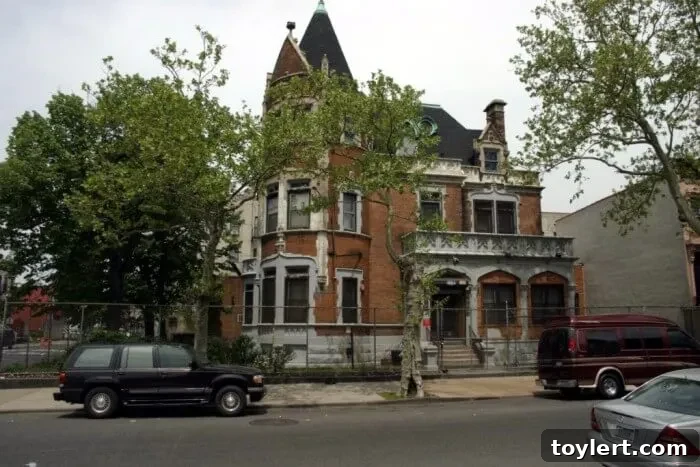
Nestled on the bustling northeast corner of Willoughby and Nostrand Avenues in Brooklyn’s historic Bedford-Stuyvesant neighborhood, stands an architectural enigma. The Jacob Dangler House, a colossal edifice of golden brick and exquisite limestone, often looms large and silent, its grandeur starkly contrasting with the more modest brownstone residences that typically define the surrounding blocks. Encircling it, a utilitarian chain-link fence barely contains the sprawling property, which occupies an unusually expansive lot for this densely packed urban environment. For countless individuals—whether they are patrons visiting the nearby Home Depot, just a block away, or commuters waiting for the Nostrand Avenue bus across the street—this majestic structure often sparks a moment of fleeting curiosity, a silent question mark punctuating their daily routines. Many gaze upon it, wondering about its origins, its purpose, and the stories hidden within its formidable walls. Was this truly the home of a wealthy family? What secrets does it hold?
An Architectural Anomaly in Bedford-Stuyvesant’s Urban Fabric
The very presence of the Jacob Dangler House is a study in contrasts. While Bedford-Stuyvesant is renowned for its magnificent rows of brownstones and other historically significant residential buildings, the Dangler Mansion presents an entirely different architectural narrative. Its design, a flamboyant French Gothic Revival style, characterized by ornate detailing, steeply pitched roofs, intricate tracery, and often asymmetrical massing, is more reminiscent of European châteaux than a typical Brooklyn dwelling. This opulent aesthetic, featuring elaborate stonework, turrets, gargoyles, and towering chimneys, sets it apart, demanding attention and inviting speculation. It’s a building that doesn’t just sit on the landscape; it dominates it, posing an immediate question to any observer: how did such a magnificent and seemingly out-of-place structure come to grace this particular corner of Bed-Stuy? Its golden brick facade, accentuated by the brilliant white of its limestone trim, glows distinctively, especially during sunrise or sunset, creating a visual spectacle unlike anything else on the block.
The Visionary Behind the Mansion: Who Was Jacob Dangler?
The name “Jacob Dangler” evokes images of a bygone era, of ambition, and significant wealth. While the exact details of Dangler’s life are often veiled in the mists of local lore and historical archives, it’s clear he was a man of considerable means and discerning taste. To commission a home of this scale and architectural extravagance in the late 19th or early 20th century—a period of significant industrial growth and burgeoning fortunes in New York—suggests a prominent figure, perhaps a successful merchant, industrialist, or financier. Such individuals often sought to establish their legacy not just through business ventures, but through monumental homes that reflected their prosperity and social standing. The choice of the French Gothic style, then highly fashionable among the elite, was a deliberate statement of sophistication and a nod to old-world grandeur, signaling the occupant’s aspiration to European refinement within the burgeoning American metropolis. Dangler likely intended this mansion to be a lasting testament to his success and a focal point for his family’s prominence within Brooklyn society.
A Glimpse into Bed-Stuy’s Gilded Age and Architectural Diversity
The construction of the Jacob Dangler House speaks volumes about the historical trajectory of Bedford-Stuyvesant itself. In its formative years, especially during the late 19th century, sections of Bed-Stuy, like neighboring areas such as Clinton Hill and Prospect Heights, were considered prime residential locations for Brooklyn’s elite. Wealthy families, drawn by the spacious lots, burgeoning infrastructure, and convenient access to Manhattan, invested heavily in constructing grand homes and mansions. These architectural treasures often showcased the diverse styles popular at the time, from Romanesque Revival to Queen Anne, Italianate, and, evidently, French Gothic. The Dangler House, therefore, is not merely an isolated architectural marvel; it is a tangible link to a vibrant chapter in Bed-Stuy’s history, a period when the neighborhood was home to a different kind of urban affluence. It represents a deliberate departure from the more common brownstone aesthetic, highlighting a period where individual wealth allowed for grander, more eclectic architectural expressions, ultimately contributing to the rich cultural tapestry that persists in the area today.
The Lingering Questions: Abandoned, Empty, or Simply Waiting for a New Chapter?
The most persistent questions revolve around the mansion’s current state. Is it truly abandoned? Is it simply empty? These inquiries are frequently voiced by those who pass by, struck by its imposing presence yet apparent dormancy. The presence of a chain-link fence, while offering some degree of security, also contributes to the perception of neglect or disuse. Large, historic properties like the Dangler House present unique challenges to their owners. The costs associated with maintenance, heating, and preserving intricate architectural details can be astronomical. Furthermore, the sheer size of the building makes it less adaptable to modern residential needs without significant, and often costly, renovations. As such, many grand mansions across urban landscapes face periods of vacancy or uncertain futures, caught between their historical significance and the demands of contemporary urban development and economics. The Dangler House embodies this common dilemma, standing as a silent testament to the challenges of urban preservation.
Inside the Enigma: Has Anyone Ever Been Inside the Jacob Dangler Mansion?
The question of whether anyone has ever been inside this mysterious mansion fuels the local legend. For many, the interior remains an untouched realm, conjuring images of dust-laden ballrooms, grand staircases shrouded in cobwebs, and forgotten remnants of a lavish past. While it’s highly improbable that the house has remained entirely untouched since its original occupants, the public’s perception of it as a sealed-off time capsule only adds to its mystique. The reality of historic property ownership often involves periods of renovation, varying uses (from private residence to institutional building), and sometimes, unfortunately, decline. Speculation about the interior might include elaborate Victorian-era decor, rich wood paneling, ornate plasterwork, and stunning stained-glass windows, all elements typical of such a grand French Gothic design. A grand foyer would likely open to a sweeping staircase, leading to multiple levels of generously proportioned rooms, each designed for specific social functions, from formal dining to private libraries and master suites. The unknown, in this case, allows the imagination to run wild, painting vivid pictures of the opulent life that once thrived within its impressive walls, beckoning us to wonder about the stories those walls could tell if they could speak.
The potential future of the Jacob Dangler House is a topic of ongoing discussion among preservationists, real estate developers, and local residents. Could it be restored to its former glory as a magnificent private residence, perhaps attracting a new owner with the vision and resources to undertake such a monumental task? Could it be adapted for institutional use, perhaps as a vibrant cultural center, a unique museum, a boutique hotel, or even converted into luxury condominiums, a common fate for many historic urban mansions seeking new life in the modern era? Each option presents its own set of hurdles, from navigating complex zoning regulations and securing substantial funding to the delicate balance of modernization without compromising historical integrity. The community’s enduring interest in the house often stems from a collective desire to see this unique landmark not only preserved but also reintegrated into the vibrant life of Bed-Stuy, serving a purpose that honors its past while contributing meaningfully to the neighborhood’s future cultural and economic landscape.
A Beacon of History and an Enduring Local Identity
Despite its air of mystery and occasional apparent neglect, the Jacob Dangler House serves as an undeniable landmark for Bedford-Stuyvesant. It’s more than just a building; it’s a conversation starter, a clear point of reference for directions, and a silent observer to the ever-evolving streetscape. For long-time residents, it might evoke memories of earlier days in the neighborhood, recalling its grandeur in different eras, while for newcomers, it sparks an immediate curiosity about Bed-Stuy’s rich and complex history. It stands as a testament to the diverse architectural heritage of Brooklyn, reminding passersby that even within seemingly uniform urban grids, pockets of extraordinary history and individual expression can be found. Its unique incongruity with the surrounding urban fabric is precisely what makes it so captivating, a golden brick anomaly defying easy categorization and continually beckoning deeper inquiry into the narratives of wealth, aspiration, and architectural artistry that shaped this corner of Brooklyn.
The enduring allure of the Jacob Dangler House lies not just in its imposing architecture or its unusual location, but in the layers of unanswered questions it presents to all who encounter it. It challenges us to look beyond the surface, to ponder the lives of those who built and inhabited such grand structures, and to consider the profound forces—social, economic, and cultural—that shape our urban environments. As Bed-Stuy continues its dynamic transformation, balancing the critical need for preservation with the relentless march of progress, the fate of the Jacob Dangler House remains a captivating symbol of its past and a potential harbinger of its future. It is a silent sentinel, guarding stories untold and awaiting the next chapter in its remarkable existence, a true architectural jewel that continues to fascinate, inspire, and provoke thought among all who encounter its enigmatic presence on Willoughby Avenue.