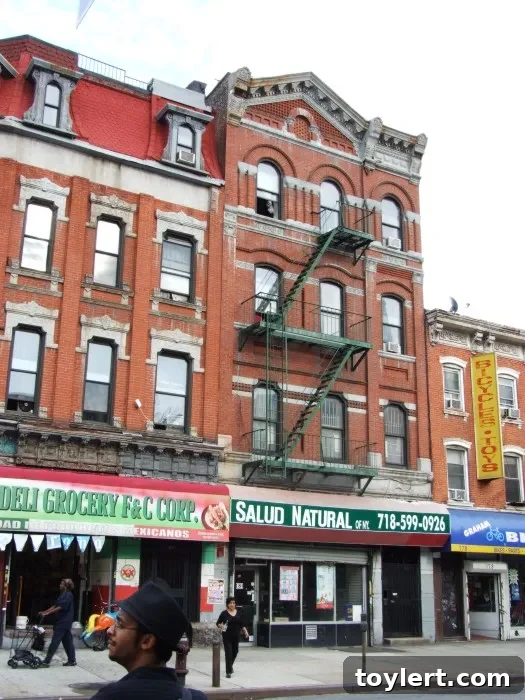
Brooklyn’s Architectural Heartbeat: Exploring 180 Graham Avenue
Brooklyn, a borough renowned for its distinctive character and vibrant communities, tells its rich story one building at a time. Each structure, from the grand brownstones of Park Slope to the industrial-chic conversions of Dumbo, contributes a unique chapter to the borough’s illustrious history. Among these architectural narratives, buildings like 180 Graham Avenue stand as quintessential examples of Brooklyn’s enduring charm and functional design. This particular address represents a classic example of a “flats building with storefront,” a mixed-use archetype that has shaped the urban landscape and fostered bustling neighborhoods for generations.
The Enduring Appeal of Brooklyn’s Mixed-Use Architecture
The concept of a building housing both residential “flats” and a ground-floor “storefront” is deeply embedded in the fabric of New York City, and particularly Brooklyn. This architectural style emerged as a practical solution to urban living, providing convenient access to essential goods and services for residents living directly above or nearby. Such buildings are not merely structures; they are vital arteries of local commerce and community life, fostering a walkable environment and contributing significantly to the lively, street-level energy that defines so many Brooklyn neighborhoods. They represent a harmonious blend of domestic tranquility and commercial dynamism, making them highly desirable in today’s urban planning conversations.
180 Graham Avenue: A Snapshot of Brooklyn’s Legacy
Located on Graham Avenue, a thoroughfare known for its eclectic mix of old and new establishments, 180 Graham Avenue perfectly encapsulates this mixed-use tradition. This building, like many of its contemporaries, would have been constructed during a period of rapid urban expansion in Brooklyn, likely in the late 19th or early 20th century. During this era, as Brooklyn’s population soared with waves of immigrants and new residents, there was a pressing need for efficient, multi-functional buildings that could accommodate both the growing population and their daily needs. The design of 180 Graham Avenue reflects a practical aesthetic, prioritizing utility while often incorporating elements of popular architectural styles of its time.
Architectural Features and Historical Context
While specific architectural blueprints for 180 Graham Avenue might not be immediately available, its designation as a “flats building with storefront” allows us to infer many of its typical characteristics. These buildings are typically constructed from robust, locally sourced materials, predominantly brick, chosen for its durability, fire resistance, and aesthetic appeal. The facade would likely feature a distinctive commercial storefront at street level, characterized by large display windows designed to showcase merchandise and invite passersby. Above this commercial base, the residential floors, or “flats,” would typically feature more modest windows, often arranged symmetrically, providing natural light and ventilation to the living spaces within.
Craftsmanship and Design Elements
One can imagine the craftsmanship evident in the details of 180 Graham Avenue. Look for decorative brickwork patterns, perhaps a subtle cornice or lintels above windows that offer a touch of architectural embellishment without being overly ostentatious. The entrance to the residential units would typically be separate from the storefront, often a discreet doorway leading to a staircase, ensuring privacy for residents while maintaining easy access to the commercial space below. These buildings often feature high ceilings on the ground floor to accommodate various retail configurations, while residential units above would offer a range of layouts, from studios to multi-bedroom apartments, catering to diverse populations that sought affordable and convenient housing in a thriving urban center.
The Storefront: A Mirror to Neighborhood Evolution
The ground-floor storefront at 180 Graham Avenue has undoubtedly witnessed a fascinating evolution over the decades. Historically, it might have housed a neighborhood grocery, a butcher shop, a pharmacy, or a dry goods store – essential services that catered directly to the local community. These establishments were more than just businesses; they were informal community hubs where neighbors would meet, exchange news, and form social bonds. In contemporary Brooklyn, such storefronts continue to adapt, often transforming into boutique cafes, artisanal shops, modern eateries, or service-based businesses that reflect the current tastes and demographics of the area. This adaptability is a testament to the enduring versatility and commercial viability of this building type.
Graham Avenue: A Historic Corridor in an Evolving Brooklyn
Graham Avenue itself holds significant historical importance in Brooklyn. Spanning neighborhoods like Williamsburg and Bushwick, it has long served as a vital commercial and residential artery. Its history is interwoven with the stories of countless immigrants and communities who have called Brooklyn home. From its early days as a bustling market street to its current status as a vibrant destination for dining, shopping, and culture, Graham Avenue continues to be a dynamic reflection of Brooklyn’s constant evolution. Buildings like 180 Graham Avenue are the very pillars of this continuity, anchoring the street’s historical character amidst inevitable change and modernization.
The Pulse of a Brooklyn Neighborhood
Walkability is a key feature of life on Graham Avenue, a characteristic largely enabled by the prevalence of mixed-use buildings. The proximity of homes to shops, restaurants, and other amenities creates a vibrant, pedestrian-friendly environment. Residents of 180 Graham Avenue, for instance, would have had (and still have) the convenience of stepping out of their building directly onto a street bustling with activity, allowing them to fulfill their daily needs without relying on extensive travel. This design philosophy fosters a strong sense of local identity and community engagement, encouraging residents to explore their immediate surroundings and support local businesses, thereby strengthening the neighborhood’s economic and social fabric.
Connecting Past and Present
The charm of 180 Graham Avenue extends beyond its functional design; it lies in its ability to connect the past with the present. It stands as a silent witness to generations of life, laughter, commerce, and community. Its brick facade might hold untold stories of the families who lived in its flats and the entrepreneurs who ran businesses from its storefront. In an age where urban development often favors large-scale, anonymous structures, buildings like 180 Graham Avenue remind us of the value of human-scaled architecture, of structures that integrate seamlessly into the daily lives of their inhabitants and contribute profoundly to the unique identity of their neighborhood. They are living museums, continually adapting yet retaining an undeniable link to their origins.
The Significance of Preserving Brooklyn’s Architectural Heritage
Preserving structures like 180 Graham Avenue is crucial for maintaining Brooklyn’s distinctive architectural heritage and its unique sense of place. These buildings are not just old; they embody historical periods, architectural styles, and community narratives that are irreplaceable. Efforts to maintain and sensitively restore such buildings ensure that future generations can appreciate the craftsmanship of the past and understand the historical evolution of their urban environment. They serve as valuable educational tools, illustrating the principles of sustainable urban development long before the term became commonplace, showcasing how density, mixed-use, and walkability have always been key to thriving cities.
A Blueprint for Sustainable Urban Living
Beyond their historical value, mixed-use buildings offer a practical blueprint for sustainable urban living in the 21st century. By consolidating residential and commercial functions, they reduce commuting needs, lower energy consumption, and foster more efficient use of urban land. The design of 180 Graham Avenue, with its integrated living and working spaces, exemplifies a model that many modern urban planners are now striving to recreate. It demonstrates that vibrant, self-sufficient neighborhoods are often built around such multi-functional structures, creating a dynamic interplay between public and private life, commerce and community.
180 Graham Avenue: A Testament to Brooklyn’s Enduring Spirit
In conclusion, 180 Graham Avenue is more than just an address; it is a microcosm of Brooklyn’s spirit. It embodies the borough’s resilience, its architectural ingenuity, and its unwavering commitment to community. As “a flats building with storefront,” it stands as a humble yet powerful monument to a functional and beautiful architectural tradition that continues to define Brooklyn’s urban landscape. Exploring such individual buildings allows us to appreciate the intricate tapestry that makes Brooklyn one of the world’s most cherished and dynamic cities, reminding us that its true magic lies in the stories etched into the brick and mortar of its everyday architecture.