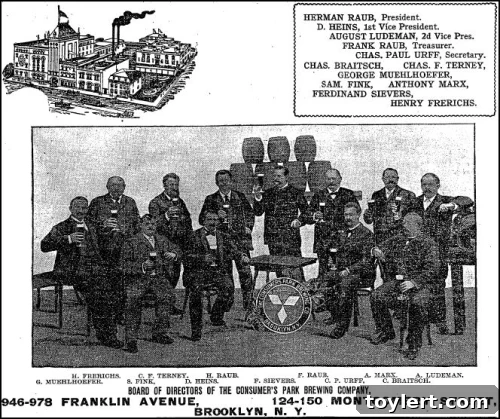
(Brooklyn Eagle, June 1, 1900)
For deeper insights into this compelling narrative, we invite you to explore Part 2 of this comprehensive story.
Brooklyn’s Brew and Ball: The Enduring Legacy of Consumers Park Brewery and Ebbets Field
In the vibrant, rapidly developing landscape of early 20th-century Brooklyn, a visionary quest was unfolding – one that would irrevocably merge the borough’s robust industrial past with its burgeoning passion for America’s favorite pastime. The year was 1908, and Charles H. Ebbets, the astute and ambitious owner of the Brooklyn Dodgers baseball team, was on a relentless search for the perfect site to construct a magnificent new ballpark. He envisioned a permanent, grand home for his beloved team, a stadium that would not only serve as a cutting-edge venue for sports but also symbolize Brooklyn’s spirit and ambition.
Ebbets’ extensive search eventually led him to an inconspicuous, somewhat neglected stretch of land known as Crow Hill. This area, nestled strategically between the flourishing neighborhoods of Flatbush and the historic St. Marks District, appeared at first glance to be an unlikely candidate. It was largely undeveloped, serving primarily as an ash dump, with minimal activity beyond a few sprawling industrial complexes. Yet, Ebbets, with his sharp business acumen and profound foresight, perceived beyond the superficial. He saw not just a desolate plot, but a canvas ripe for transformation, a location with unparalleled potential for his dream stadium.
Despite its underdeveloped appearance, Crow Hill was not entirely devoid of significant operations. It was home to two key industrial entities that underscored the era’s economic priorities. One was the Flatbush Hygeia Ice Company, located prominently at 984 Franklin Avenue, a crucial provider of ice in a time when modern refrigeration was still a nascent technology. The other, and arguably the more dominant presence, was the Consumers Park Brewery. This colossal complex of robust buildings was a veritable powerhouse, dedicated to crafting the very beverage that had become an integral part of Brooklyn’s identity: rich, flavorful lager beer. For Charles Ebbets, this remarkable convergence of a vast, accessible plot of land, a major brewery, and a vital ice plant presented an almost poetic opportunity. After all, what could be a more iconic and beloved pairing in American culture than the thrilling excitement of a baseball game complemented by the crisp, refreshing taste of an ice-cold beer?
The Ambitious Quest: Charles Ebbets’ Vision for Ebbets Field
Charles Ebbets’ arduous journey to construct what would become the legendary Ebbets Field was a testament to his sheer determination, masterful negotiation skills, and an unwavering belief in the future prosperity of Brooklyn baseball. For many years, the Dodgers had operated from various temporary or increasingly inadequate venues, most notably Washington Park. Ebbets, however, harbored a grander vision: a modern, capacious stadium that would not only significantly enhance the experience for baseball fans but also firmly anchor the team’s presence within the heart of Brooklyn. To realize this vision, he required a location that met several critical criteria: it needed to be easily accessible to the public, sufficiently expansive to accommodate future growth, and, vitally, affordable enough to make the ambitious project financially feasible.
Crow Hill, with its comparatively low property values and its somewhat neglected status, emerged as an ideal candidate, a blank slate for Ebbets’ monumental project. The area, which was then considered part of Flatbush and would later become integrated into the vibrant Crown Heights neighborhood, was quite distant from the borough’s established commercial and residential centers. Nevertheless, its gentle topographical rise offered natural advantages for stadium construction, promising excellent sightlines for spectators and efficient drainage. The inherent challenge, of course, lay in transforming what was essentially an industrial wasteland, punctuated by an ash dump, into a magnificent sporting cathedral. Ebbets was keenly aware that this undertaking would not be simple, demanding substantial investment in land acquisition, site preparation, and infrastructure development. However, the strategic proximity to rapidly growing residential areas and the potential for future transportation links made this daunting gamble seem eminently worthwhile.
Crow Hill’s Transformation: From Overlooked Land to Historic Locale
Before Charles Ebbets’ transformative vision took hold, Crow Hill existed as a poignant symbol of urban neglect and industrial pragmatism. It literally functioned as an ash dump, a sprawling receptacle for the refuse and byproducts generated by a rapidly industrializing city. While certainly unglamorous, this designation meant that the land was both inexpensive and readily available for acquisition. Yet, beneath its rough and unpolished exterior, the area possessed intrinsic, often overlooked, value. Its elevated position offered potential panoramic views, and its strategic location, bordering several burgeoning residential districts, promised a steady influx of future baseball enthusiasts. Furthermore, the established presence of the Consumers Park Brewery and the Flatbush Hygeia Ice Company strongly indicated that, despite its undeveloped state, the area was already a hub of significant industrial activity, suggesting that essential infrastructure and transportation networks could be developed or improved with relative ease.
Consumers Park Brewery: A Colossus in Brooklyn’s Brewing Heritage
Long before the resounding crack of baseball bats echoed and the roaring cheers of crowds reverberated across the future site of Ebbets Field, the air in Crow Hill was perennially rich with the distinct, yeasty aroma of brewing malt and fermenting hops. The Consumers Park Brewery was far more than just another brewery; it stood as an foundational pillar of Brooklyn’s esteemed reputation as one of America’s foremost brewing capitals. Established in the latter half of the 19th century, it rapidly ascended to become one of the largest and most prolific breweries throughout the entire region, boasting an expansive complex of buildings. This included state-of-the-art brewhouses, subterranean fermentation cellars, high-capacity bottling plants, and extensive storage facilities. Its imposing red-brick structures and towering smokestacks were iconic features of the Crow Hill skyline, serving as powerful symbols of the era’s industrial might and economic prosperity.
A Thriving Industrial Hub and the Golden Age of Brooklyn Lager
The late 1800s and early 1900s unequivocally marked the golden age of brewing in Brooklyn. The borough was a veritable epicenter of beer production, home to dozens of breweries that collectively produced an astonishing volume of beer, with lager consistently leading in immense popularity across the entire United States. The Consumers Park Brewery played an exceptionally significant and central role in fueling this massive boom. Its strategic location afforded seamless access to critical rail lines and burgeoning waterways, greatly facilitating both the efficient import of essential raw materials and the widespread distribution of its highly sought-after finished products across the vast expanse of New York City and far beyond. The brewery itself was a major employer, providing livelihoods for hundreds of local residents, thereby contributing profoundly to the local economy and intricately weaving itself into the very fabric of the community. Its undeniable success was a direct result of a potent combination of highly efficient production methodologies, widely popular recipes, and sophisticated, effective marketing strategies, which collectively transformed its “Consumers Park Beer” into a recognizable and beloved household name.
The operational scale of the brewery was nothing short of a marvel of industrial engineering. From the meticulous malting of high-quality barley to the precise and carefully controlled fermentation processes and the painstaking bottling procedures, every single step in the production chain was meticulously optimized for both unparalleled quality and maximum volume. This was an era where local breweries wielded immense influence over regional tastes and preferences, and the Consumers Park Brewery stood as an undisputed titan within this competitive landscape, consistently brewing millions of barrels of beer annually. Its product transcended being merely a beverage; it embodied a symbol of leisure, facilitated community gatherings, and offered well-earned relief after a long day of strenuous labor. It was profoundly woven into the social tapestry of Brooklyn life, serving as a natural and anticipated companion to local festivals, cherished family picnics, and, of course, the burgeoning excitement of sporting events.
The Symbiosis of Baseball and Beer: A Deep Cultural Connection
The remarkable convergence of a major brewery and a future baseball stadium on the very same plot of land represented far more than just a convenient logistical arrangement for Charles Ebbets; it was a profound, almost symbolic, alignment of two deeply ingrained American passions. Baseball and beer have historically shared an intrinsic and powerful connection within American culture. Spectators at baseball games routinely quenched their thirst with locally brewed beverages, and breweries themselves frequently sponsored local sports teams, cementing this cultural bond. The innovative concept of having a bustling brewery virtually adjacent to a major ballpark was, for Ebbets, a stroke of genuine genius. This unique proximity promised not only a reliable and abundant supply of his favorite refreshment but also cultivated a deep cultural resonance that would undoubtedly appeal to the everyday Brooklynite, reinforcing a sense of community and shared experience.
One can vividly imagine the bustling scene: thousands of enthusiastic fans streaming into the newly constructed stadium, the tantalizing scent of hot dogs intermingling with the lingering, earthy aroma of malt wafting from the nearby brewery. It was a rich sensory experience that perfectly encapsulated the very essence of urban leisure, communal celebration, and the burgeoning spirit of a growing metropolis. The brewery’s imposing presence, with its robust industrial aesthetic, lent an authentic, turn-of-the-century charm to the site, grounding the grand spectacle of professional sports within the tangible, working-class reality of Brooklyn. This symbiotic relationship between industry and entertainment created a unique atmosphere that was quintessentially Brooklyn, a place where hard work and hearty enjoyment went hand-in-hand.
The Flatbush Hygeia Ice Company: An Essential Cold Companion to Industry
Any comprehensive discussion of early 20th-century industry, particularly the intricate processes of brewing, would be incomplete without a thorough acknowledgment of the absolutely critical and often overlooked role of ice. In an era predating widespread electric refrigeration, ice was an indispensable commodity, vital for preserving perishable foods, chilling beverages to palatable temperatures, and facilitating numerous industrial processes. The Flatbush Hygeia Ice Company, strategically positioned in close proximity to the Consumers Park Brewery, was therefore a profoundly vital component of the local industrial infrastructure. The term “Hygeia” itself was commonly used by companies that prided themselves on producing sanitary, artificially manufactured ice, distinguishing their product from natural ice harvested from lakes and rivers, which often carried the risk of impurities.
The mere presence of the ice plant at 984 Franklin Avenue meant that the Consumers Park Brewery enjoyed a consistently reliable, large-scale source of high-quality ice readily available. This was absolutely crucial for maintaining the precise temperature control required during the delicate fermentation and storage phases of beer production, and especially for ensuring the beer remained “ice cold” for its subsequent distribution to thirsty consumers. The inherent synergy between the ice company and the brewery created a highly efficient micro-ecosystem of industrial collaboration, perfectly illustrating how various specialized industries mutually supported each other within the constraints of a pre-modern infrastructural landscape. While perhaps less outwardly glamorous than the grand process of beer production, the ice company functioned as a silent, unwavering workhorse, directly enabling the brewery’s monumental success and, by extension, providing a fundamental and indispensable service to the broader Brooklyn community, impacting daily life in numerous unseen ways.
Transformation and Enduring Legacy: From Brewery to Ballpark and Beyond
The collective story of Crow Hill, the Consumers Park Brewery, and the indefatigable Charley Ebbets is one of profound and inevitable transformation. The expansive land Ebbets painstakingly acquired, much of which was either occupied by or directly adjacent to the sprawling brewery complex, was destined to undergo a radical metamorphosis. The brewery itself, despite its monumental scale, immense importance to the local economy, and its deep roots in Brooklyn’s industrial fabric, would ultimately yield to the relentless march of urban progress and strategic development. By the time the majestic Ebbets Field first opened its gates to an eager public in 1913, significant portions of the Consumers Park Brewery had already been systematically demolished or ingeniously repurposed to clear space for the grandstands, sprawling concourses, and myriad facilities of the groundbreaking new stadium. The complete demolition of the brewery complex was a gradual process, unfolding over several years as Ebbets progressively acquired additional parcels of land essential for stadium expansion and the construction of vital ancillary facilities.
From Brewery to Ballpark: A Changing Landscape Reflecting Societal Shifts
The ambitious conversion of a robust industrial site into a world-class baseball stadium stood as a powerful testament to the era’s boundless ambition and forward-thinking vision. The Consumers Park Brewery, once a towering symbol of Brooklyn’s formidable industrial prowess, was gradually but decisively superseded by Ebbets Field, an iconic monument to the borough’s burgeoning sporting spirit and its embrace of mass entertainment. This monumental transition mirrored broader, sweeping shifts occurring within American society, moving away from heavy manufacturing as the primary source of public identity and economic might, towards the burgeoning influence of mass media and spectator sports as dominant forms of cultural engagement and leisure. The brewery’s eventual demise was also critically accelerated by the ominous and looming specter of Prohibition, which would soon devastate the entire brewing industry across the United States when it was enacted in 1920. Even prior to the full force of Prohibition, the accumulating economic pressures and Ebbets’ relentless, singular pursuit of his dream ballpark ensured that the brewery’s days on that particular, invaluable site were emphatically numbered.
Remembering a Bygone Era: The Echoes of a Rich History
Today, the tangible, physical remnants of the once-mighty Consumers Park Brewery are largely non-existent, having long since been replaced by the modern residential buildings and diverse commercial establishments that collectively define the contemporary face of Crown Heights. Ebbets Field itself, after hosting countless legendary moments, iconic players, and beloved teams for several glorious decades, tragically met a similar fate, being demolished in the 1960s – a deeply painful and indelible loss for generations of Brooklynites following the Dodgers’ controversial relocation to Los Angeles. Yet, despite the physical absence, the profound memory and enduring legacy of these once-grand institutions persist and resonate deeply within the collective consciousness of the borough.
The fascinating narrative of the Consumers Park Brewery serves as a potent reminder of Brooklyn’s incredibly rich industrial past, its pivotal and often unsung role in shaping America’s brewing history, and the vibrant, interconnected economic ecosystem that once thrived so powerfully in neighborhoods like Crow Hill. It stands as a compelling historical account, vividly illustrating how seemingly disparate elements – an overlooked ash dump, an immense, bustling brewery, an essential ice plant, and the singular vision of an ambitious baseball owner – converged synergistically to forge a truly legendary chapter in the extensive urban development of New York City. The next time you find yourself savoring a perfectly chilled beer or reminiscing about the glorious, unforgettable days of classic baseball, take a moment to recall the unsung heroes of industry, like the Consumers Park Brewery, whose very foundations once laid the groundwork for dreams, literally paving the way for one of baseball’s most iconic stadiums and forever altering Brooklyn’s historical trajectory.