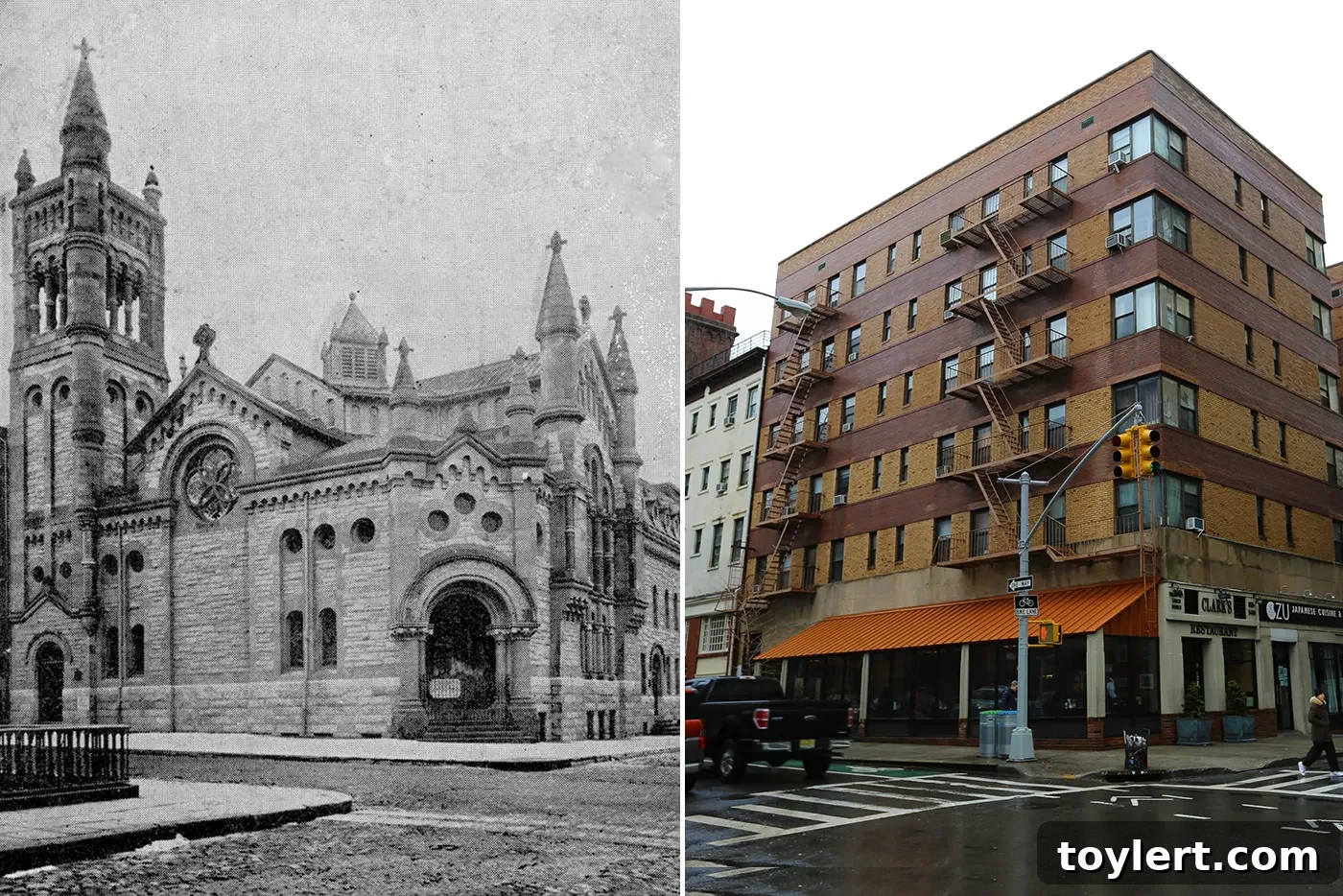
The Enduring Architectural Debate: Sands Street Memorial Church vs. 70 Clark Street, Brooklyn Heights
Brooklyn Heights, a neighborhood renowned for its picturesque brownstones and historic charm, holds countless stories of architectural evolution within its tree-lined streets. One such compelling narrative unfolds at the corner of Henry and Clark streets, a site that has witnessed a dramatic transformation over the past century. Here, the opulent Sands Street Memorial Church, a true marvel of Victorian design, once commanded attention. Today, a distinctly modern apartment building stands in its place, sparking a timeless debate about style, progress, and preservation. This stark contrast at 70 Clark Street encapsulates the broader architectural journey of Brooklyn, inviting us to ponder which era’s aesthetic truly resonates more deeply with the spirit of the borough.
From Victorian Grandeur to Modern Functionality: A Brooklyn Heights Saga
Imagine Brooklyn Heights in its late 19th-century heyday, a bustling hub of ornate design and intricate craftsmanship. The Sands Street Memorial Church, a quintessential example of “over-the-top Victorian architecture,” would have been a breathtaking sight to behold. Churches of this era were not merely places of worship; they were monumental expressions of faith, community pride, and architectural ambition. Characterized by towering spires that pierced the sky, elaborate stained-glass windows depicting biblical scenes, and façades adorned with intricate stonework, turrets, and gargoyles, the Sands Street Memorial Church embodied the maximalist aesthetic popular at the time. Its construction reflected a period when buildings were designed to inspire awe and convey a sense of permanence and grandeur. Every archway, every meticulously carved detail, and every vibrant hue would have contributed to an overwhelming sensory experience, drawing the eye upwards and captivating the imagination of passersby.
This magnificent structure likely served as a vibrant cornerstone of the Brooklyn Heights community, a gathering place for worship, social events, and civic engagement. Such churches were often central to neighborhood identity, their presence shaping the urban fabric and contributing significantly to the character of the surrounding blocks. The architectural style, often borrowing from Gothic Revival or Romanesque Revival traditions, emphasized a connection to historical European precedents, albeit with a distinct American interpretation. The sheer scale and decorative richness of the Sands Street Memorial Church would have made it an undeniable landmark, a testament to the era’s robust economy and fervent belief in artistic expression through monumental construction.
The Dawn of “Apartment Modern”: A Post-War Reimagining
Fast forward to the mid-20th century, specifically 1948, and the architectural landscape of Brooklyn, much like the rest of New York City, was undergoing a significant paradigm shift. The post-World War II era ushered in an urgent need for housing, coupled with a philosophical move away from the highly decorative and often labor-intensive styles of the past. Modernism, with its emphasis on functionality, clean lines, and efficient use of space and materials, began to dominate urban planning and construction. This new aesthetic, often termed “apartment modern,” prioritized practicality and accessibility over elaborate ornamentation.
The building that replaced the Sands Street Memorial Church at 70 Clark Street perfectly encapsulates this transition. Described by Brownstoner historian Suzanne Spellen as a “boxy banded apartment building” – a description that speaks volumes about its aesthetic – it represents a stark departure from its predecessor. Gone were the spires and intricate carvings, replaced by a more understated, often rectilinear design. Such buildings typically feature a harmonious blend of brick, concrete, and large windows, designed to maximize light and provide comfortable, albeit less ornate, living spaces. While perhaps “not an award winner” in the traditional sense of groundbreaking architectural innovation, its practicality and durability have ensured its place as a “perfectly decent building” that has served its residents well for decades.
The decision to replace a grand Victorian church with a modern apartment complex was indicative of broader urban development trends. Demolitions of older, often costly-to-maintain structures were common, making way for new developments that could address the pressing demand for housing in a rapidly growing metropolitan area. The new building at 70 Clark Street, with its focus on efficiency and utility, provided much-needed residential units in a prime Brooklyn Heights location. Its architectural language, while contrasting sharply with the Victorian era, spoke to a different set of values: affordability, accessibility, and a streamlined approach to urban living.
A Neighborhood Landmark Transformed: The Legacy of 70 Clark Street
Beyond its architectural style, the current building at 70 Clark Street has established its own unique legacy within Brooklyn Heights. For many years, its lower floor housed a beloved neighborhood drug store and soda shop. These ground-floor businesses were more than just retail spaces; they were vital community hubs, places where neighbors gathered, shared news, and forged connections. The local drug store often served as an informal meeting point, a place for quick chats and friendly faces, while the soda shop provided a nostalgic setting for families and friends to enjoy simple pleasures. Such establishments contribute immensely to the fabric of a neighborhood, fostering a sense of belonging and continuity that extends beyond the aesthetic appeal of the building itself.
The enduring presence of these community-focused businesses highlights an important aspect of urban development: a building’s true value often lies not just in its facade, but in its utility and its capacity to support a thriving community. Even if its architecture doesn’t inspire the same “over-the-top” awe as its predecessor, the 70 Clark Street apartment building has undeniably played a crucial role in the daily lives of Brooklyn Heights residents. It represents a different kind of architectural success – one rooted in practicality, resilience, and its ability to house both people and essential services over many decades.
The Unending Dialogue: Preservation vs. Progress in Brooklyn’s Urban Landscape
The story of 70 Clark Street is a microcosm of a larger, ongoing dialogue in urban centers worldwide: the tension between architectural preservation and the demands of modern progress. On one hand, historic buildings like the Sands Street Memorial Church are irreplaceable cultural artifacts. They offer tangible links to the past, preserving the craftsmanship, artistic values, and societal structures of previous generations. To lose them is to lose a piece of collective memory and a unique aesthetic contribution to the urban environment. Architectural preservationists argue for the importance of maintaining these landmarks, not just for their beauty, but for their historical significance and their ability to enrich the cultural tapestry of a city.
On the other hand, urban areas like Brooklyn are dynamic entities, constantly evolving to meet the needs of their inhabitants. The necessity for more housing, updated infrastructure, and modern amenities often dictates changes to the existing built environment. The “apartment modern” style that emerged post-war was a pragmatic response to these challenges, offering efficient and affordable solutions for a growing population. While some might lament the loss of Victorian grandeur, others appreciate the functional simplicity and accessibility that modern architecture provides. This constant push and pull between honoring the past and building for the future defines the character of neighborhoods like Brooklyn Heights, which has carefully balanced development with the preservation of its distinctive architectural heritage, particularly within its designated historic districts.
Reflecting on Brooklyn Heights’ Architectural Evolution
Brooklyn Heights itself is a testament to this delicate balance. As one of New York City’s first historic districts, it is celebrated globally for its stunning array of 19th-century architecture, from classic brownstones to Federal-style homes and Greek Revival mansions. Yet, within this preserved landscape, pockets of modernization, like 70 Clark Street, serve as reminders of the district’s continuous evolution. These architectural juxtapositions tell a compelling story of adaptation, illustrating how urban spaces respond to changing social, economic, and aesthetic demands over time.
The transformation at Henry and Clark streets invites us to reflect on our own architectural preferences and values. Do we gravitate towards the intricate, narrative-rich designs of the Victorian era, finding beauty in their historical depth and lavish ornamentation? Or do we find greater appeal in the clean lines, functional efficiency, and understated elegance of “apartment modern” buildings, which prioritize practical living and contemporary design? There is no single correct answer, as both styles contribute uniquely to the rich, layered architectural history of Brooklyn. The site at 70 Clark Street, captured in the striking ‘then and now’ imagery, serves as a powerful visual prompt, urging us to consider the ongoing dialogue between the past and present, and to appreciate the diverse beauty that defines Brooklyn’s enduring urban landscape.
Ultimately, the choice between old and new, or rather, the appreciation of both, is a personal one. What remains undeniable is the fascinating narrative woven into the very foundations of Brooklyn Heights, a story that continues to unfold with every passing decade, shaping the identity of one of New York City’s most cherished neighborhoods. The corner of Henry and Clark streets stands as a living testament to this ever-evolving architectural journey.