The Enduring Legacy of Partnership: Crafting Brooklyn’s Iconic 19th-Century Apartments
Continue reading about this remarkable partnership in Part 2 of our story.
Throughout history, the power of collaboration has often been the catalyst for transformation, elevating individuals from mere competence to unparalleled greatness. This phenomenon is particularly evident in the creative arts, where artists, musicians, dancers, and architects frequently reach their zenith not in isolation, but through the synergistic bond forged with a supportive partner. This support can manifest in myriad forms—financial backing, personal encouragement, professional collaboration, or even constructive antagonism—yet the consistent outcome is a body of work that inspires, moves, and profoundly benefits society. Today, we delve into such a profound union: that of a celebrated architect and his less-known but equally pivotal developer partner. Together, they sculpted some of Brooklyn’s earliest and most distinguished late 19th-century apartment buildings, advancing their individual careers and leaving an indelible mark on the borough’s urban landscape, all while nurturing a friendship that endured until their final days.
The Genesis of a Vision: Brooklyn in the Gilded Age
The late 19th century was a period of explosive growth and dramatic change for Brooklyn. Once a collection of independent towns, it rapidly transformed into a burgeoning metropolis, poised to merge with New York City. This era, often dubbed the Gilded Age, was characterized by industrial expansion, burgeoning wealth, and a population boom driven by immigration. As the borough’s population swelled, so did the demand for innovative housing solutions. The traditional brownstone, while elegant, no longer sufficed for the burgeoning middle class seeking modern conveniences and communal living options. This societal shift paved the way for the rise of the apartment building—a revolutionary concept at the time—offering comfort, efficiency, and a new urban lifestyle.
It was in this dynamic environment that two remarkable individuals, architect Montrose W. Morris and developer Louis F. Seitz, found their paths intersecting. Morris, already gaining recognition for his distinctive architectural style and innovative designs, possessed an artistic vision that sought to elevate the utilitarian nature of housing into something grand and aesthetically pleasing. Seitz, on the other hand, brought an astute business acumen, a keen understanding of the real estate market, and the financial wherewithal necessary to transform architectural blueprints into tangible structures. Their partnership was not merely a professional arrangement; it was a complementary blend of creative genius and practical execution, destined to redefine urban living in Brooklyn.
Montrose W. Morris: The Architect of Brooklyn’s Splendor
Montrose W. Morris stands as one of Brooklyn’s most prolific and influential architects of the late 19th century. His designs are instantly recognizable for their intricate detailing, eclectic styles, and a penchant for incorporating elements from Romanesque Revival, Queen Anne, and Renaissance Revival architecture. Morris was not content with simple facades; his buildings often featured elaborate brickwork, terra cotta ornamentation, bay windows, turrets, and grand entrances that commanded attention. He understood that apartment buildings, though a relatively new housing type, could possess the same dignity and artistic merit as the standalone mansions of the wealthy.
Morris’s genius lay in his ability to design buildings that were not only aesthetically rich but also highly functional. He meticulously planned interiors to maximize light, air circulation, and privacy for residents, a progressive approach for an era when tenement housing often lacked such considerations. His apartment layouts often included large rooms, high ceilings, and modern amenities like built-in iceboxes, electric wiring (as it became available), and efficient heating systems. He envisioned apartment living as a sophisticated and desirable option, attracting a clientele eager for convenience without sacrificing elegance. His work fundamentally shaped the architectural identity of neighborhoods like Bedford-Stuyvesant (Bed-Stuy), Prospect Heights, and Park Slope, where his structures continue to be admired landmarks today.
Louis F. Seitz: The Visionary Developer
While Montrose W. Morris’s name often graces architectural history books, Louis F. Seitz, his trusted developer partner, played an equally crucial role in bringing Morris’s ambitious visions to life. Seitz was more than just a financier; he was a shrewd businessman with a deep understanding of Brooklyn’s rapidly expanding real estate market. He had the foresight to acquire prime parcels of land, the organizational skills to manage complex construction projects, and the financial backing to fund large-scale developments. Without Seitz’s pragmatic approach and investment, many of Morris’s most celebrated designs might have remained confined to paper.
Seitz understood the evolving demands of urban residents and saw the potential in sophisticated apartment living. He was adept at identifying emerging neighborhoods and recognizing the ideal locations for high-quality residential buildings. His ability to navigate the complexities of permits, material sourcing, and construction logistics allowed Morris to focus on the creative aspects of design. This symbiotic relationship meant that Morris could push architectural boundaries, confident that Seitz possessed the capabilities to execute those designs effectively and bring them to market successfully. Their partnership was a testament to how creative and business minds, when aligned, can achieve extraordinary results far beyond what either could accomplish alone.
The Alhambra and Beyond: Landmarks of Collaboration
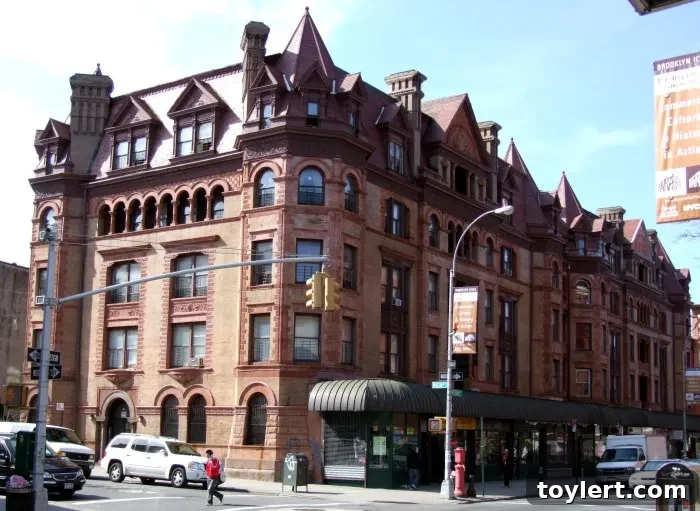
Among their numerous collaborations, the Alhambra apartment building stands as an iconic testament to the synergy between Morris and Seitz. Located in the heart of Bed-Stuy, the Alhambra is a masterpiece of late 19th-century residential architecture. Its distinctive Moorish-inspired details, elaborate terra cotta work, and commanding presence made it an instant landmark. Completed in the early 1890s, the Alhambra was not just a building; it was a statement about the possibility of elegant urban living. It offered a level of luxury and architectural distinctiveness that set a new standard for apartment houses in Brooklyn.
Beyond the Alhambra, Morris and Seitz collaborated on a multitude of other projects across Brooklyn. Their portfolio includes an array of apartment buildings, often characterized by similar high-quality construction and innovative design. Each project was carefully tailored to its specific location, yet all bore the unmistakable hallmarks of Morris’s architectural genius and Seitz’s unwavering commitment to quality development. These buildings were instrumental in shaping the streetscapes of Brooklyn, contributing to its reputation as a borough of beautiful homes and sophisticated urbanity. Their collective body of work not only addressed the practical need for housing but also enriched the aesthetic fabric of the city, leaving a lasting architectural legacy that continues to be admired and inhabited today.
A Friendship Forged in Brick and Mortar
What distinguished the partnership between Montrose W. Morris and Louis F. Seitz was not just their professional success, but the deep personal friendship that developed between them. Their collaboration was built on mutual respect, shared vision, and an understanding of each other’s strengths. This bond transcended mere business transactions, allowing them to navigate challenges, celebrate triumphs, and continue their work together for decades. In an era often characterized by fierce competition, their enduring friendship provided a stable and supportive foundation for their ambitious undertakings.
The lasting nature of their partnership, until death, speaks volumes about the character of both men. It suggests a camaraderie that fostered creativity and resilience, enabling them to tackle the complex demands of urban development. Their legacy is not only etched in the brick and mortar of Brooklyn’s historic buildings but also in the story of a powerful human connection. Their work provided homes, jobs, and beautiful urban environments for countless Brooklynites, contributing significantly to the borough’s growth and identity. The partnership of Montrose W. Morris and Louis F. Seitz remains a shining example of how a collaborative spirit, fueled by both artistic vision and practical expertise, can shape the very foundations of a city and leave an enduring mark for generations to come.