For a broader perspective on early Dutch influences in New York, you might also be interested in Part 1 of this historical exploration.
Unearthing the Foundations: Fort Nassau, The Dawn of Dutch New York, and the Birth of Albany
Growing up in Otsego County, nestled in what local tourism boards proudly brand as “Leatherstocking Country,” my understanding of New York’s history was largely shaped by the vivid narratives of James Fenimore Cooper. The tales of “The Last of the Mohicans” and “The Deerslayer” were more than just stories; they were foundational texts that painted a rich picture of life and adventure during the French and Indian Wars of the 1750s. For a group of impressionable, if sometimes bored, junior historians, this mid-18th-century frontier represented the genesis of our local historical consciousness. The conflicts, the untamed wilderness, and the complex relationships between European settlers and Native American tribes formed the bedrock of what we perceived as New York’s heritage.
However, a deeper dive into the state’s past reveals a far more ancient and equally compelling narrative, one that predates Cooper’s era by more than a century. Just a few counties to the east of our familiar stomping grounds lay Albany, the venerable capital, whose true antiquity was largely unknown to us. It wasn’t until later that I truly grasped the profound depth of Albany’s history, realizing that its origins weren’t merely colonial but deeply rooted in the earliest European explorations and settlements of North America. This revelation opened a window into the fascinating world of New Netherland and the pivotal role played by an often-overlooked outpost: Fort Nassau.
Beyond the Frontier: Unveiling New York’s Earliest Chapters
The conventional image of New York’s colonial past often conjures up images of bustling British ports or revolutionary war battlegrounds. Yet, long before the Union Jack flew prominently over Manhattan, and even prior to the French and Indian Wars, the vast wilderness of what would become New York was the stage for Dutch ambition and enterprise. This chapter begins not with grand fortifications or sprawling settlements, but with tentative explorations and the establishment of crucial trading posts.
The catalyst for European interest in the region was Henry Hudson’s 1609 voyage aboard the *Half Moon*. Though seeking a Northwest Passage to Asia, Hudson instead charted the magnificent river that would eventually bear his name. His reports of abundant wildlife, especially beaver, ignited a spark in Dutch merchants, recognizing the immense potential for a lucrative fur trade. This discovery marked the beginning of sustained European interaction with the Indigenous peoples of the Hudson River Valley, setting the stage for one of the most dynamic and formative periods in the state’s history.
The Dawn of Dutch Enterprise: Establishing Fort Nassau
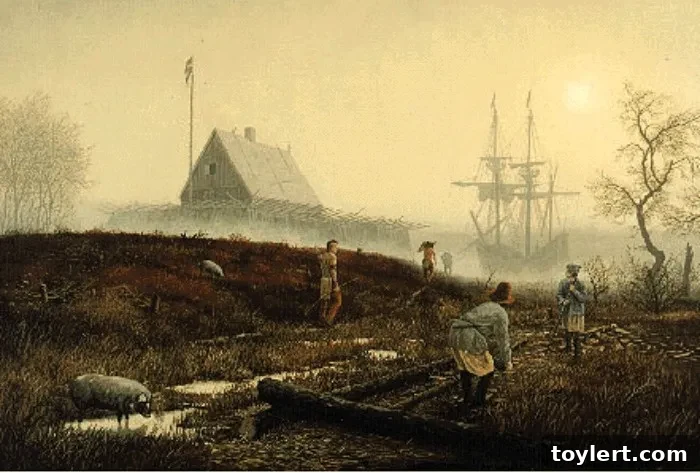
In the wake of Hudson’s expedition, Dutch traders quickly capitalized on the region’s immense fur resources. By 1614, a small, yet profoundly significant, trading post was established on what is now known as Castle Island, a small island in the Hudson River near present-day Albany. This pioneering outpost was christened Fort Nassau, named in honor of the House of Orange-Nassau, the ruling dynasty of the Netherlands. It wasn’t a formidable fortress in the traditional sense, but rather a robust trading house, fortified with palisades and a few cannons, designed primarily to facilitate commerce and offer protection to its inhabitants.
Under the leadership of figures like Hendrick Christiansen, Fort Nassau served as the vanguard of Dutch colonial ambition in the interior of North America. Its strategic location, at the confluence of the Hudson and Mohawk rivers, placed it at the heart of Native American fur-trapping territories. The fort’s primary purpose was singular and economically driven: to engage in the highly profitable fur trade with the powerful Mohawk and Mahican tribes. This endeavor, while seemingly modest, laid the very foundation for what would become New York’s capital city and shaped the intricate web of relationships between Europeans and Indigenous populations for decades to come.
The Lucrative Fur Trade: A Colonial Cornerstone
The fur trade was the economic lifeblood of early New Netherland, and Fort Nassau stood as its beating heart in the upper Hudson Valley. European demand for beaver pelts, particularly for fashionable felt hats, was insatiable, making beaver fur an incredibly valuable commodity. Dutch traders at Fort Nassau exchanged European manufactured goods—such as iron tools, kettles, blankets, glass beads, and eventually firearms—for the meticulously trapped beaver pelts brought by Native American hunters. This exchange was more than mere transaction; it was a complex economic and cultural interaction that fundamentally altered the lifestyles and economies of both the Dutch settlers and the Indigenous communities.
The influx of European goods introduced new technologies and materials to Native American societies, while the desire for these items spurred increased trapping activities. This symbiotic, yet ultimately transformative, relationship defined the early decades of Dutch presence in the region, establishing patterns of trade and interaction that would persist even as the colonial landscape evolved. The wealth generated from the fur trade fueled further investment and settlement, solidifying the Dutch foothold and paving the way for more permanent establishments.
Forging Relationships: Native American Alliances and Tensions
The success and survival of Fort Nassau hinged entirely on the relationships forged with the local Native American tribes, primarily the Mahicans and the powerful Iroquois Confederacy, particularly the Mohawks. Initial interactions were generally driven by mutual economic benefit, with the Dutch seeking furs and the Native Americans seeking European goods. These relationships were carefully cultivated through gift-giving, ceremonies, and, at times, formal agreements.
One of the most frequently cited, though historically debated, events is the “Tawagonshi Treaty” of 1613, which purportedly established a formal alliance between the Dutch and the Iroquois. While the exact details of this treaty remain elusive, its spirit speaks to the necessity of cooperation in the rugged frontier. The Dutch understood that their presence depended on the goodwill and cooperation of the Indigenous inhabitants, who possessed unparalleled knowledge of the land and its resources. However, these alliances were fragile, susceptible to misunderstandings, competition over resources, and the ever-present pressures of colonial expansion. The delicate balance of trade and diplomacy at Fort Nassau foreshadowed the complex, often fraught, history of European-Native American relations throughout the continent.
Challenges and Relocation: From Nassau to Orange
Despite its critical role in establishing the Dutch presence, Fort Nassau was not destined for longevity. Its location on Castle Island, while initially advantageous for trade, proved to be its undoing. The island was prone to severe seasonal flooding from the Hudson River, especially during spring thaws. These annual inundations made life at the fort precarious, frequently damaging structures and disrupting operations. The harsh winters and the logistical difficulties of maintaining a distant outpost further compounded these challenges.
Recognizing the need for a more stable and defensible location, the Dutch West India Company, which took over the administration of New Netherland in 1621, decided to relocate the settlement. In 1624, Fort Orange was established on higher, more secure ground on the west bank of the Hudson River, a short distance north of the original Fort Nassau site. Fort Orange was a more substantial and permanent structure, designed not just as a trading post but also as a military garrison and the nucleus of a burgeoning settlement. The abandonment of Fort Nassau marked the end of an era, but it was a necessary step in the evolution of Dutch colonial efforts in the region, paving the way for the growth of Beverwijck, which would eventually become the city of Albany.
The Enduring Legacy: How Fort Nassau Shaped New York
Though Fort Nassau itself had a remarkably brief existence, its significance far outweighs its short lifespan. It stands as a powerful symbol of pioneering European settlement in the upper Hudson Valley, serving as the direct precursor to Fort Orange and, ultimately, to the city of Albany. Fort Nassau was the first continuous European habitation in this vital inland region, laying the crucial groundwork for future Dutch colonization and economic development. Its establishment cemented the Dutch claim to the territory, spurred the growth of the fur trade as a central economic engine, and initiated the complex intermingling of European and Native American cultures.
The experiences at Fort Nassau — the challenges of the wilderness, the intricacies of cross-cultural trade, and the constant negotiation of power dynamics — provided invaluable lessons for the Dutch. These early trials informed the design and administration of subsequent settlements, contributing to the unique character of New Netherland. Even after the English takeover in 1664, the Dutch imprint on the region remained indelible, manifest in architectural styles, place names, legal traditions, and a distinct cultural heritage that persists in New York to this day. Fort Nassau, in its transient existence, represents the very genesis of this rich and multicultural legacy.
Revisiting the Past: Bridging Historical Narratives
For those of us who grew up steeped in the narratives of “Leatherstocking Country,” discovering the deep history of Fort Nassau is akin to unearthing a forgotten foundational chapter. It challenges preconceived notions of when and where New York’s story truly began. While the French and Indian Wars certainly constitute a critical period, understanding the 17th-century Dutch presence at Fort Nassau provides a richer, more comprehensive tapestry of the state’s origins.
This early history highlights New York’s unique position as a crossroads of cultures from its very inception. It underscores the incredible resilience of early settlers, the strategic importance of the Hudson River, and the profound impact of Indigenous peoples on the course of colonial development. Fort Nassau, though now only a historical memory, serves as a powerful reminder that the roots of New York extend far deeper than many realize, reaching back to a time of intrepid exploration, bustling trade, and the complex birth of a new society on North American soil.
In conclusion, the story of Fort Nassau is not merely a footnote in history; it is an essential prologue. It represents the courage of early Dutch traders, the immense value of the fur trade, and the intricate relationships that defined the initial encounters between Europeans and Native Americans in the Hudson River Valley. This brief but pivotal outpost set in motion a chain of events that would ultimately lead to the flourishing of Albany and the enduring character of New York State. By looking back at Fort Nassau, we gain a clearer perspective on the diverse and ancient foundations upon which one of America’s greatest states was built, far predating the echoes of Cooper’s frontier tales.