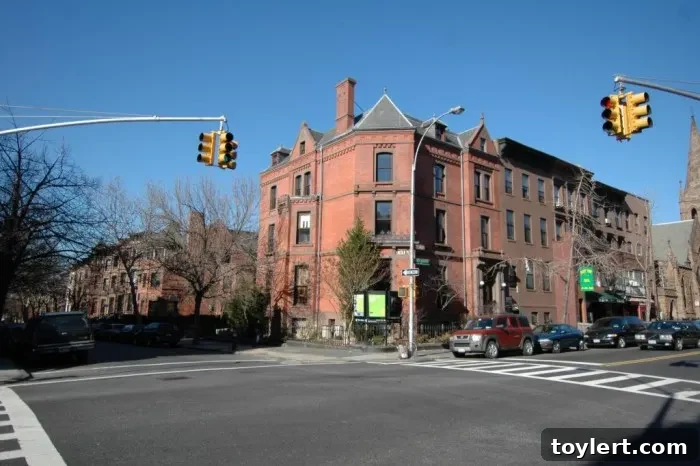
The Enduring Legacy of 58 7th Avenue: From Gilded Age Mansion to Brooklyn’s Musical Heart
Nestled within the vibrant and historic Park Slope neighborhood of Brooklyn, the distinguished building at 58 7th Avenue stands as a testament to the borough’s rich architectural heritage and evolving cultural landscape. Today, it is widely recognized as the esteemed home of the Brooklyn Conservatory of Music, a venerable institution that has nurtured musical talent and enriched the community for generations. Yet, its story began long before the melodies filled its grand halls, rooted in the ambitions and prosperity of a prominent 19th-century Brooklyn family.
The edifice itself, a magnificent example of Gilded Age residential architecture, was originally commissioned and constructed in 1881. Its first owner, a prominent figure in Brooklyn’s burgeoning industrial scene, was William M. Brasher. Brasher, an astute businessman, had carved out a significant niche for himself and his family through his successful oil cloth manufacturing enterprise. His factory, strategically located just a few blocks away at 20th and 7th, was a hub of industrial activity, producing durable and decorative oilcloth that was a staple in homes and businesses across the nation. The construction of this grand residence on 7th Avenue was a clear reflection of Brasher’s prosperity and his family’s elevated social standing within Brooklyn society.
William M. Brasher: An Industrialist’s Vision and His Park Slope Home
William M. Brasher’s journey from industrious manufacturer to proprietor of one of Park Slope’s most impressive homes illustrates a common narrative of the late 19th century. Brooklyn, then an independent city, was experiencing rapid growth, fueled by industrialization, trade, and an influx of ambitious entrepreneurs. Men like Brasher, who mastered a specific trade or manufacturing process, often accumulated considerable wealth, which they then invested in significant real estate, cementing their legacy and status.
Oilcloth, though perhaps an unfamiliar product to modern ears, was an incredibly important commodity in the 19th century. It was a versatile, waterproof material used for everything from floor coverings and table coverings to luggage and carriage tops. Brasher’s factory would have been a hive of activity, transforming raw materials into this ubiquitous product, employing numerous Brooklynites, and contributing significantly to the local economy. His decision to build such a substantial home in Park Slope was no accident. At the time, Park Slope was rapidly developing into one of Brooklyn’s most fashionable residential areas, attracting wealthy merchants, professionals, and industrialists eager to escape the more crowded districts and build impressive homes that reflected their success. The tree-lined streets, proximity to Prospect Park, and easy access to Manhattan via newly developing transportation networks made it an ideal location.
The Brasher mansion, while its precise architectural style might blend elements common to the era, would have likely showcased the opulence of Victorian brownstone architecture. Grand facades, often adorned with intricate stone carving, bay windows, and high stoops, were hallmarks of these residences. Inside, one could expect spacious rooms, high ceilings, ornate fireplaces, and rich woodwork – features designed for both lavish entertaining and comfortable family living. For the Brasher family, 58 7th Avenue was not just a house; it was a statement, a symbol of their achievements and their contribution to Brooklyn’s economic prowess.
A Shifting Landscape: From Private Residence to Public Institution
The history of a grand urban home rarely remains static, and 58 7th Avenue is no exception. While the Brasher family undoubtedly enjoyed their magnificent residence for many years, the tides of time, economic shifts, and generational changes inevitably brought about transformations. As the 20th century dawned and progressed, many of Brooklyn’s large single-family mansions, particularly in areas like Park Slope, began to find new purposes. The cost of maintaining such large properties, combined with changing lifestyles and urban development patterns, often led to their conversion into multi-family dwellings, professional offices, or, in more fortunate cases, homes for educational or cultural institutions.
It was through this transformative process that 58 7th Avenue eventually became the home of the Brooklyn Conservatory of Music. Founded in 1897, the Conservatory’s mission was, and remains, to provide exceptional music education to students of all ages and abilities, and to enrich the cultural life of Brooklyn. As the Conservatory grew and evolved, it sought a location that could accommodate its expanding programs, provide a suitable environment for musical instruction, and reflect the gravitas of its mission. The acquisition of the Brasher mansion was a stroke of serendipity, offering a building with a rich history and grand spaces that could be adapted for musical practice, performance, and education.
Converting a stately private residence into a functional music conservatory would have involved thoughtful renovations. While preserving the inherent architectural beauty and integrity of the original structure, modifications would have been necessary to create soundproof practice rooms, teaching studios, performance spaces, and administrative offices. Imagine the careful planning to integrate modern utilities while maintaining the historic charm of the building’s interiors. The grand parlors where the Brasher family once hosted social gatherings would have been transformed into recital halls, filled with the sounds of pianos, strings, and voices, resonating with a new kind of vibrance.
The Brooklyn Conservatory of Music: A Cultural Beacon
Today, the Brooklyn Conservatory of Music stands as a vibrant cultural beacon at 58 7th Avenue. Its presence ensures that the historic building continues to serve the community in a profound way, enriching countless lives through the power of music. The Conservatory offers a diverse range of programs, from early childhood music classes to advanced adult instruction, encompassing classical, jazz, and contemporary genres. It hosts numerous concerts, workshops, and community events, making music accessible to a broad audience and fostering a deep appreciation for the arts within Brooklyn.
The building itself, with its imposing facade and elegant interiors, provides an inspiring backdrop for musical education. Students and faculty alike are immersed in an environment that speaks of history, refinement, and artistic dedication. The architectural details, which once defined the Brasher family’s private world, now contribute to an atmosphere conducive to creativity and learning. The building’s continued use as a vibrant educational and cultural center ensures its preservation and relevance in the modern era, preventing it from falling into disrepair or being redeveloped for less impactful uses.
Architectural Significance and Lasting Impact
The structure at 58 7th Avenue is more than just a building; it’s a living piece of Brooklyn’s history, intertwining the narrative of 19th-century industrial prosperity with 21st-century cultural enrichment. Architecturally, it represents a significant period in American urban development, showcasing the craftsmanship and design sensibilities prevalent in the late Victorian era. Its robust brownstone construction, intricate detailing, and stately presence contribute significantly to the visual character of the Park Slope historic district.
For visitors and residents of Park Slope, the Brooklyn Conservatory of Music Building serves as a tangible link to the past, reminding us of the borough’s evolution from a collection of villages and industrial hubs into the diverse and culturally rich metropolis it is today. Its transformation from a private mansion to a public institution reflects the dynamic nature of urban environments and the enduring human desire for education and artistic expression. Preserving such landmarks is crucial not only for their architectural merit but also for the stories they tell, offering valuable insights into the lives, aspirations, and communities that shaped our cities.
The journey of 58 7th Avenue, from the private dwelling of an oilcloth magnate to a renowned center for musical arts, underscores a powerful narrative of adaptation, legacy, and community spirit. It continues to stand proudly on one of Brooklyn’s most iconic avenues, a silent witness to history, yet now filled with the joyous sounds of future generations of musicians, forever echoing the vibrancy of Brooklyn itself.