Marie Zimmermann: A Pioneering Woman’s Masterpiece in Metalwork and American Craftsmanship
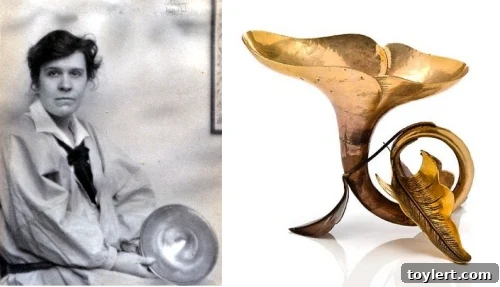
In the grand tapestry of American craftsmanship, certain threads shine brighter, woven by hands that dared to defy convention and elevate skill into art. This article is the second in a captivating series dedicated to illuminating the lives and legacies of remarkable craftspeople, many with deep connections to Brooklyn, whose contributions have shaped the aesthetic and material culture we cherish today. Our previous exploration delved into the formidable talent of Sam Yellin, a master metal crafter whose ironwork possessed the soul of a sculptor. This installment introduces us to another such luminary, one whose story is particularly compelling due to the era in which she thrived: Marie Zimmermann.
Brooklyn, a borough synonymous with innovation and diverse talent, has historically been a crucible for exceptional artistry. While many of these artisans directly contributed to the iconic architecture and vibrant streetscapes of New York City, others, whether born here or influenced by its dynamic energy, ventured further, leaving indelible marks on the broader American cultural landscape. Our mission is to shine a spotlight on these often unsung heroes and heroines of craft, inviting you to discover their enduring works in museums, architectural details, or through diligent research online and in historical texts. They represent the astounding talent nurtured in and around Brooklyn, enriching our world with beauty and ingenuity.
Defying Convention: A Woman in a Man’s Metal World
Even in the early 21st century, the realm of metalworking often conjures images of robust, male artisans. The perception persists that manipulating large, unforgiving metals is a domain best suited for strength and endurance, a stark contrast to the delicate artistry often associated with jewelry making, which has historically been more accepting of women. Imagine, then, the profound challenge and sheer audacity it took for a woman to pursue a career in heavy metalworking at the turn of the 20th century. This was a time when societal expectations rigidly defined gender roles, and opportunities for women in industrial arts were exceptionally limited. Yet, Marie Zimmermann paid little heed to these prevailing norms or the skeptical gaze of her contemporaries. Her singular ambition was to create objects of profound beauty and lasting artistic merit, and in this pursuit, she not only succeeded but excelled spectacularly.
Marie Zimmermann (1879-1972) emerged as one of the most remarkable and prolific American metalworkers and designers of her generation. Her career, spanning several decades of the early to mid-20th century, saw her produce an astonishing array of works, from intricate jewelry to grand-scale decorative arts, challenging the very definition of what a female artist could achieve. She was not merely a craftsperson; she was an innovator, a technician, and an artist whose vision transcended the boundaries of her chosen medium.
The Genesis of a Master: Early Life and Influences
Born in Brooklyn, New York, Marie Zimmermann’s roots firmly anchor her to the very community this series celebrates. Her artistic journey began at a pivotal time in American art history, coinciding with the height of the Arts and Crafts movement. This intellectual and artistic trend, which championed traditional craftsmanship, simple forms, and the integrity of materials against the perceived excesses of industrialization, found a passionate advocate in Zimmermann. She studied at the Brooklyn Pratt Institute, a renowned institution known for its forward-thinking approach to art and design education. It was here that she honed her skills in various mediums, but it was metal that truly captured her imagination and unleashed her potential.
Her education at Pratt, coupled with an innate artistic sensibility, provided her with a robust foundation. Unlike many female artists of her time who gravitated towards painting or ceramics, Zimmermann was drawn to the physical demands and transformative power of metal. She delved into techniques such as raising, chasing, repoussé, enameling, and casting, mastering each with an astonishing degree of precision and artistry. Her studio, initially established in her family home in Brooklyn and later relocated, became a crucible of creativity where she experimented tirelessly with different metals, finishes, and forms.
A Unique Artistic Vision: Embracing the Arts and Crafts Ethos
Marie Zimmermann’s work is a testament to the core principles of the Arts and Crafts movement, yet it possesses a distinct originality that sets her apart. She believed deeply in the inherent beauty of natural materials and the importance of handcrafted objects in an increasingly mechanized world. Her pieces often feature organic motifs, drawing inspiration from flora, fauna, and classical mythology, rendered with a delicate yet powerful sensibility. While deeply rooted in tradition, her designs were never merely imitative; they were fresh, innovative, and infused with a modern spirit.
She worked with a diverse palette of metals, including copper, silver, bronze, and even gold, frequently incorporating precious and semi-precious stones, enamels, and carved ivory into her designs. Her ability to seamlessly blend disparate materials into harmonious compositions was a hallmark of her genius. From practical domestic wares like bowls, trays, and candlesticks to elaborate decorative pieces such as lamps, vases, and ecclesiastical objects, Zimmermann approached every project with the same meticulous attention to detail and unwavering commitment to artistic excellence. Each piece was not just functional; it was a sculptural statement, a unique work of art.
Beyond Jewelry: Sculptural Forms and Architectural Accents
While Zimmermann is often recognized for her exquisite jewelry, her most significant contributions lie in her larger-scale metalwork. She produced a remarkable range of decorative and functional objects for both private commissions and public display. Her work often exhibits a monumental quality, even in smaller pieces, showcasing a mastery of form and volume that many of her male counterparts would envy. Imagine the physical exertion involved in hammering a large copper bowl into shape, or meticulously chasing intricate patterns onto a bronze lamp base – tasks that required immense strength, precision, and an intimate understanding of the metal’s properties.
Her pieces frequently incorporated a blend of classical and modern aesthetics. She might combine the robust forms of ancient Roman bronzes with the sinuous lines of Art Nouveau, or the clean geometry of nascent Modernism with the rustic charm of Arts and Crafts. This eclectic yet cohesive style made her work highly sought after by discerning patrons and collectors, positioning her as a leading figure in American decorative arts. Many of her creations graced the interiors of prominent homes, museums, and churches, adding a touch of bespoke elegance and artistic gravitas. Her designs were not just decorative; they were integral to the spaces they inhabited, reflecting a holistic approach to design that was characteristic of the Arts and Crafts movement.
The Enduring Legacy of Marie Zimmermann
Marie Zimmermann’s impact extends far beyond the beauty of her individual creations. She paved the way for future generations of women in the arts, demonstrating that gender was no barrier to mastering traditionally male-dominated crafts. Her success challenged entrenched prejudices and expanded the possibilities for female artisans in America. She worked independently for much of her career, overseeing every aspect of her studio, from design and fabrication to marketing and sales – a feat of entrepreneurial spirit that was highly unusual for a woman of her era.
After a highly successful career spanning over four decades, Zimmermann retired in the early 1940s, leaving behind a prodigious body of work that continues to captivate and inspire. Her pieces are held in prestigious collections across the United States, including the Metropolitan Museum of Art, the Brooklyn Museum (a fitting home for her Brooklyn-born talent), the Newark Museum, and the Dallas Museum of Art, among many others. These institutions serve as vital repositories of her legacy, allowing new audiences to experience the exquisite craftsmanship and visionary artistry of this pioneering woman.
Marie Zimmermann’s story is a powerful reminder of the hidden talents that have enriched our history. Her unwavering dedication to her craft, her innovative spirit, and her refusal to be constrained by societal expectations make her an enduring icon of American artistry. By seeking out her remarkable metalwork, whether through museum visits or scholarly research, we not only celebrate a singular talent but also honor the broader movement of American craftsmanship that she so brilliantly embodied. Her legacy is a beacon, illuminating the path for those who dare to create beauty against all odds, reminding us that true artistry knows no boundaries.