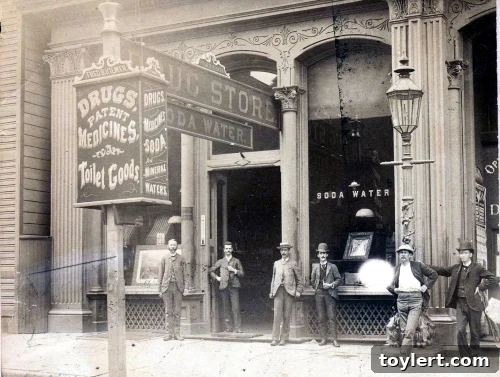
This article continues our exploration into the fascinating history of the “drug business old school.” Read Part 1 here for a deeper dive into the foundations of early pharmacy.
The Evolving World of 19th Century Pharmacy: From Ancient Remedies to Opiate ‘Miracles’
The latter half of the 19th century marked a pivotal era in the history of medicine and pharmaceuticals. It was a period characterized by both remarkable scientific breakthroughs and a persistent reliance on age-old remedies, often leading to a complex and sometimes paradoxical landscape of healing practices. As the Industrial Revolution transformed societies and scientific inquiry gained unprecedented momentum, the understanding of disease, the development of treatments, and the role of the apothecary underwent a profound metamorphosis. This era laid much of the groundwork for modern pharmacology, yet it also wrestled with the ethical and public health challenges posed by newly accessible, powerful substances.
Great Strides in Medical Science and Practice
By the 1870s and 1880s, the medical community was experiencing what could only be described as a revolution. Significant advancements were being made across various disciplines. Louis Pasteur’s germ theory was gaining widespread acceptance, fundamentally altering the understanding of infectious diseases and driving the development of antiseptics by figures like Joseph Lister. Surgical practices, once brutal and highly dangerous, began to transform with the introduction of anesthesia and sterile techniques, drastically reducing mortality rates and enabling more complex procedures. The field of chemistry was also flourishing, allowing for the isolation and synthesis of active compounds from natural sources, leading to more potent and standardized medicines.
Hospitals, previously seen as places of last resort, started to evolve into institutions of healing and research. Medical education became more formalized and rigorous, moving away from apprenticeships towards university-based curricula. Diagnoses became more precise with the advent of new tools and a deeper understanding of human anatomy and physiology. Yet, despite these leaps forward, the daily reality for most people seeking medical care remained a blend of scientific promise and traditional practices. The local pharmacy, or apothecary, served as a crucial bridge between these two worlds, often being the primary point of contact for common ailments and a repository of both cutting-edge (for the time) and ancient remedies.
The Enduring Power of Natural Substances
Even as laboratories buzzed with new discoveries, the foundations of medicine remained deeply rooted in the natural world. For millennia, civilizations across the globe had relied on a vast pharmacopoeia of plants, minerals, and animal products to combat illness and alleviate suffering. Many of these substances, passed down through generations of healers, continued to be indispensable tools in the 19th-century medicine cabinet. Botanicals like cinchona bark (source of quinine for malaria), digitalis (from foxglove, used for heart conditions), and various herbs known for their calming or stimulating properties were still widely employed. Pharmacists were experts in materia medica, understanding the properties, preparations, and dosages of these raw ingredients.
The beauty of these natural remedies lay in their proven, albeit sometimes poorly understood, efficacy. They represented a continuity with humanity’s earliest attempts to control disease and pain. While scientific methods were beginning to unravel the chemical compounds responsible for their effects, many practitioners and patients alike still held a profound respect for the wisdom embedded in traditional healing. The local pharmacist often cultivated an herb garden or sourced raw materials from trusted suppliers, grinding, mixing, and compounding these substances into tinctures, poultices, and pills according to established recipes or physician’s prescriptions. This tangible connection to nature’s bounty made medicine accessible and understandable to a public often skeptical of purely synthetic innovations.
The Universal Quest for Pain Management
Throughout history, one of humanity’s most persistent adversaries has been pain. From the dull ache of a tooth to the debilitating agony of chronic illness, the desire to find relief is universal. Ancient healers employed a variety of methods, from spiritual rituals and herbal concoctions to crude surgical interventions, all in the pursuit of mitigating suffering. Before the 19th century, effective pain relief was often elusive, leaving patients to endure considerable discomfort. Alcohol, cannabis, and various plant-based sedatives offered some respite, but their potency and reliability varied greatly. The scientific advancements of the 19th century, particularly in chemistry, promised a new era for pain management, and indeed, delivered what many initially perceived as miraculous solutions.
The isolation of active principles from natural sources represented a quantum leap. Early chemists were able to extract specific compounds, making medicines more concentrated, predictable, and effective. It was within this context that the focus on the opium poppy intensified. Known and utilized for its analgesic and euphoric properties for thousands of years, opium was not a new discovery. However, the 19th century saw its derivatives become central to medical practice, fundamentally changing how pain was approached and treated, albeit with unforeseen and profound consequences.
Opiates: The Double-Edged Sword of 19th-Century Medicine
The opium poppy, *Papaver somniferum*, has been cultivated for its medicinal properties since ancient times, with references found in Sumerian, Egyptian, and Greek texts. Its milky latex, opium, was a potent analgesic and sedative. However, the 19th century brought a new level of understanding and exploitation of this ancient remedy. In the early 1800s, German pharmacist Friedrich Sertürner successfully isolated morphine, the principal active alkaloid in opium, naming it after Morpheus, the Greek god of dreams. This achievement marked a turning point, allowing for the production of a standardized, much more potent painkiller.
The subsequent invention of the hypodermic syringe in the mid-19th century further revolutionized the administration of morphine, enabling rapid and direct delivery into the bloodstream, making its effects almost instantaneous and incredibly powerful. Codeine, another alkaloid of opium, was isolated later, providing a milder analgesic and cough suppressant. These substances were quickly embraced by the medical community as unparalleled solutions for pain management, chronic diseases, and even conditions like dysentery and nervous disorders. They offered profound relief from suffering that previous generations could only dream of, leading many to hail them as nothing short of a “miracle cure.”
At the time, the full ramifications of prolonged opiate use, particularly the insidious nature of addiction, were not widely understood. While physicians recognized that some patients developed a dependence, it was often attributed to a moral failing or weakness of character rather than a physiological process. Opiates were readily available in various forms: laudanum (opium dissolved in alcohol), morphine pills, and even opium smoking, which was more prevalent in certain communities. They were found in countless patent medicines, often marketed as “soothing syrups” for infants or “cures” for a myriad of ailments, without clear labeling of their potent ingredients.
The Community Pharmacist: A Pillar of Victorian Society
In the bustling cities and quiet towns of the late 19th century, the local pharmacy was more than just a shop; it was a cornerstone of the community. The pharmacist, or druggist, held a position of considerable trust and respect, often second only to the physician, and sometimes even serving as the first point of contact for medical advice. Unlike modern pharmacies, where most medicines are pre-manufactured, the 19th-century pharmacy was a hub of creation. Pharmacists were skilled artisans, knowledgeable chemists, and careful compounders. Behind the counter, amidst rows of glass jars filled with exotic herbs, chemicals, and powders, they meticulously prepared remedies from scratch.
Their daily tasks involved a wide array of activities: weighing precise amounts of ingredients, grinding them into fine powders using a mortar and pestle, dissolving them in liquids to create tinctures and elixirs, rolling pills by hand, and preparing ointments and suppositories. Each prescription was a bespoke creation, tailored to the individual needs of the patient. This demanded a deep understanding of pharmacology, meticulous attention to detail, and a steady hand. Beyond dispensing physician-prescribed medications, pharmacists also formulated their own proprietary remedies, often based on traditional recipes or their own innovative blends, which were popular for common complaints like colds, indigestion, and headaches.
Moreover, the pharmacy often functioned as a general store for household goods, toiletries, and sometimes even soda fountains, particularly in American establishments. This made it a vibrant social space, where people exchanged news, sought advice, and found comfort. The pharmacist’s expertise extended beyond medicine; they were often consulted on matters of health, hygiene, and even local affairs, making them indispensable figures in the social fabric of the era. In places like Brooklyn, the neighborhood pharmacy was an essential fixture, reflecting the diverse needs and aspirations of its rapidly growing population.
The Dawn of Regulation and Public Health Awareness
As the century drew to a close and the 20th century began, the unregulated proliferation of potent medicines, particularly opiates and cocaine (another powerful alkaloid isolated in the 19th century), began to reveal its darker side. The widespread availability of these substances, often without clear warnings or professional oversight, led to a growing addiction crisis. “Morphinism” and “cocainism” became increasingly recognized medical conditions, and public concern mounted.
Journalists, social reformers, and a nascent public health movement started to expose the dangers lurking in the deceptively benign labels of patent medicines. The highly addictive nature of many popular elixirs, often containing significant amounts of opium, alcohol, or cocaine, was brought to light. This growing awareness began to fuel calls for greater accountability and regulation. The transition from a largely unregulated market, where anyone could buy virtually any substance, to a system of control was gradual and fraught with debate.
In the United States, this culminated in landmark legislation such as the Pure Food and Drug Act of 1906, followed by the Harrison Narcotics Tax Act of 1914. These acts were pioneering efforts to regulate the manufacture, labeling, and sale of drugs, requiring ingredients to be listed and placing restrictions on the sale of narcotics. While not immediately solving the problem, they marked the beginning of a paradigm shift – a recognition that public health demanded governmental oversight and that the “miracle cures” of the past needed careful scrutiny. The era of the freely available, potent “cure-all” was slowly drawing to a close, paving the way for modern pharmaceutical regulation and a more nuanced understanding of both the power and peril of medicine.
Conclusion: A Legacy of Innovation and Caution
The late 19th century stands as a fascinating epoch in the history of medicine and pharmacy. It was a time when the echoes of ancient healing traditions mingled with the burgeoning roar of scientific discovery. Pharmacists, bridging these worlds, dispensed both time-honored herbal remedies and newly isolated, powerful compounds. The “great strides” in medicine brought unprecedented relief from suffering, particularly through the widespread application of opiates for pain management. Yet, these very advancements also unveiled the profound challenges of addiction and the critical need for public health oversight.
The story of the 19th-century drug business, particularly in vibrant urban centers like Brooklyn, is one of rapid progress, entrepreneurial spirit, and unintended consequences. It highlights humanity’s relentless quest for healing and comfort, demonstrating how perceptions of “miracle cures” can evolve from wonder to a deeper understanding of their complexities and risks. This period ultimately laid the vital groundwork for the rigorous scientific and regulatory frameworks that govern medicine today, reminding us that with great power, whether derived from nature or synthesized in a lab, comes immense responsibility.