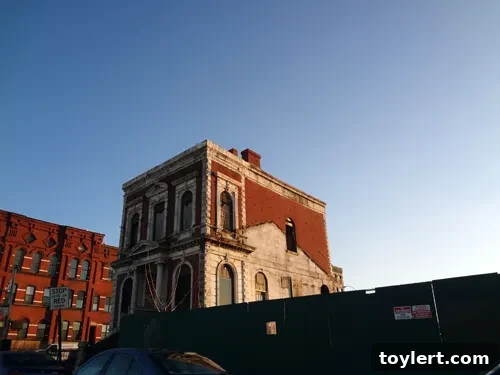
The Historic Coignet Building and Whole Foods: A Battle for Brooklyn’s Past and Future in Gowanus
The urban landscape of Brooklyn is a dynamic tapestry woven with threads of history, innovation, and relentless development. Few places encapsulate this interplay quite as vividly as Gowanus, where the proposed arrival of a Whole Foods Market at 3rd Street and 3rd Avenue stirred a passionate debate centered around the venerable Coignet Stone Company Building. What seemed like a straightforward commercial development quickly evolved into a complex narrative exploring landmark preservation, architectural heritage, and the evolving identity of one of Brooklyn’s most rapidly transforming neighborhoods.
For years, the prospect of Brooklyn’s first Whole Foods Market in Gowanus had been a saga of approvals, variances, and meticulous planning. After an extensive, eight-year process, many believed the final hurdle was cleared when the Board of Standards and Appeals approved a crucial variance request. However, as often happens in New York City’s intricate development landscape, a final, ceremonial step remained. According to reports, the City Council still needed to cast its vote to officially approve the reduction of the lot size pertaining to the historic Coignet Stone Company Building, which stood proudly on the grocer’s intended site. Though the Landmarks Preservation Commission (LPC) had already given its stamp of approval for the lot reduction in January, making the Council’s vote largely a pro forma formality, the process brought into sharp focus the building’s fascinating history and the anxieties of preservationists regarding its future amidst a sprawling new commercial enterprise.
The Coignet Stone Company Building: A Landmark of Innovation and History
At the heart of this discussion stands the Coignet Stone Company Building, a structure far more significant than its current unassuming position might suggest. Constructed in 1872, this elegant Italianate mansion serves as a tangible link to a pivotal moment in architectural history. It was officially landmarked in 2006, recognizing its exceptional historical and architectural value. Beyond its aesthetic appeal, the building originally provided office space for the Coignet Stone Company itself, and subsequently for a succession of other businesses, most notably the Brooklyn Improvement Co., which leased the land for Coignet’s stone works for many years.
A Revolutionary Material: Beton Coignet and its Showcase
The Coignet Building was not merely a structure but a pioneering advertisement for a revolutionary building material: Beton Coignet. Developed in France by François Coignet in the 1850s, this innovative form of concrete promised durability, versatility, and efficiency. The Brooklyn mansion, designed by William Field & Son, was a living testament to this new technology. Every element of its design, from its stately façade to intricate decorative flourishes, was intentionally crafted from Beton Coignet, demonstrating that concrete could meticulously replicate the intricate stone-and-chisel methods of traditional masonry. This was a bold statement, showcasing that an industrialized material could achieve the grandeur and detail previously reserved for natural stone.
Designed by William Field & Son, the curious building was a showcase for Beton Coignet, a new concrete developed in France by François Coignet in the 1850s. The Brooklyn mansion was built of the very material it championed and displayed various architectural features and ornament cast from molds, showing that concrete could replicate the stone-and-chisel method of old. ‘It was definitely an advertisement [for the company]. They put it on the most visible position on the lot,’ said Matthew Postal, a landmarks commission researcher who studied the Coignet building, ‘This is a building that was testing a new technology; it would be an engineering landmark.’ Noteworthy commissions using the new building material included portions of St. Patrick’s Cathedral, the Metropolitan Museum of Art and the Cleft Ridge Span in Prospect Park, the oldest such arch in the country. Coignet also supplied concrete for new residential developments, simultaneously rising to prominence with the Brooklyn Improvement Co., founded by Edwin Clark Litchfield.
Matthew Postal, a respected researcher for the Landmarks Preservation Commission, aptly described the Coignet Building as “an engineering landmark.” Its strategic placement on the lot was deliberate, maximizing its visibility as a grand advertisement for the company’s groundbreaking material. It stood as a symbol of progress, demonstrating how prefabricated concrete elements could be used to create sophisticated architectural forms, offering a cost-effective and structurally sound alternative to traditional stone construction. This innovative approach allowed for the rapid and economical construction of complex designs, signaling a paradigm shift in building practices that would profoundly shape urban development for generations to come.
Coignet’s Enduring Legacy Beyond Gowanus
The influence of François Coignet’s Beton Coignet extended far beyond this single Brooklyn edifice. Its success in replicating the elegance of traditional stone quickly made it a sought-after material for other prestigious projects across New York City and beyond. Notable commissions utilizing Coignet’s concrete included significant portions of the iconic St. Patrick’s Cathedral, adding to the grandeur of its revered structure. Similarly, sections of the Metropolitan Museum of Art incorporated this innovative material, showcasing its versatility even in the construction of cultural institutions. Perhaps one of the most enduring testaments to its early adoption is the Cleft Ridge Span in Prospect Park, which stands as the oldest such arch in the entire country, a testament to the longevity and structural integrity of Coignet’s concrete. The material also played a crucial role in the burgeoning residential developments of the era, contributing to the rapid expansion of Brooklyn and simultaneously bolstering the prominence of the Brooklyn Improvement Co., a powerful development entity founded by Edwin Clark Litchfield, a key figure in Brooklyn’s industrial and urban expansion.
The Whole Foods Controversy: Preservation vs. Progress
The arrival of a major retailer like Whole Foods in a rapidly gentrifying area like Gowanus inevitably brings with it complex questions about balancing commercial interests with the preservation of local history. While Whole Foods has publicly pledged to undertake a comprehensive facelift and restoration of the Coignet Building, ensuring its structural integrity and aesthetic appeal, the proposed reduction of the building’s lot size ignited significant concerns among preservationists and local advocates.
The “Lost in the Sauce” Dilemma
The primary fear articulated by preservationists is that, by reducing the surrounding lot, the Coignet Building’s unique distinctiveness and historical context could become “lost in the sauce.” Their concern is that a large, modern Whole Foods store, wrapping tightly around the venerable 19th-century structure, would overwhelm it visually and conceptually. The building, originally designed as a standalone statement and a prominent showcase for a new technology, risks being reduced to a mere appendage or an architectural accent for a much larger commercial development. This could diminish its perceived importance, obscure its original context, and undermine its status as a significant landmark. The argument posits that an architectural gem like the Coignet Building deserves ample space to breathe, allowing its intricate details and historical narrative to be appreciated independently, rather than being overshadowed by a contemporary commercial giant.
The lot reduction, while perhaps necessary for Whole Foods’ development footprint, raises fundamental questions about how modern urban planning integrates historical structures. For preservationists, it’s not just about maintaining the physical shell of a building, but about preserving its integrity, its narrative, and its visual dominance within its original setting. They argue that surrounding it too closely with a new, much larger structure risks stripping it of its unique presence and relegating it to a secondary role, thereby diluting its landmark status.
Gowanus: A Neighborhood in Transition
The debate surrounding the Coignet Building and Whole Foods is emblematic of the larger transformation occurring in Gowanus. Historically an industrial heartland, characterized by its eponymous canal and a rich manufacturing past, Gowanus is now experiencing a profound shift. Once home to factories, warehouses, and working-class communities, the neighborhood has become a prime target for redevelopment, attracting artists, new businesses, and upscale residential projects.
This revitalization, while bringing economic growth and new amenities, also brings with it the challenges of gentrification, displacement, and the often-contentious task of integrating new development with existing historical and community fabric. The Whole Foods project, with the Coignet Building at its literal and symbolic center, serves as a microcosm of this broader urban narrative. It highlights the delicate balance urban planners, developers, and preservationists must strike: honoring the past while building for the future, fostering economic vitality without erasing the unique character and history that define a place.
Conclusion: A Future Forged in Dialogue
The approval process for the Whole Foods Market in Gowanus, particularly concerning the Coignet Stone Company Building, has been a prolonged journey, underscoring the complexities inherent in urban development within a city rich with history. While the City Council’s vote on the lot reduction might appear to be a mere formality, its significance extends far beyond bureaucratic procedure. It represents a critical juncture in how Brooklyn chooses to evolve – embracing progress while safeguarding its invaluable heritage.
The Coignet Stone Company Building stands not just as a piece of architecture, but as a testament to human ingenuity and a historical marker of industrial innovation. Its narrative, intertwined with the future of the Whole Foods development, will continue to shape the dialogue around preservation, sustainable development, and community identity in Gowanus. As the neighborhood continues its rapid transformation, the story of this landmark building will undoubtedly remain a poignant reminder of the enduring importance of architectural heritage in the face of relentless urban change, ensuring that Brooklyn’s past is not merely preserved but actively integrated into its vibrant future.