Seamless Integration: A Brooklyn Townhouse Transformed into a Live-Work Oasis for Artists by GRT Architects
The concept of merging home and professional life, particularly for visual artists, often presents a unique architectural challenge. When a prominent pair of visual artists, a painter and a photographer, first approached GRT Architects with their vision, it was clear this would be no ordinary renovation. Their newly acquired four-story row house in a vibrant Brooklyn neighborhood was destined to become more than just a family home; it was to be a dynamic live-work sanctuary, providing dedicated studio spaces for each artist, alongside a comfortable dwelling for their young family and an independent apartment for visiting in-laws. Rustam Mehta, a founding partner of the Greenpoint-based GRT Architects, candidly admitted that the hybrid nature of the project initially seemed “unusual.” Yet, it was precisely this ambitious blend of functions that captivated the firm from the outset, evolving from an intriguing design brief into what would ultimately feel like “the most natural thing in the world” upon its completion.
The Artistic Vision: Crafting Distinct Worlds Within a Single Home
The homeowners, celebrated in their respective fields – she as a painter primarily, and he as a photographer, though both proficient across various media – presented GRT Architects with a multifaceted program. At its core, they required two distinct studio environments. Each studio needed public-facing areas capable of hosting gallerists, clients, and collaborators, demanding an aesthetic that was both professional and inspiring. Simultaneously, they also needed less formal, private “messy” workspaces where the true grit of creation could unfold without compromise. This duality – public display versus private production – underscored the complexity of the spatial planning required. Beyond their professional needs, the brief emphasized the creation of functional and aesthetically pleasing living quarters for their family of four, designed to foster connection and comfort. Adding another layer to the design, a self-contained one-room apartment was essential to accommodate visiting in-laws, ensuring privacy and autonomy for extended family members.
The challenge was significant: how to create a harmonious blend of these diverse requirements within the confines of a traditional four-story row house without sacrificing its inherent character or creating a sense of disjointedness. The success of such a project hinged on GRT Architects’ ability to interpret these needs into an intelligent architectural solution that maximized every square foot while respecting the building’s historical context and enhancing the daily lives of its occupants. This ambitious project aimed to redefine what a home could be, transforming it into a versatile hub that supports both burgeoning creative careers and a thriving family life.
GRT Architects’ Ingenious Approach: Harmonizing Function and Form
Rustam Mehta articulated the guiding principle behind GRT Architects’ design philosophy for this project: “The goal was to make the most logical split while not totally undoing the townhouse feel.” This statement encapsulates the delicate balance they sought to achieve. The renovation was not merely about adding rooms; it was about orchestrating a spatial narrative that seamlessly transitions between different modes of living and working. A key objective was to ensure that even the studio areas, despite their professional intent, retained the warmth and architectural integrity characteristic of a Brooklyn townhouse, dispelling any notion of a sterile, industrial “warehouse building.”
The Art of the Logical Split: Vertical Zoning for Diverse Needs
To achieve this logical split, GRT Architects meticulously strategized the vertical organization of the four-story structure. The ground floor, with its direct street access, was ideally positioned to house the more public-facing aspects of the artists’ studios. This allowed for dedicated entrances for clients and gallerists, effectively creating a clear boundary between professional and private life. Ascending through the house, the middle floors were intelligently designated for the family’s primary living spaces – encompassing open-plan living, dining, and kitchen areas that foster interaction and communal gathering. The upper floors were then thoughtfully allocated to bedrooms and private retreats for the family, ensuring tranquility and personal space. The one-room in-law apartment was also integrated into this vertical scheme, perhaps at a lower level for ease of access or cleverly tucked away on an upper floor to maximize privacy, demonstrating GRT Architects’ commitment to comprehensive family solutions.
This strategic layering of functions allowed for each zone to operate independently while remaining part of a cohesive whole. The design accounted for acoustics, light, and flow, ensuring that the vibrant energy of the studios did not intrude upon the peaceful domesticity of the living areas, and vice versa. It was a masterclass in urban density and multi-functional design, making every level of the row house contribute meaningfully to the overarching vision of a blended live-work environment.
Preserving the Townhouse Soul: Avoiding the Warehouse Aesthetic
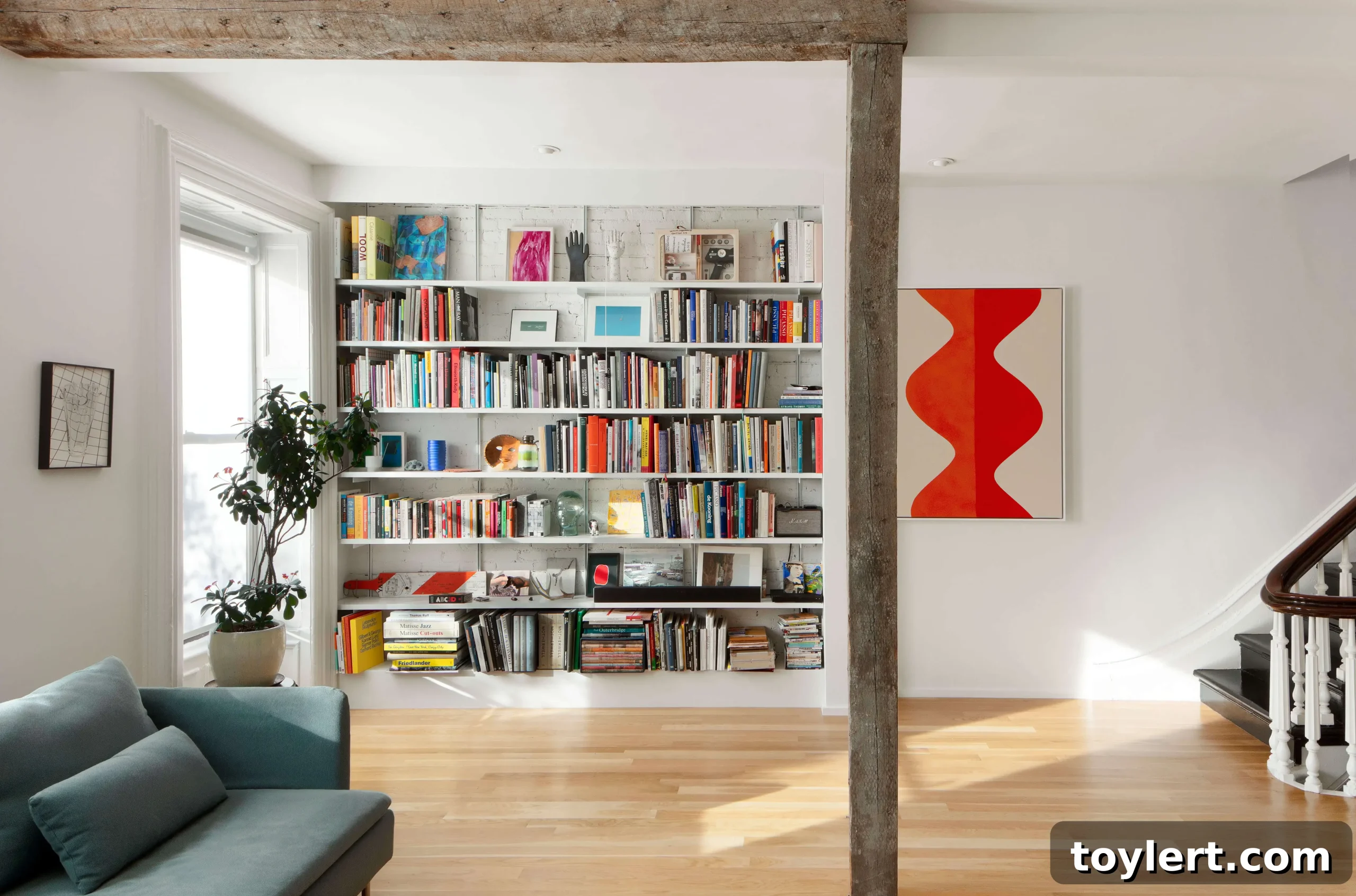
A significant design challenge was to prevent the artist studios from feeling like detached, industrial units. GRT Architects achieved this by carefully selecting materials, finishes, and architectural details that resonate with the historic charm of a Brooklyn townhouse. Instead of stark, utilitarian surfaces, they likely incorporated elements like warm wood flooring, custom millwork, thoughtful lighting, and perhaps even retained or restored original architectural features where appropriate. Large, well-placed windows were crucial, not only for providing ample natural light essential for artists but also for maintaining a visual connection to the residential streetscape. The careful balance between robust, art-appropriate finishes and domestic comfort was key to creating studios that felt integrated, inspiring, and distinctly part of a home rather than a commercial enterprise. The result is a series of spaces that are undeniably professional yet imbued with a warmth and character that speaks to their residential context.
Architectural Innovations and Integrated Design Elements
The transformation by GRT Architects goes beyond mere spatial division; it’s a testament to thoughtful design and architectural innovation. Maximizing natural light, a critical element for any artist, was paramount in this row house setting. Given the typical constraints of urban row houses, the architects likely employed strategies such as expanding existing window openings, integrating skylights where feasible, and utilizing reflective surfaces to bounce light deep into the interiors. The design undoubtedly considered the specific light requirements for both painting and photography, ensuring that each studio benefited from optimal conditions, whether it be diffused northern light for a painter or controlled light for a photographer’s setup.
Materiality played a crucial role in defining the character of the spaces. While the studios might feature more durable, easy-to-clean surfaces suitable for artistic processes, the living areas would likely showcase materials that evoke comfort, warmth, and domesticity. This careful selection of finishes, from exposed brick or plaster walls that honor the building’s heritage to contemporary fixtures and bespoke cabinetry, creates a rich tactile experience that distinguishes each zone without creating jarring transitions. Throughout the entire structure, the architects paid meticulous attention to details, ensuring that custom built-ins, clever storage solutions, and integrated furniture elements contributed to both the aesthetic appeal and the supreme functionality required by a busy family of artists. This holistic approach ensured that every design decision supported the overarching goal of creating a highly efficient, aesthetically pleasing, and genuinely livable environment.
The Outcome: A Harmonious Live-Work Oasis
The completed renovation stands as a powerful testament to GRT Architects’ ingenuity and their ability to translate complex needs into elegant architectural solutions. The artists now enjoy the unparalleled convenience of a minimal commute, stepping from their private living quarters directly into professionally designed studios. This seamless transition fosters enhanced productivity and creativity, eliminating the logistical burdens often associated with maintaining separate workspaces. Dedicated zones for showcasing finished pieces allow for professional presentations, while the “messy” areas provide the freedom for uninhibited artistic experimentation, all under one roof.
For the family, the design delivers a cohesive and comfortable home that supports their daily routines and fosters togetherness. The thoughtful separation of work and living areas means that family life can flourish independently, providing sanctuary from the demands of artistic production. Similarly, the independent in-law apartment offers a welcoming and private retreat for extended family, enhancing familial connections without compromising personal space. This project exemplifies successful adaptive reuse, demonstrating how historic urban dwellings can be reimagined to meet contemporary needs and lifestyles. It proves that with insightful architectural design, a row house can be transformed from a traditional residence into a dynamic, multi-functional hub that profoundly enriches the lives of its inhabitants, seamlessly blending artistic endeavor with everyday family living.
Conclusion: A Blueprint for Creative Urban Living
In conclusion, the transformation of this four-story Brooklyn row house by GRT Architects into a bespoke live-work space for visual artists is more than just a renovation; it’s a pioneering blueprint for creative urban living. What began as an “unusual” request for Rustam Mehta and his team ultimately culminated in a remarkably cohesive and harmonious environment that feels inherently “natural.” By deftly navigating the intricate requirements of dedicated artist studios, a vibrant family home, and an independent in-law suite, GRT Architects has not only delivered on the homeowners’ ambitious vision but has also set a new standard for multi-functional residential design. The project underscores the profound impact that thoughtful, human-centered architecture can have on quality of life, productivity, and overall well-being. It stands as a shining example of how innovative design can transform challenges into opportunities, creating spaces that truly nurture both art and life.