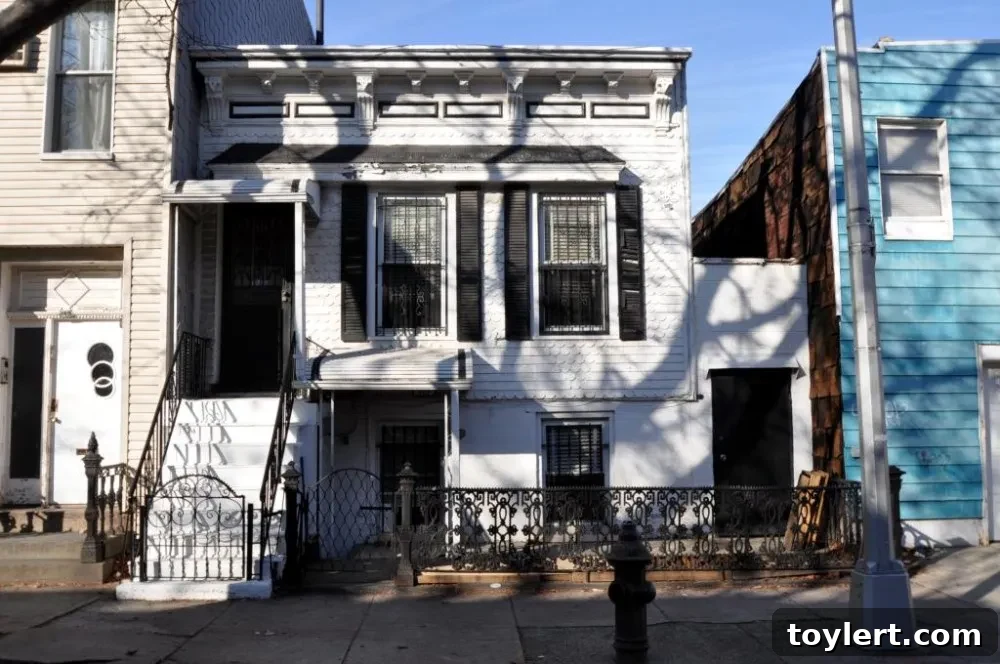
The Enduring Legacy of 151 Powers Street: A Wood-Framed Survivor in Williamsburg, Brooklyn
Brooklyn, a borough renowned for its iconic brownstones and grand pre-war apartment buildings, harbors a fascinating architectural secret: the surprising resilience of its early wood-framed homes. While much of the borough’s historical narrative centers on the brick and stone structures that came to define its urban landscape, a closer look reveals scattered remnants of a bygone era. These modest dwellings, often overlooked amidst towering new developments, offer a tangible link to Brooklyn’s foundational past. One such extraordinary survivor stands proudly at 151 Powers Street in Williamsburg, a tiny wood-framed house that defies the relentless march of time and development.
Its very presence in the heart of modern Williamsburg is a testament to the layers of history that coexist in this dynamic neighborhood. This humble abode is not just a building; it is a sentinel, quietly witnessing centuries of change, preserving the architectural DNA of a Brooklyn that looked very different from the bustling metropolis it is today. Its continued existence underscores a vital aspect of urban history: the stories held within the structures that predate our collective memory, offering insights into the lives and times of early Brooklynites.
A Glimpse into Brooklyn’s Past: The Prevalence of Wood-Frame Homes
Before the widespread adoption of brick and brownstone, wood was the primary building material for residential structures across New York City, including Brooklyn. In the early 19th century, as Brooklyn transitioned from a collection of rural villages into a burgeoning city, wood-framed houses were both economical and efficient to construct. They catered to the needs of a rapidly growing population, including a diverse mix of working-class families, artisans, and small business owners who sought affordable housing near the bustling waterfront and nascent industrial centers. Areas like Williamsburg, with its direct access to the East River and evolving manufacturing base, were particularly dense with these wooden dwellings.
However, the convenience of wood came with a significant drawback: fire. Devastating conflagrations frequently swept through densely packed neighborhoods, leading to catastrophic losses. The Great Fire of 1841 in Brooklyn Heights, which destroyed hundreds of wooden structures, was a pivotal event that spurred significant changes in building codes. By the mid-19th century, strict ordinances were enacted, effectively banning new wood-frame construction in many parts of the city center and mandating fire-resistant materials like brick, stone, and stucco. This shift marked a turning point, making existing wood-framed houses increasingly rare, especially in areas that experienced rapid redevelopment. Consequently, finding a standalone wood-frame house today, particularly one as well-preserved as 151 Powers Street, is akin to uncovering an archaeological treasure.
151 Powers Street: A Testament to Time
Architectural Character and Enduring Appeal
The house at 151 Powers Street is a quintessential example of early American vernacular architecture, likely dating back to the mid-19th century, before the city’s building boom reshaped much of Brooklyn. While specific architectural styles were still evolving, many of these homes borrowed elements from Federal, Greek Revival, or early Victorian designs, often simplified for practical construction. This particular dwelling, with its modest proportions and straightforward design, embodies the unpretentious charm of its era. It likely features a pitched roof, a narrow facade, and perhaps a simple stoop or porch, characteristic of a working-class or artisan’s home.
Its enduring appeal lies not in grandeur, but in its authentic connection to Brooklyn’s origins. Imagine the countless stories held within its walls: families growing, generations passing, and the daily rhythms of life unfolding against the backdrop of a constantly changing urban landscape. The original siding, whether clapboard or shingle, would have been painted in earth tones or simple whites, blending into the then-predominant streetscape of similar wooden structures. Today, its distinct appearance stands out, offering a visual pause in a street often dominated by larger, newer constructions. Its compact footprint and traditional construction methods remind us of a time when space was utilized differently, and homes were built with a clear purpose of shelter and community.
The Shifting Landscape of Williamsburg
The survival of 151 Powers Street is made even more remarkable by its location in Williamsburg, a neighborhood that has undergone one of the most dramatic transformations in New York City. Once a thriving industrial hub with a strong immigrant working-class population, Williamsburg experienced a period of decline in the mid-20th century, only to rebound spectacularly in recent decades as a global epicenter of arts, culture, and high-end residential development. This rapid gentrification has brought with it an influx of luxury condominiums, boutique shops, and trendy restaurants, driving up property values to astronomical levels.
In this fiercely competitive real estate market, undeveloped lots or properties with smaller, older structures are often prime targets for demolition and redevelopment into multi-story residential buildings. The economic pressures to maximize density and profit are immense. Yet, 151 Powers Street has managed to escape this fate, standing as a quiet sentinel amidst the urban sprawl. It serves as a stark, yet beautiful, contrast to the glass and steel structures that now dominate parts of the Williamsburg skyline, offering a poignant reminder of the neighborhood’s humble beginnings and diverse architectural heritage. Its survival speaks volumes about the value placed on historical continuity, perhaps by its owners, or by its unique positioning within a block.
The Perilous Journey of Historic Wood-Frame Houses in Brooklyn
The path to survival for Brooklyn’s wood-framed houses has been fraught with peril. Beyond the historical threat of fire, these structures face ongoing challenges in the modern era. The primary threat today is demolition for redevelopment. As land becomes scarcer and more valuable, older, smaller buildings are often seen as inefficient use of space. Developers frequently acquire such properties with the intention of replacing them with larger, multi-unit buildings, erasing a piece of the city’s past in the process.
Additionally, the maintenance of historic wood-frame homes can be costly. They require specialized knowledge and materials for restoration, often making them more expensive to upkeep than modern constructions. Issues like water damage, pests, and the need for structural reinforcement can deter potential buyers or lead to neglect. Without proper care, these homes can fall into disrepair, becoming vulnerable to demolition by neglect. The rising property taxes in gentrifying neighborhoods also place an immense financial burden on homeowners of historic properties, often pushing them to sell to developers who can afford to build bigger and higher.
Why Preservation Matters: More Than Just a Building
The preservation of structures like 151 Powers Street goes far beyond simply saving an old building. These homes are vital threads in the fabric of a community’s identity and memory. They connect us tangibly to previous generations, offering a window into the daily lives, struggles, and triumphs of those who came before us. Each wooden plank, each weathered facade, tells a story of Brooklyn’s evolution, from a series of disparate towns to one of the world’s most vibrant urban centers.
Preserving these architectural relics helps maintain the unique character and diversity of neighborhoods. Without them, our cities risk becoming homogenous landscapes of new construction, devoid of the charm, texture, and historical depth that makes places like Brooklyn so compelling. They offer visual cues that anchor us in time and place, preventing a complete disconnection from our urban roots. Moreover, historic buildings are often more sustainable than new construction, as they represent embodied energy and materials that would otherwise be discarded, contributing to a greener, more mindful approach to urban development.
The Future of Brooklyn’s Architectural Heritage
The story of 151 Powers Street is a microcosm of the larger struggle to preserve Brooklyn’s architectural heritage. As the borough continues to grow and evolve, the tension between development and preservation remains a constant challenge. The future of its remaining wood-frame homes and other historic structures depends on a delicate balance of economic pressures, community advocacy, and enlightened public policy.
Efforts by local preservation groups, the establishment of historic districts, and the individual decisions of property owners play crucial roles in safeguarding these irreplaceable assets. Educating the public about the value of historic preservation, not just for aesthetic reasons but for cultural, environmental, and economic benefits, is paramount. By appreciating and protecting these tangible links to our past, we ensure that future generations can also experience the rich, layered history that defines Brooklyn.
In conclusion, 151 Powers Street is more than just a tiny wood-framed house; it is a symbol of resilience, a historical marker, and a poignant reminder of Brooklyn’s multifaceted story. Its enduring presence in the ever-changing landscape of Williamsburg invites us to pause, reflect, and appreciate the hidden gems that continue to tell the tale of Brooklyn, one building at a time. May its humble facade long continue to inspire and remind us of the deep historical roots that lie beneath the modern sheen of our urban environments.