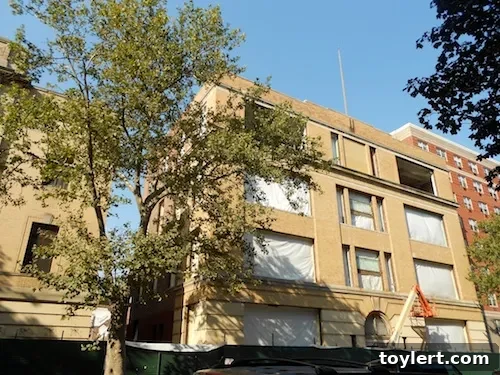
Revitalizing a Landmark: The St. Teresa Complex Transforms into a Cutting-Edge NYS Court Officer Training Academy
A significant urban renewal project is underway in the heart of Brooklyn, breathing new life into the long-dormant St. Teresa building complex. Situated prominently at the intersection of St. Johns Place and Classon Avenue, this historic site is undergoing a profound transformation, poised to emerge as a state-of-the-art training academy for New York State Court Officers. After two decades of vacancy and disuse, the complex is finally bustling with activity, as evidenced by recent visible construction milestones.
This ambitious renovation is designed to create a comprehensive training environment, featuring modern classrooms, comfortable dormitories, and advanced training facilities. The project represents a crucial investment in public safety and the New York justice system, ensuring that future generations of court officers receive the best possible preparation for their demanding roles. Anticipation is building in the community, with the extensive renovation work expected to conclude and the academy to open its doors by next summer.
A Glimpse into the Past: The St. Teresa Complex’s Enduring Legacy
Before its current metamorphosis, the St. Teresa complex held a cherished place in the community as St. Teresa’s School. For generations, its halls echoed with the sounds of learning and growth, serving as a pillar of education and community life in Brooklyn. The multi-building complex, with its distinctive architecture, contributed significantly to the neighborhood’s historical tapestry, bearing witness to decades of change and development in the area.
However, like many urban institutions facing shifting demographics and financial pressures, St. Teresa’s School eventually closed its doors. What followed was a protracted period of emptiness, spanning an unsettling 20 years. The complex, once a vibrant hub, became boarded up, standing as a stark reminder of neglect and missed opportunities in the urban landscape. Long-term vacancies of such prominent structures often cast a shadow over neighborhoods, detracting from aesthetic appeal and sometimes leading to concerns about safety and community spirit.
The local residents and preservationists alike harbored a strong desire to see the complex restored to its former glory or repurposed for a beneficial new chapter. The site, possessing significant architectural character, was always considered ripe for revitalization. The current renovation, therefore, is not merely a construction project but a profound act of historical reclamation and community reinvestment, erasing years of blight and replacing it with a beacon of progress and purpose.
A New Chapter: The Vision for the Training Academy
The decision to convert the St. Teresa complex into a training academy for New York State Court Officers marks an innovative and vital repurposing of the site. New York State Court Officers play an indispensable role in maintaining the integrity and safety of the state’s judicial system. Their duties are multifaceted, encompassing the security of courthouses, judges, and personnel, maintaining order in courtrooms, escorting defendants, and responding to emergencies within judicial facilities. Given the evolving complexities of public safety and the unique environment of the courts, robust and continuous training is paramount.
This new academy is envisioned as a cutting-edge facility designed to equip officers with the specialized skills, knowledge, and physical conditioning necessary to excel in their critical responsibilities. The extensive renovation plans include:
- State-of-the-Art Classrooms: These learning spaces will be outfitted with modern technology, facilitating interactive lessons, legal studies, and theoretical components of court security. Simulation rooms may also be incorporated to provide realistic scenarios for trainees to practice decision-making and procedural execution in a controlled environment.
- Comfortable Dormitories: On-site accommodation is a key feature, allowing trainees to immerse themselves fully in the rigorous program without external distractions. These dorms will foster a sense of camaraderie and discipline essential for law enforcement professionals, providing a secure and supportive living environment during their intensive training period.
- Advanced Training Facilities: Beyond traditional classrooms, the academy will host dedicated areas for practical skill development. This could include mock courtrooms for procedural drills, physical fitness centers to ensure officers meet stringent physical requirements, and areas for tactical training to address various security challenges. The aim is to create a dynamic learning environment where theoretical knowledge is immediately applied through practical exercises.
The vision is clear: to establish a premier institution that not only meets but exceeds the demands for highly skilled and professional court officers, thereby enhancing public trust and safety throughout New York State’s judicial infrastructure.
Architectural Challenges and Modern Solutions
Transforming a multi-building historical complex, vacant for two decades, into a modern, functional training facility presents a unique set of architectural and engineering challenges. Preserving the integrity and historical charm of the St. Teresa buildings while integrating contemporary infrastructure and meeting stringent building codes requires careful planning and execution. The project team must navigate the delicate balance between preservation and modernization, ensuring the new design respects the site’s heritage while providing a secure and technologically advanced environment.
Key considerations include structural assessments to ensure the buildings’ long-term stability, updating antiquated electrical and plumbing systems to handle modern demands, and installing advanced HVAC systems for climate control and air quality. Accessibility for all individuals must also be a priority, requiring the integration of elevators and ramps where necessary, seamlessly blending with the existing architecture. Furthermore, the renovation likely incorporates sustainable building practices, such as energy-efficient lighting, insulation, and water-saving fixtures, reflecting a commitment to environmental responsibility alongside functional excellence. The meticulous attention to detail during this phase ensures that the revitalized complex will serve its new purpose effectively for decades to come, standing as a testament to thoughtful urban redevelopment.
Impact on the Brooklyn Community
The revitalization of the St. Teresa complex is set to bring a significant positive impact to the Classon Avenue and St. Johns Place neighborhood, as well as the broader Brooklyn community. Foremost, it represents the removal of a long-standing eyesore, replacing a boarded-up and neglected property with a vibrant, active institution. This transformation enhances the aesthetic appeal of the area and instills a renewed sense of pride among local residents.
During the construction phase, the project has already generated job opportunities for skilled tradespeople and construction workers, contributing to the local economy. Once operational, the academy will bring a consistent presence of staff and trainees, potentially boosting local businesses such as cafes, restaurants, and shops that can cater to the daily needs of the academy’s occupants. Furthermore, the presence of a New York State Court Officer training facility is inherently linked to enhanced security and public safety, which can indirectly benefit the surrounding residential areas by increasing a visible law enforcement presence.
While the overall impact is overwhelmingly positive, community integration will be key. Any major institutional presence in a residential area can raise considerations such as increased traffic during peak hours or potential noise during certain training exercises. However, careful planning and community engagement initiatives are typically employed to mitigate these concerns, ensuring a harmonious relationship between the new academy and its neighbors. The long-term economic and social benefits of activating this significant site far outweigh potential minor adjustments, making it a welcome addition to the fabric of Brooklyn.
A Future-Proof Investment in Justice
The establishment of the New York State Court Officer Training Academy at the St. Teresa complex represents a forward-thinking and critical investment in the future of the state’s justice system. By providing a dedicated, modern, and comprehensive training environment, New York is ensuring that its court officers are not only well-prepared for their immediate duties but also equipped to adapt to evolving security challenges and legal landscapes. This proactive approach underscores a commitment to maintaining the highest standards of professionalism, integrity, and effectiveness within the judicial branch.
This academy will serve as a cornerstone for recruitment, training, and ongoing professional development, drawing aspiring officers from across the state. It signifies a long-term commitment to public safety, reinforcing the crucial role court officers play in protecting the public, preserving order, and facilitating the fair administration of justice. As a symbol of progress and dedication to excellence, the revitalized St. Teresa complex will stand as a testament to New York State’s unwavering commitment to its citizens and the robust functioning of its legal institutions.
Conclusion
The transformation of the St. Teresa complex from a long-vacant historical landmark into a cutting-edge New York State Court Officer training academy is a powerful narrative of urban renewal and strategic investment. Located at the vibrant crossroads of St. Johns Place and Classon Avenue, this project not only revitalizes a significant piece of Brooklyn’s architectural heritage but also establishes a vital institution dedicated to upholding justice and public safety across the state.
With visible construction progressing steadily, the countdown to its grand opening next summer has begun. This academy is poised to become a hub of excellence, fostering the next generation of dedicated court officers and ensuring the enduring strength and security of New York’s judicial system for years to come.
For more insights into the history and ongoing developments of the St. Teresa complex, you can refer to New Life for St. Teresa’s Building Complex by Brownstoner. To locate the specific address and explore the surrounding neighborhood, check out the GMAP.